Volley & net · Net position
How close to the net before the lob beats you?
From 1.4 m off the net you can volley 18 degrees downward; from near the service line, barely 1. Closeness has a price, and it flies over your head.
You’re at the net in doubles and your partner is in a cross-court rally. One more step in? Closer is better, everyone says. Until the ball goes over your head.
What does one step in buy you?
Take a shoulder-high volley, 1.5 m up. From 1.4 m off the net you can hit it 18 degrees downward and still clear the net by 10 cm. It lands just 2.5 m past the net: short and steep. From near the service line, 6.0 m off the net, the same volley can go down only 1 degree and lands 4.7 m past the net. From the middle of the service box it’s 7 degrees and 4.2 m.
The LTA agrees with the direction: push further in when your team is attacking, and closing the net down makes it harder for them to pass you.1
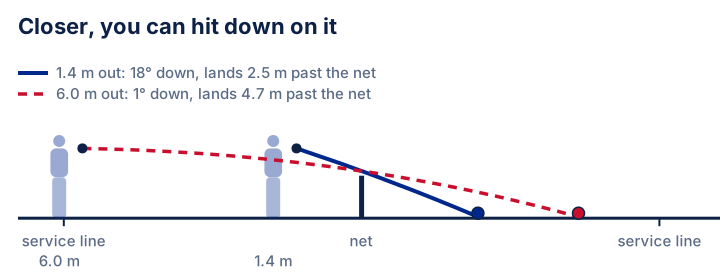
Figure 1. The same shoulder-high volley from two spots. The numbers under the players are metres from the net.
So why not stand on the net? Because of the lob.
Why does one lob beat you at 1.4 m and not at 6?
Take a 70 km/h topspin lob that lands 2 m inside your baseline. It passes 4.1 m above a player 1.4 m from the net. A net player reaches about 3 m with an overhead without jumping (our estimate), so that ball is 1.1 m out of reach. At 3.2 m it is still 3.7 m up. At 6.0 m it is 2.6 m, and you can get a racket on it. The same lob drops about 0.3 m for every metre you stand back.
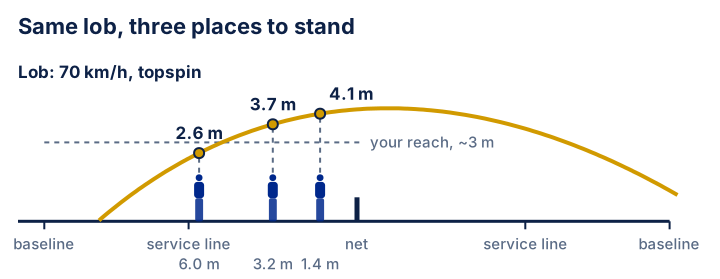
Figure 2. One lob over a net player at three spots, with the metres from the net under each. The dashed line is a reach of about 3 m.
So where is the sweet spot?
So where do you stand?
Start with the LTA’s three states: push in when you’re attacking, stand in the middle of the service box when the point is neutral, and move back toward the service line when you’re defending.1
For a default, the LTA suggests holding your racket out so you could almost touch the net, then taking a step back.2 That’s about 2 m by our estimate, and our lob is still 4.0 m up there. Some lob risk comes with that spot. Give up half a step as soon as they show you one.
Three ways to lose the net battle
- Crowding the net. You can’t touch the net as you hit, so you don’t want to be too close.2
- Standing too deep. Too far from the net makes the volley harder and invites a ball at your feet or past you.2
- Ignoring the lob. One lob you can’t reach gives away the point, and a good lobber only needs one.
Try it this week: three cones
- Put cones 1.5 m, 3 m and 6 m from the net.
- A feeder mixes drives and lobs. You hold one cone for 10 balls: +1 for a volley you win, -1 for a lob that gets past you.
- Compare the three cones.
How we got the numbers
Our ball-flight model uses the drag and topspin-lift coefficients measured by Cross and Lindsey.3 Lob: 70 km/h, 2,000 rpm, hit 1.0 m high and 0.3 m behind the lobber’s baseline, landing 2 m inside yours, on an ITF-sized court.4 Volley: 80 km/h, no spin, 1.5 m up, at the steepest angle that clears the net by 10 cm. The 1.5 m contact height and the 3 m reach are our estimates. Read the numbers as a guide.
References
-
LTA, “Essential doubles tactics and hand signals.” Net players push further in when attacking, stand in the middle of the service box when neutral and closer to the service line when defending; closing the net down makes it harder for them to pass. https://www.lta.org.uk/play/tennis-tips-and-techniques/essential-doubles-tactics-and-hand-signals/ ↩ ↩2
-
LTA, “How to improve your tennis volleys.” Stand where you can almost touch the net with your racket stretched, then take a step back; don’t touch the net; too far away makes volleys harder and invites a ball at your feet or past you. https://www.lta.org.uk/play/tennis-tips-and-techniques/how-to-improve-your-tennis-volleys/ ↩ ↩2 ↩3
-
Rod Cross and Crawford Lindsey, “Tennis Ball Trajectories: The Role of Aerodynamic Drag and Lift in Tennis Shots,” Tennis Warehouse University, 22 December 2013. Drag and spin-lift coefficients. https://twu.tennis-warehouse.com/learning_center/aerodynamics2.php ↩
-
International Tennis Federation, Rules of Tennis 2026, Rule 1 (The Court): 23.77 m long, net 0.914 m high at the centre, service lines 6.40 m from the net. https://www.itftennis.com/media/7221/2026-rules-of-tennis-english.pdf ↩