Volley & net · Low volley
Ball below the net: why not go for the winner?
From knee height, a volley harder than about 65 km/h flies out. Pace won't save you down there; depth will. Here is how to play it.
They’ve hit it at your feet. You’re at the net, the ball is 0.4 m off the ground, and the net is 0.914 m high. Every instinct says: put it away.
Why can’t you hit it hard?
Because you have to hit up. From 0.4 m up and 3 m off the net, the ball has to leave your racket pointing about 15 degrees upward just to clear the net by 15 cm. In our model the fastest flat volley that still lands in is about 64 km/h. At 80 km/h it clears the net and lands 5 m behind the baseline.
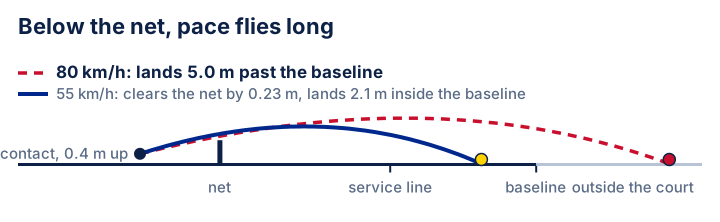
Figure 1. The same contact point, two speeds. The harder ball is the one that goes out.
Raise the contact point and the limit rises: 76 km/h at 0.7 m, 92 km/h at 0.9 m (about net height), and over 160 km/h at 1.2 m. Coaches say it in words: hit up so the ball clears the net, but not so weakly that they get an easy pass.1 Hitting it so hard that it has no time to lift over the net is a very common low-volley error.2
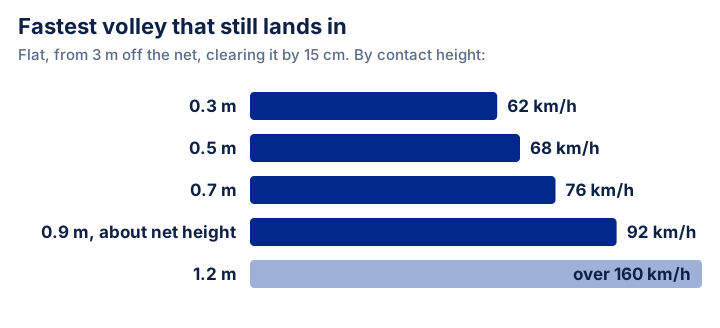
Figure 2. The lower the contact, the less pace you can afford.
So if pace is out, what’s left?
What do you do instead?
Get low with your legs, not your back. Bend your knees and use them like shock absorbers.3 Meet the ball to the side of your body and out in front of you.1
Open the face a little. Picture a coin on the racket head, tilted until it almost slides off. That lifts the ball over the net without sending it too high. Open it too far and the ball climbs; close it and it is driven down.2
Then play the standard shot: a controlled ball deep in the court.3 In our model a 55 km/h volley clears the net by 0.23 m and lands 2 m inside the baseline, with room to spare. Now and then, mix in a soft, short ball that just drops over the net. They have to run forward, and often their only choice is to hit up.3
Three habits that sink a low volley
- Palming or shovelling. A racket head pointing straight up tends to send the ball down; pointing straight down, up. Keep it more sideways than either.2
- Swinging hard. Control matters more than power here.2
- Lunging. Players reach too far to the side or in front, or wait until the ball is behind them.1
Try it this week: the ball under your arm
- Tuck a ball under your hitting arm. If your arm reaches too far to the side or in front, the ball falls out.1
- A partner feeds low balls to your forehand and backhand from the service line.
- Bend your knees, open the face a touch, and aim for a cone 2 m inside the baseline.
- Ten balls each side. Every dropped ball was a lunge.
How we got the numbers
Our ball-flight model uses the drag and topspin-lift coefficients measured by Cross and Lindsey.4 Every volley is flat (no spin), hit 3 m from the net on an ITF-sized court,5 and clears the net by at least 15 cm. “Lands in” means the first bounce is inside the baseline. Real volleys carry some backspin and vary, so read the numbers as a guide.
References
-
Keith Swindoll, “How To: Get in Position for a Low Volley,” TENNIS magazine, July 2009, tennis.com. Hit up to clear the net but not so weakly that the opponent has an easy pass; contact to the side and in front; the ball-under-the-arm drill. https://tennis.com/news/articles/how-to-get-in-position-for-a-low-volley ↩ ↩2 ↩3 ↩4
-
John Mills, “Low Volley,” Tennis Server, June 2010. Racket-head angle (pointing up sends the ball down, pointing down sends it up); tilt the face up until a coin balanced on it almost falls off; hitting so hard the ball cannot lift over the net is a common error; control over power. https://www.tennisserver.com/Mills-tip/Mills-tip_10_06.shtml ↩ ↩2 ↩3 ↩4
-
Tennis.com, “Tip: The Lowdown on Low Volleys,” TENNIS magazine. Get low with the legs, not the back, like shock absorbers; the standard play is a controlled shot deep in the court; mix in a soft, short ball that just drops over the net. https://www.tennis.com/news/articles/tip-the-lowdown-on-low-volleys ↩ ↩2 ↩3
-
Rod Cross and Crawford Lindsey, “Tennis Ball Trajectories: The Role of Aerodynamic Drag and Lift in Tennis Shots,” Tennis Warehouse University, 22 December 2013. Drag and spin-lift coefficients. https://twu.tennis-warehouse.com/learning_center/aerodynamics2.php ↩
-
International Tennis Federation, Rules of Tennis 2026, Rule 1 (The Court): 23.77 m long, net 0.914 m high at the centre, service lines 6.40 m from the net. https://www.itftennis.com/media/7221/2026-rules-of-tennis-english.pdf ↩