Volley & net · Body volley
A ball aimed at your belly: forehand or backhand?
In our model a hard drive reaches your belt in under half a second. No time to dodge or swing. So which volley gives your racket room?
You’re at the net and the drive comes straight at your belt buckle. You can’t take a backswing. You can’t get out of the way. You have to pick a side now.
How fast does it arrive?
A 120 km/h topspin drive from the baseline reaches a net player 2 m off the net 0.49 seconds after the hit, at belt height (1.05 m) and still doing 93 km/h (our model). That is no time to dodge and no time to swing. USTA’s advice for volleys is “squeeze and freeze,” because most volley trouble comes from trying to swing at the ball.1
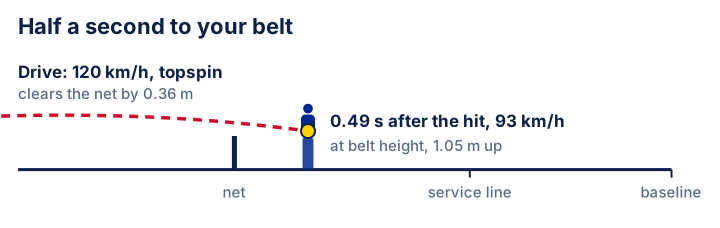
Figure 1. Under half a second from their racket to your belt.
So block it. But with which hand?
Why is the backhand the answer?
The usual rule is to meet a volley to the side of your body, not straight on.1 A ball aimed at your belly takes the side away.
So take it on the backhand. When someone drills the ball directly at you, one coach calls the backhand volley typically the best option.2 A Tennis Server columnist gives the reason: every volley should be hit in front of your body if at all possible, and that is much easier on the backhand side than on the forehand side.3
From the ready position, do three things at once. Bring your hitting elbow up and away from your body. Put the racket face out in front of your midsection. If there is time, drive through the ball with your shoulder.2
What if you get one more beat?
Take a diagonal step forward and away from the ball with your inside foot. That makes room for a controlled volley instead of a block.2
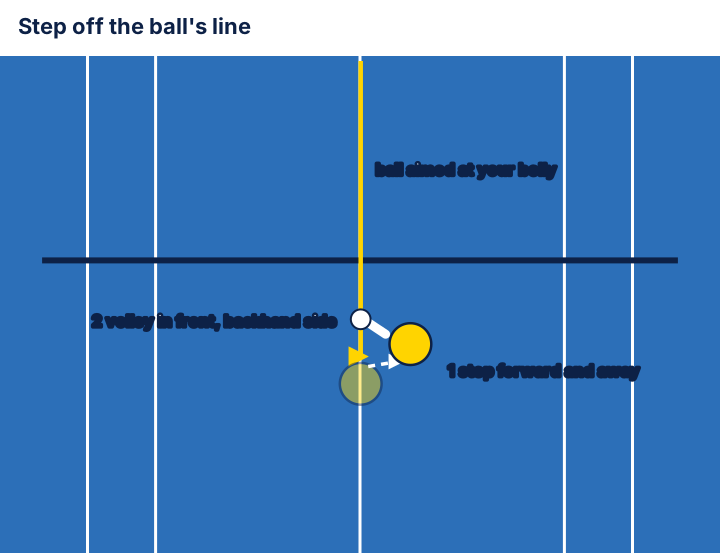
Figure 2. A right-handed player. The step moves your body off the ball’s line, so the ball arrives in front of you on the backhand side.
Never step backward. It collapses your balance and takes the power out of the shot.2
Three ways a ball at your belly beats you
- Stepping back. It collapses your balance and removes power.2
- Forehand by habit. The forehand side makes it harder to meet the ball in front of your body.3
- Swinging. You have under half a second. Squeeze and freeze.1
Try it this week: belt-high feeds
- A partner stands across the net and feeds easy balls straight at your belt.
- Answer with a backhand volley: elbow up and away, racket face out in front of your midsection.
- When the feeds are easy, add the diagonal step before you hit.
- Ten feeds, then ask for more pace. Count how many you control.
How we got the numbers
Our ball-flight model uses the drag and topspin-lift coefficients measured by Cross and Lindsey.4 The drive: 120 km/h, 2,500 rpm, 7 degrees up, hit 1.0 m high and 0.3 m behind the baseline, on an ITF-sized court.5 The net player stands 2 m from the net, and belt height is the height of the ball there. Real drives vary, so read the numbers as a guide.
References
-
Elliott Pettit, “Tennis 101: Perfecting the Volley,” USTA.com, 1 January 2017. Make contact off to the side, not straight on; “squeeze and freeze,” because most people have trouble with volleys by trying to swing at the ball. https://www.usta.com/en/home/improve/tips-and-instruction/national/learning-the-basics--volleys.html ↩ ↩2 ↩3
-
Randy Reynolds, “Tennis Backhand Volley: Ultimate Guide,” Tennis Nation (Reno Tennis Center), 31 December 2021. For a ball hit at your body, the backhand volley is typically the best option: hitting elbow up and away, racquet face out in front of the midsection, a diagonal step forward and away with a little more time, and never a step backward. https://www.tennisnation.com/?p=143 ↩ ↩2 ↩3 ↩4 ↩5
-
Ron Waite, “TURBOSTROKES: The Backhand Volley,” Tennis Server (Turbo Tennis), June 2001. All volleys should be hit in front of the body if at all possible, which is much easier on the backhand side than on the forehand side. https://www.tennisserver.com/turbo/turbo_01_06.html ↩ ↩2
-
Rod Cross and Crawford Lindsey, “Tennis Ball Trajectories: The Role of Aerodynamic Drag and Lift in Tennis Shots,” Tennis Warehouse University, 22 December 2013. Drag and spin-lift coefficients. https://twu.tennis-warehouse.com/learning_center/aerodynamics2.php ↩
-
International Tennis Federation, Rules of Tennis 2026, Rule 1 (The Court): 23.77 m long, net 0.914 m high at the centre, service lines 6.40 m from the net. https://www.itftennis.com/media/7221/2026-rules-of-tennis-english.pdf ↩