Volley & net · Approach
You've come in. Does the first volley win the point?
From 5 m off the net at waist height, even your steepest firm volley lands past the service line. Play the first one deep and let the second one win.
You hit your approach and ran in. The ball comes back and you’re about 5 m from the net, with the first volley of the point. Everything in you says: end it.
Why can’t the first volley end it?
Because of where you are. In our model, 5 m off the net with the ball waist high (1.0 m), the steepest 80 km/h volley that still clears the net launches 3 degrees upward and lands 6.9 m past it, beyond the 6.4 m service line. There is no downward angle to use.
So a winner means hard and deep, and that thins your margin. A 70 km/h volley to 2 m inside the baseline clears the net by 0.60 m. At 100 km/h it clears by 0.16 m, a sliver.
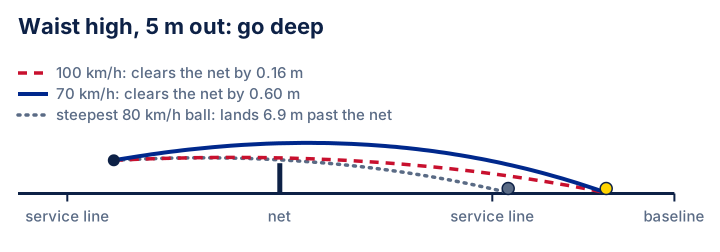
Figure 1. The dot is the contact point. Every deep volley lands in the same spot, but the harder one barely clears the net.
A coach’s serve-and-volley rule says the same: think “in play,” not “put away,” and think “winner” only when the return is high.1 Coaches drill it as a deep first volley and a shorter, angled second one.2
So when does the point end? On the second volley, once you’ve closed in.
Where do you stop, and where do you go next?
Split step before you reach the service line, or just as they get ready to hit.1 Time it to their contact with the ball.3 A split step is the small hop that readies you to push off either way.
Then play the first volley deep and move in. Move in behind a good volley, not behind a short, high one.1
From 2 m, if their reply sits up at chest height (1.3 m), the steepest 80 km/h volley goes 7 degrees downward and lands 4.6 m past the net, inside the service box. Now you can finish.
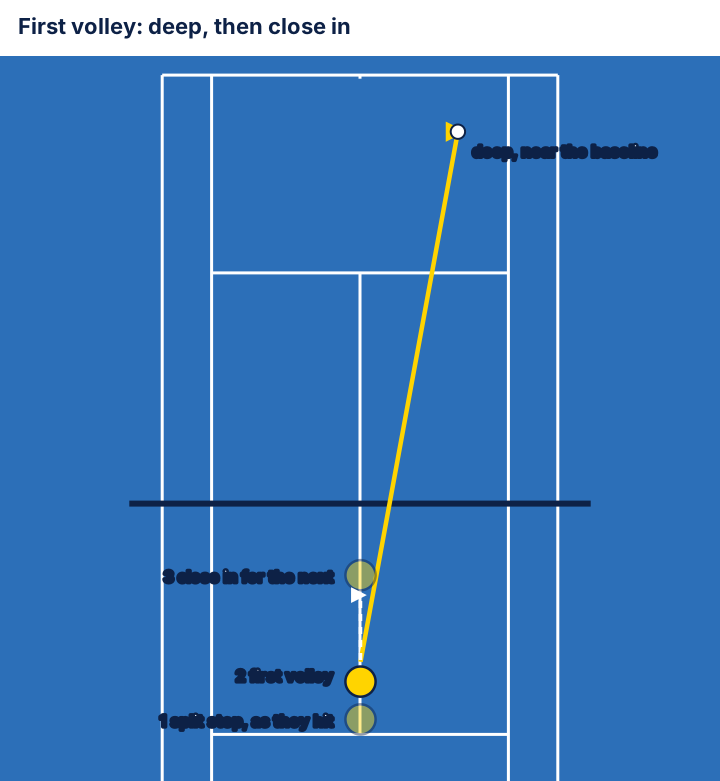
Figure 2. Split step, deep first volley, close in.
Is the first volley ever a winner? When the return is high, yes. And one coach says that after a big approach you can finish with one volley, angled to the open court.3
Three first volleys that give the point back
- Aiming for the corner. Think “in play,” not “put away.”1
- Splitting late. Time the split step to their contact with the ball, not after it.3
- Following a weak volley in. Move in behind a good one, not a short, high one.1
Try it this week: deep, then in
- A partner feeds from the baseline. You start between your baseline and service line, moving forward.
- Split step as they hit.2
- Hit the first volley deep, to a cone 2 m inside the baseline, then move in.
- Hit the second volley shorter and angled.2 Ten balls, then swap.
How we got the numbers
Our ball-flight model uses the drag and topspin-lift coefficients measured by Cross and Lindsey.4 Every volley is flat (no spin), hit on an ITF-sized court5 from 5.0 m off the net at 1.0 m high (our assumption for waist height), except the second volley (2.0 m off the net, 1.3 m up). “Steepest” means the most downward angle that clears the net by 10 cm. Real volleys vary, so read the numbers as a guide.
References
-
John Mills, “Serve and Volley with Success,” Tennis Server, April 1997. Split step before reaching the service line or just as the returner is ready to hit; think first volley “in play,” not “put away,” and “winner” only when the return is high; move in further behind a good volley, not behind a short, high ball. https://www.tennisserver.com/Mills-tip/Mills-tip_4_97.html ↩ ↩2 ↩3 ↩4 ↩5
-
Sportplan, “Tennis: 1st and 2nd volley position,” coaching drill. Players run forward and split step as the feeder makes contact; the first volley must be played deep and the second as a shorter angled shot. https://www.sportplan.net/drills/Tennis/Volley-Drills/1st-and-2nd-volley-position-st20.jsp ↩ ↩2 ↩3
-
Tennis.com, “The Modern Approach: Hit Big and Cover the Line.” Time your split step as your opponent makes contact; after a big approach, finish with one volley, angled off to the open court. https://tennis.com/news/articles/the-modern-approach-hit-big-and-cover-the-line ↩ ↩2 ↩3
-
Rod Cross and Crawford Lindsey, “Tennis Ball Trajectories: The Role of Aerodynamic Drag and Lift in Tennis Shots,” Tennis Warehouse University, 22 December 2013. Drag and spin-lift coefficients. https://twu.tennis-warehouse.com/learning_center/aerodynamics2.php ↩
-
International Tennis Federation, Rules of Tennis 2026, Rule 1 (The Court): 23.77 m long, net 0.914 m high at the centre, service lines 6.40 m from the net. https://www.itftennis.com/media/7221/2026-rules-of-tennis-english.pdf ↩