Smash & lob · Attacking lob
Why is a topspin lob so hard to run down?
Take the spin off a good lob and it floats a metre higher, then lands 1.7 m long. Put it on and it dives in right behind the net player. Here is the recipe.
Your opponent is crowding the net, 1.5 m from the tape, and every drive you hit comes back as a volley. A lob can fail two ways: it lands short and gets smashed, or it sails out.
A topspin lob handles both. Here is one at 73 km/h, launched 28 degrees up, with 2,500 rpm of topspin (turns per minute). It passes 3.8 m above a player 1.5 m from the net, well over their reach of about 3 m (our estimate), and lands 2 m inside the baseline.
Now keep the same swing and take the spin off. The ball floats a metre higher over them and lands 1.7 m beyond the baseline. Out.
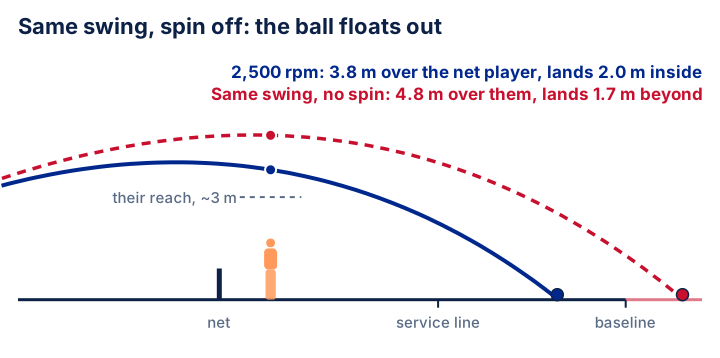
Figure 1. Same swing, with and without topspin. The spin pulls the ball down behind the net player.
Why does it drop?
Topspin makes the air push the ball down.1 Cross and Lindsey call it the “diving” shot. In this lob the spin takes 3.7 m off the flight.
Two things follow. You can hit the lob faster and still keep it in: 73 km/h with spin, 66 without. And the ball comes down sooner. How much sooner?
How much time does that take from them?
We compared three lobs that all pass 3.8 m above the net player and land at the same spot. The topspin lob takes 1.52 s from your racket to the ground. The one with no spin takes 1.69 s, and the one with backspin 1.82 s.
The net player sees the topspin ball go over 0.1 s sooner than the flat one, and it lands 0.66 s after passing them, 8.4 m behind them. Covering that takes a run of 12.8 m/s, about 46 km/h. They can still play the ball after the bounce, but they start with it already past them.
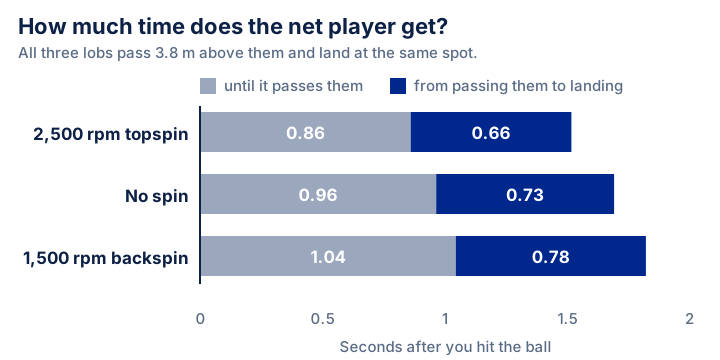
Figure 2. The topspin lob reaches the net player sooner and lands sooner after passing them.
How do you hit it?
Coaching tips: accelerate the racket to create spin, bend your knees, and get below the ball.2 Then pick your height: just over their reach. Each extra 0.4 m over them gives the net player about 0.1 s more.
A classic pattern: pull them forward with a drop shot, then lob over them.3
Two lob fixes that backfire
- Adding height instead of spin. Spin takes time away; height gives it back.
- Slowing the ball to keep it in. Without spin you must drop to 66 km/h, and the ball takes 0.17 s longer.
Try it this week: lob the crowder
A friend stands 1.5 m from the net, racket raised as high as they can reach. Hit ten topspin lobs: a lob scores only if it clears the racket and lands in.
How we got the numbers
The paths come from our ball-flight model, which uses the drag and spin-lift coefficients measured by Cross and Lindsey.1 Every lob is hit from 1.0 m high, 0.3 m behind your baseline, with no wind, on an ITF-sized court.4 The net player stands 1.5 m from the net and reaches about 3 m without a jump (our estimate). For each spin (2,500 rpm of topspin, none, 1,500 rpm of backspin) we solved the speed and angle that pass 3.8 m above them and land 2 m inside the far baseline. Times run to the first bounce. Treat the numbers as a guide.
References
-
Rod Cross and Crawford Lindsey, “Tennis Ball Trajectories: The Role of Aerodynamic Drag and Lift in Tennis Shots,” Tennis Warehouse University, 22 December 2013. Drag and spin-lift coefficients; the “diving” topspin shot and the “floating” backspin slice; spins up to about 2,500 rpm measured. https://twu.tennis-warehouse.com/learning_center/aerodynamics2.php ↩ ↩2
-
Tennis.com, “Master Every Stroke: Lob,” 10 February 2011 (coaching tips). For the topspin lob, an offensive shot: accelerate the racquet to create spin, bend your knees, and get below the ball to hit it up and over your opponent. https://www.tennis.com/news/articles/master-every-stroke-lob ↩
-
Joey Rive and Scott C. Williams, Tennis Skills & Drills, Human Kinetics, publisher’s excerpt “Strategies give players a competitive edge.” Hit a drop shot, bring the opponent forward, and then lob over them. https://us.humankinetics.com/blogs/excerpt/strategies-give-players-a-competitive-edge ↩
-
International Tennis Federation, Rules of Tennis 2026, Rule 1 (The Court): 23.77 m long, net 0.914 m high at the centre. https://www.itftennis.com/media/7221/2026-rules-of-tennis-english.pdf ↩