Smash & lob · Bounce smash
A very high lob is coming. Smash it or let it bounce?
A 12 m lob falls through your hitting zone at 45 km/h and 66 degrees, nearly twice as fast as a 5 m lob. That is why most players wait for the bounce.
Your opponent throws up a lob that vanishes into the sky. You back up, track it, swing. The ball drops faster than you expected and you frame it.
It isn’t just you. The higher a lob goes, the faster it falls through the one place you need it. A 5 m lob passes your contact height at 24 km/h downward. A 12 m lob passes it at 45 km/h, nearly twice as fast.
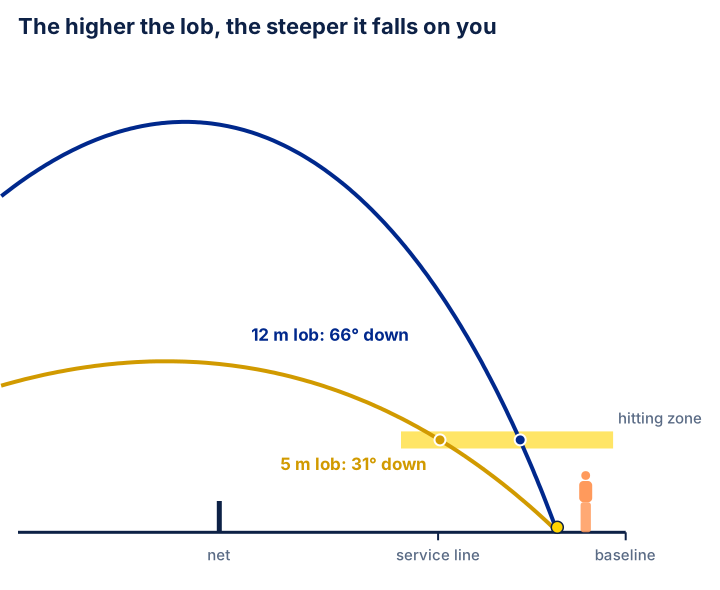
Figure 1. Both lobs land at the same spot. The yellow band is a 0.5 m hitting zone around a 2.7 m contact.
How steep is it really?
We followed lobs peaking 5, 8, 12 and 16 m, all landing 2 m inside your baseline, down to 2.7 m: where you meet a serve or a smash. The ball’s overall speed hardly changes (46 to 54 km/h). Its direction does: 31 degrees for the 5 m lob, 66 for the 12 m lob, 74 for the 16 m lob. It comes almost straight down.
Tennis.com makes the same point: high lobs travel faster on the way down, so most players wait for the bounce.1
How much timing does that cost you?
How little time do you have?
Suppose you can still hit a good ball anywhere within 0.5 m of your contact point (our assumption). The 5 m lob crosses that zone in 0.08 s. The 12 m lob crosses it in 0.04 s: half the time, so you must be twice as exact.
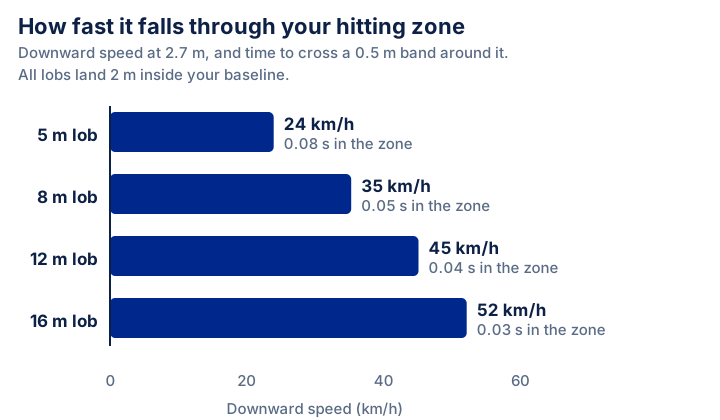
Figure 2. The higher the lob, the faster it falls through your hitting zone.
So when do you stop trying to smash it out of the air?
When do you let it bounce?
When it is too high to time, or when sun or wind is getting in the way. That is the advice in a Tennis.com how-to on the bounce overhead.2 Our numbers show what that means: 66 degrees, and 0.04 s to meet it.
Then hit it like a serve. You are usually far from the net, so go up after the ball, extend fully, and meet it at your serve contact point.2
If you take it in the air, get behind the ball. The USTA’s tip: block or catch it above you with your free hand, so you hit in front of your head, not over it.3
Two ways the high lob still beats you
- Standing right under it. A ball falling at 66 degrees comes almost straight down. Stay behind its line so you can hit in front of your head.3
- Hitting the bounce like a normal smash. Treat it like a serve.2
Try it this week: point, bounce, serve
A friend lobs high. Point at each ball with your free hand,2 let it bounce, and hit it at your serve contact height. Ten balls: count the clean hits that land in.
How we got the numbers
The paths come from our ball-flight model, using the drag and spin-lift coefficients measured by Cross and Lindsey.4 Each lob is hit from 1.0 m high, 1.5 m behind the opponent’s baseline, with 1,000 rpm of topspin and no wind, on an ITF-sized court.5 We chose the peak, solved the speed and angle that land it 2 m inside your baseline, and read its speed and direction at 2.7 m, a serve contact height (our assumption). The 0.5 m zone is our illustration. The model stops at the first bounce, so we say nothing about the ball after it.
References
-
Tennis.com, “Tip: Hit Your Lobs Higher,” 27 October 2010. Since the ball gains speed as it drops, high lobs travel faster on the way down; only players with excellent timing smash them before the bounce, and most wait for the bounce. https://tennis.com/news/articles/tip-hit-your-lobs-higher ↩
-
Ed McGrogan, “How To: Hit a Bounce Overhead,” Tennis.com, 17 July 2009 (TENNIS magazine, August 2009). Let a lob bounce when it is so high it is hard to time, or when sun or wind trouble you; track the ball by pointing at it with your free hand; treat a bounce overhead like a serve and meet it at your serve contact point. https://www.tennis.com/news/articles/how-to-hit-a-bounce-overhead ↩ ↩2 ↩3 ↩4
-
Ben Zaiser, “Improve your game: Master the overhead,” USTA. Get your body behind the ball; reach up with the non-racquet hand to block or catch the ball above your head, slightly in front, so you hit in front of your head instead of over it. https://www.usta.com/en/home/improve/tips-and-instruction/national/improve-your-tennis-game--tips-for-mastering-the-overhead.html ↩ ↩2
-
Rod Cross and Crawford Lindsey, “Tennis Ball Trajectories: The Role of Aerodynamic Drag and Lift in Tennis Shots,” Tennis Warehouse University, 22 December 2013. Drag and spin-lift coefficients used by our model. https://twu.tennis-warehouse.com/learning_center/aerodynamics2.php ↩
-
International Tennis Federation, Rules of Tennis 2026, Rule 1 (The Court): 23.77 m long, net 0.914 m high at the centre. https://www.itftennis.com/media/7221/2026-rules-of-tennis-english.pdf ↩