Smash & lob · Smash footwork
The lob is over your head. Where do your feet go?
Wait until the lob is over your head and you must cover the same ground at four times the speed. Turn sideways as they hit, then move back.
You’re at the net, 1.4 m from the tape. They lob. The ball is over your head before you’ve decided anything, and your feet take two quick steps backward, still facing the net. That’s the step that loses the point.
Why is the lob always faster than you?
In our model a 70 km/h topspin lob passes 4.1 m above you 0.90 seconds after they hit it. It comes down to your smash height of 3 m (our estimate of your reach) 3.7 m behind where you stood, 1.19 seconds after the hit.
Wait until it is over your head and you have 0.29 seconds for those 3.7 m: 12.9 m/s. Start when they hit and you have 1.19 seconds: 3.1 m/s, a quarter of the speed. You only beat the lob if you leave early.
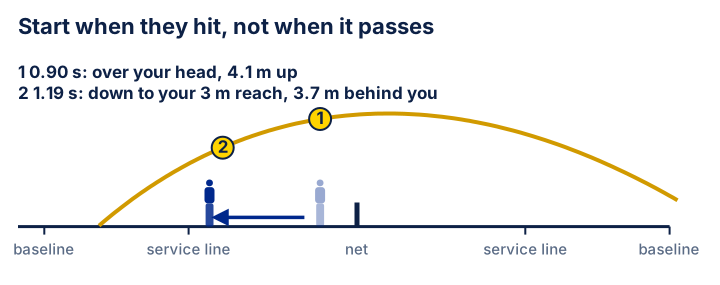
Figure 1. The ball is over you at 0.90 s, and it is not at your smash height until 1.19 s, 3.7 m back.
Getting there isn’t enough. You want to be behind the ball, so you hit it in front of your head and not over it.1 So how do you move back without losing the ball?
How do you move back?
Turn before you travel. From the ready position, turn sideways, then move to position your body for contact out in front, as you would on a serve.2 If you have to back up, turn and move sideways, not backward.2
Use side steps or crossover steps. USTA’s plans teach a drop-step, crossover and run for the overhead, with pivots and carioca (a sideways crossover drill) as complementary skills.3 Whichever you use, the order is the same: turn first, then move.
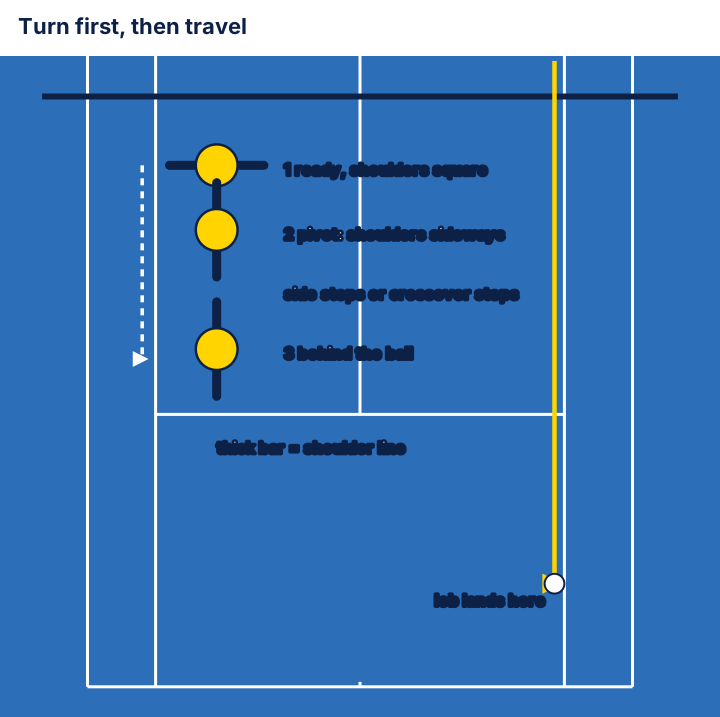
Figure 2. Turn first, then travel: shoulders sideways before the feet move.
Three footwork habits that wreck the overhead
- Backpedalling. If you need to back up for an overhead, turn and move sideways, not backward.2
- Hitting it over your head. Get behind the ball so contact is in front of your head.1
- Chasing a ball that’s too high. If it is really high, let it bounce before you hit the overhead.2
Try it this week: the catch
- A partner lobs to you from the baseline.
- Turn, move behind the ball and block it above your head, slightly in front of your body, with the palm of your free hand.1
- After several clean catches, catch it with your fingers facing up.1
- Only then pick up the swing. Ten lobs to each side.
How we got the numbers
Our ball-flight model uses the drag and topspin-lift coefficients measured by Cross and Lindsey.4 The lob: 70 km/h, 2,000 rpm, hit 1.0 m high and 0.3 m behind the lobber’s baseline, landing 2 m inside yours, on an ITF-sized court.5 You start 1.4 m from the net. The 3 m smash height is our estimate of a net player’s reach without a jump. The speeds are distance divided by time. Read them as a guide.
References
-
USTA, “Improve your game: Master the overhead” (Ben Zaiser). Get your body behind the ball; reach up with the non-racket hand to catch or block the ball above the head, slightly in front, then catch it with the fingers up; this lets you hit in front of your head instead of over it. https://www.usta.com/en/home/improve/tips-and-instruction/national/improve-your-tennis-game--tips-for-mastering-the-overhead.html ↩ ↩2 ↩3 ↩4
-
USTA, Warrior Tennis Curriculum, 2018, Practice Session 5 “Overhead Smash and Lob,” p. 35. Turn sideways and move to position the body for contact out in front; if you need to back up, turn and move sideways, not backward; a really high ball is best let bounce. https://www.usta.com/content/dam/usta/pdfs/20180302_WoundedWarriorCurricula.pdf ↩ ↩2 ↩3 ↩4
-
USTA, Net Generation Community and Coach’s Curriculum: Yellow Ball Practice and Play Plans, 2019, “Copy Cat” movement game. Progression: drop-step, crossover and run for overhead, with pivots and carioca as complementary skills. https://www.usta.com/content/dam/usta/content-fragments/tennis-service-center/assets/pdfs/Net-Generation-Practice-Plan-Yellow.pdf ↩
-
Rod Cross and Crawford Lindsey, “Tennis Ball Trajectories: The Role of Aerodynamic Drag and Lift in Tennis Shots,” Tennis Warehouse University, 22 December 2013. Drag and spin-lift coefficients. https://twu.tennis-warehouse.com/learning_center/aerodynamics2.php ↩
-
International Tennis Federation, Rules of Tennis 2026, Rule 1 (The Court): 23.77 m long, net 0.914 m high at the centre, service lines 6.40 m from the net. https://www.itftennis.com/media/7221/2026-rules-of-tennis-english.pdf ↩