Smash & lob · Defensive lob
How much time does a high defensive lob really buy?
A lob peaking 8 m up keeps the ball in the air 2.4 s, against 1.0 s for a drive. But height has a catch: each extra metre buys less than the one before.
You’re dragged wide and 1.5 m behind the baseline, off balance. Whatever you hit next has one job: keep the ball in the air long enough for you to get back.
A drive to the far end lands in 1.0 s. A lob that peaks 6 m up stays in the air 2.0 s, twice as long. Peak at 12 m and you get 3.0 s. Not 4.
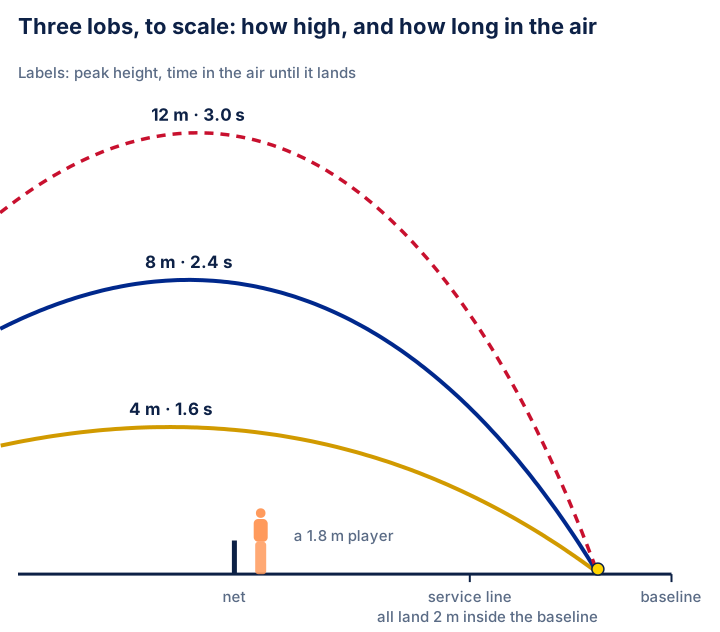
Figure 1. Same landing spot, three heights. The 4, 8 and 12 m lobs stay up 1.6, 2.4 and 3.0 seconds.
Why doesn’t twice the height give twice the time?
A falling ball’s time grows only with the square root of its height. In our model a 4 m lob stays up 1.6 s and a 16 m lob 3.5 s: four times the height, a bit more than twice the time.
So each extra metre buys less. Around a 5 m peak a metre adds about 0.2 s. Around 15 m it adds about 0.12 s, and you need a harder launch to get there: 66 km/h for an 8 m lob, 82 km/h for a 16 m one.
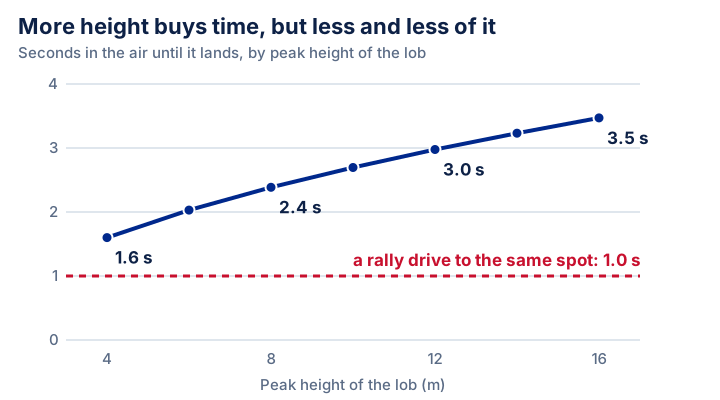
Figure 2. The curve keeps rising, but flatter and flatter. The dashed line is a drive to the same spot.
So where do you stop?
Where is the sweet spot?
About 6 to 8 m (3 to 4.5 times your own height). That already doubles the drive’s time (2.0 to 2.4 s), and each metre still buys 0.15 to 0.2 s. Past 10 m a metre buys 0.14 s or less, and the launch gets harder.
Height pays off in other ways too. Higher lobs tend to land deeper, and because the ball gains speed as it falls, they are harder to smash before the bounce, so most opponents wait for the bounce.1
Four ways a defensive lob still fails
- Lobbing short. A weak lob is an easy put-away.1 Depth first: we aimed every lob 2 m inside the baseline.
- Lobbing low. A 4 m lob buys 1.6 s, 0.4 s less than a 6 m one.
- Lobbing, then watching. The time only helps if you use it. Head back toward the middle of the court as soon as the ball leaves your strings.1
- Going for a winner. This lob is for survival. Go for height and depth, not a winner.2
Try it this week: the stopwatch lob
Stand 1.5 m behind your baseline. A friend feeds you wide balls and runs a phone stopwatch from your hit until the ball lands. Hit ten lobs that land inside the court. Aim for 2.0 to 2.4 s. Under 2 s? Hit it higher.
How we got the numbers
The paths come from our ball-flight model, which uses the drag and spin-lift coefficients measured by Cross and Lindsey.3 Every lob is hit from 1.0 m high, 1.5 m behind your baseline, with 1,000 rpm of topspin and no wind, on an ITF-sized court.4 We chose the peak height, and the model found the speed and angle that land the ball 2 m inside the far baseline. The drive is 100 km/h with 1,500 rpm, hit from 0.3 m behind the baseline to the same spot. A time is the flight until the first bounce. With no spin the 8 m lob stays up about 0.1 s longer, with backspin about 0.2 s longer. Real lobs vary, so treat the numbers as a guide.
References
-
Tennis.com, “Tip: Hit Your Lobs Higher,” 27 October 2010. High lobs keep the ball in the air longer and give more time to get back to the centre of the court; they land deeper; the ball gains speed as it drops, so most players wait for the bounce; a weak lob is an easy put-away. https://tennis.com/news/articles/tip-hit-your-lobs-higher ↩ ↩2 ↩3
-
Tennis.com, “Master Every Stroke: Lob,” 10 February 2011 (coaching tips). On the defensive lob, go for height and depth and don’t worry about hitting a winner. https://www.tennis.com/news/articles/master-every-stroke-lob ↩
-
Rod Cross and Crawford Lindsey, “Tennis Ball Trajectories: The Role of Aerodynamic Drag and Lift in Tennis Shots,” Tennis Warehouse University, 22 December 2013. Drag and spin-lift coefficients used by our model. https://twu.tennis-warehouse.com/learning_center/aerodynamics2.php ↩
-
International Tennis Federation, Rules of Tennis 2026, Rule 1 (The Court): 23.77 m long, net 0.914 m high at the centre. https://www.itftennis.com/media/7221/2026-rules-of-tennis-english.pdf ↩