Singles · Baseline rallies
Crosscourt or down the line: how much safer is it?
The net is 10 cm lower over the middle, and the diagonal gives the ball more court. Together they give a crosscourt shot about 20% more room for error.
You’re in a baseline rally. The line is wide open, you go for it, and the ball clips the tape or lands long.
It isn’t bad luck. A down-the-line shot has to clear a higher net and fit into a shorter court.
The net isn’t one height: it is 0.914 m at the centre and 1.07 m at the posts.1 A line shot crosses near the sideline, where we estimate the net is about 10 cm higher than in the middle. The court isn’t one length either. Corner to corner it is 25.15 m, against 23.77 m down the line.1
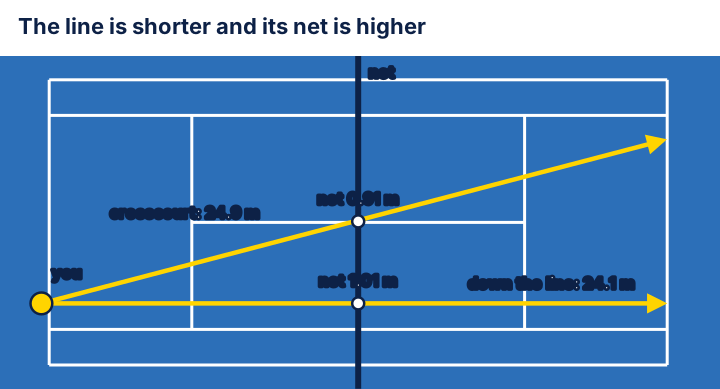
Figure 1. Hit from 1 m inside the sideline at a spot 1 m inside a line. The line shot is 0.8 m shorter and crosses a net 10 cm higher.
How much room does that give you?
Enough to count. We ran the same forehand both ways (110 km/h, 2,000 rpm of topspin) and asked which net heights still let it land in.
Down the line, the ball has to cross the net between 1.04 and 2.22 m. Crosscourt, it can cross between 0.95 and 2.36 m: 9 cm lower and 14 cm higher. That is a window about 20% taller, 1.4 m instead of 1.2 m. Aim at the exact corners and the launch-angle window is about 27% wider.
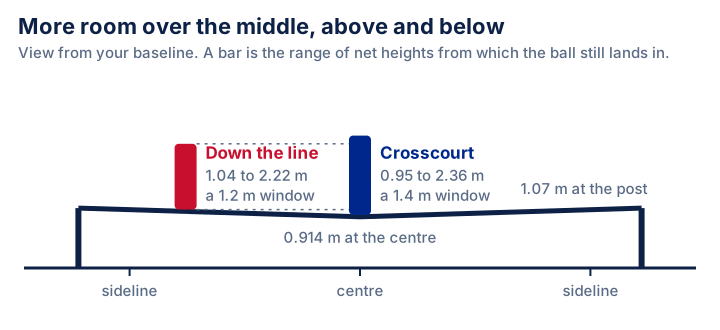
Figure 2. Seen from your baseline. The crosscourt window starts lower and ends higher.
A coaching column says the same in plain words: a crosscourt ball crosses nearer the middle, with a greater margin of error, and doesn’t need to hug the line to move your opponent.2
So is the line shot ever right?
When does the line shot pay?
After a crosscourt. A common pattern is to pull your opponent wide, then hit the next ball down the line into the space they left or behind them.3 Make the line shot your second ball, not your first.
Three ways to waste the crosscourt margin
- Going for the line off a tough ball. The window is only about 1.2 m tall even when you’re balanced. Wait until you’re set.
- Aiming at the sideline. Our windows assume a target 1 m inside it. A target on the paint leaves no room.
- Never changing direction. Crosscourt is the default, not the only shot.
Try it this week: two tallies
Rally crosscourt with a partner. Once per rally, on a ball you can step into, either of you may go down the line. Count the line shots that land in against the crosscourt ones. Which tally is higher?
How we got the numbers
Court sizes come from the ITF rules.1 We took the net height as a straight line from 0.914 m at the centre to 1.07 m at the singles stick, which stands 0.914 m outside the sideline; a real net sags a little differently. The ball paths come from our ball-flight model, using the drag and spin-lift coefficients measured by Cross and Lindsey.4 The forehand starts 1.0 m high, 0.3 m behind the baseline and 1 m inside the sideline, and aims 1 m inside a line. “Lands in” means it clears the tape and lands at or before the far baseline. Real shots vary, so treat the numbers as a guide.
References
-
International Tennis Federation, Rules of Tennis 2026, Rule 1 (The Court): singles court 23.77 m by 8.23 m; net 1.07 m at the posts or singles sticks (0.914 m outside the singles sideline) and 0.914 m at the centre. https://www.itftennis.com/media/7221/2026-rules-of-tennis-english.pdf ↩ ↩2 ↩3
-
Steve Annacone, “Tip of the Week: Reasons to Hit Crosscourt,” New York Tennis Magazine, 5 November 2018. The ball usually crosses the net towards the middle, giving a greater margin of error; crosscourt has more angles, so you needn’t hit close to the line. https://newyorktennismagazine.com/?p=26712 ↩
-
Joey Rive and Scott C. Williams, Tennis Skills & Drills, Human Kinetics, publisher’s excerpt “Strategies give players a competitive edge.” Pulling an opponent off the court, for example crosscourt and then down the line. https://us.humankinetics.com/blogs/excerpt/strategies-give-players-a-competitive-edge ↩
-
Rod Cross and Crawford Lindsey, “Tennis Ball Trajectories: The Role of Aerodynamic Drag and Lift in Tennis Shots,” Tennis Warehouse University, 22 December 2013. Drag and spin-lift coefficients used by our model. https://twu.tennis-warehouse.com/learning_center/aerodynamics2.php ↩