Singles · Baseline rallies
Your ball lands short. How high should it clear the net?
Skimming the net feels safe, but from 3 m behind the baseline it lands near their service line. Here is how high to aim, from where you stand.
Why does the safe-looking ball land short?
You’ve been pushed 3 m behind your baseline. You hit a firm ball that clears the net by just 75 cm. It feels safe. In our model it lands 5.8 m short of their baseline, near the service line.
Clear it by 2.2 m instead and it lands 0.9 m inside the baseline.
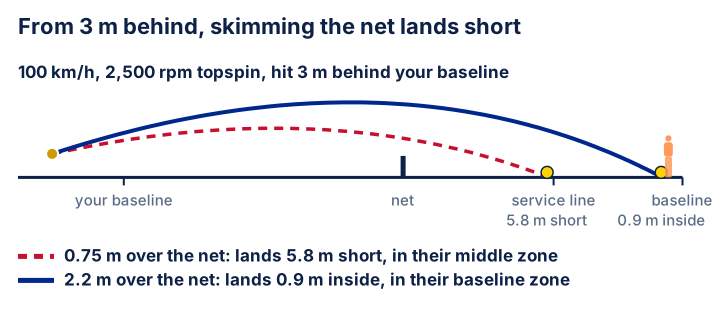
Figure 1. Same ball, same pace and spin, hit from 3 m behind the baseline. Only the height over the net changes.
The low ball lands in the middle of their court, where the book says a player can build or attack. The high one lands in the baseline zone, where the safe reply is a deep ball.1 How high is high enough?
How high is high enough?
Championship Tennis gives three heights, all measured above the net tape:1
- Inside the court: 61-91 cm (2-3 ft)
- On the baseline: 91-152 cm (3-5 ft)
- 10 ft (3 m) behind it: 2.4-3.0 m (8-10 ft)
The net is 0.914 m high at the centre,2 so you can think in net heights: about one inside the court, up to 1.7 on the baseline, about three from 3 m back.
The idea: the higher you clear the net, the deeper the ball generally lands, and the farther back you stand, the higher you must go to keep them pinned to the baseline. The authors say short balls and errors multiply when players ignore these heights.1
Why does stepping back change the height?
Distance. From farther back the ball has more court to cross, so it needs more arc to land deep. In our model, a 100 km/h topspin ball must clear the net by 1.1 m from 2 m inside the baseline, 1.5 m from the baseline and 2.2 m from 3 m behind it, just to land 1 m inside their baseline.
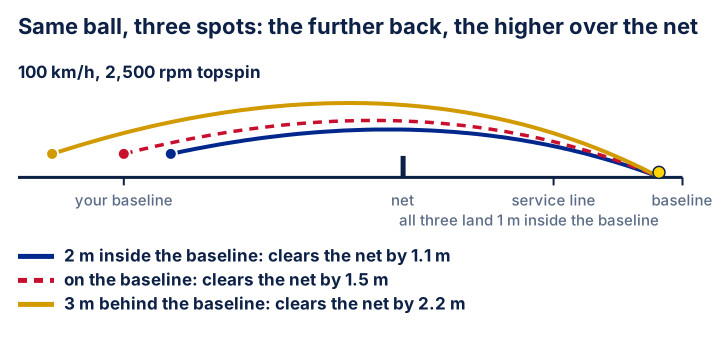
Figure 2. Same pace, same spin, same landing spot. Every step back adds height.
The book’s heights are a rule of thumb and ours use one fixed pace. Both climb the same way.
Four ways to miss the right height
- Skimming the net from far back. It feels safe and hands them the middle of the court.
- One height for every spot. Look at your feet first.
- Answering a deep ball with speed. From far back, the book says to lift the ball with heavy topspin to buy recovery time.1
Try it this week: three spots, three heights
- Pick a target zone on the far side: between the service line and the baseline.
- A partner feeds. Hit 10 balls from 2 m inside the baseline, 10 from the baseline and 10 from 3 m behind it.
- A partner at the net post calls “one”, “two” or “three”: how many net heights above the tape the ball passed. Note which call works from each spot.
How we got the numbers
The heights come from the book.1 The side views come from our ball-flight model, using the drag and topspin-lift coefficients measured by Cross and Lindsey.3 Every ball is 100 km/h with 2,500 rpm of topspin, hit 1.0 m high from the spot shown, with no wind, on an ITF-sized court.2 We solved each launch angle: in Figure 2 so the ball lands 1 m inside the baseline, in Figure 1 so it clears the net by the height shown. The model stops at the first bounce. Treat the numbers as a guide.
References
-
Frank Giampaolo and Jon Levey, Championship Tennis, Human Kinetics, publisher’s excerpt “Reduce your errors on the court by examining zones.” Air zones (2-3 ft inside the court, 3-5 ft on the baseline, 8-10 ft from 10 ft behind it), higher means deeper, and the court zones. https://us.humankinetics.com/blogs/excerpt/reduce-your-errors-on-the-court-by-examining-zones ↩ ↩2 ↩3 ↩4 ↩5
-
International Tennis Federation, Rules of Tennis 2026, Rule 1 (The Court): 23.77 m long, net 0.914 m high at the centre, service lines 6.40 m from the net. https://www.itftennis.com/media/7221/2026-rules-of-tennis-english.pdf ↩ ↩2
-
Rod Cross and Crawford Lindsey, “Tennis Ball Trajectories: The Role of Aerodynamic Drag and Lift in Tennis Shots,” Tennis Warehouse University, 22 December 2013. Drag and spin-lift coefficients. https://twu.tennis-warehouse.com/learning_center/aerodynamics2.php ↩