Singles · Opponent types
They get everything back. How do you win the point?
A coaching book says retrievers collect the trophies up to the elite level, thanks to shot choice, not strokes. Beat one with your choices, not your power.
Why does your best shot keep coming back?
You hit your best forehand. It floats back, slow and high. You hit harder. It floats back again. Then you miss, and they win a point without hitting a good shot.
USTA describes this opponent as one who reaches every ball but lacks the weapons to overwhelm you.1 Their main route to a point is your mistake. A coaching book even says that up to the elite level, retrievers tend to have all the trophies, and not because of their strokes: they win through shot selection.2
So hitting harder is not the answer. What is?
What do you choose instead?
Three tools, all from published coaching.
Make them run. USTA’s advice is to hit behind them or draw them in.1 The classic pair from Tennis Skills & Drills: hit cross-court, then send the next ball into the open court.3 Corner to corner is 8.2 m of singles court.4
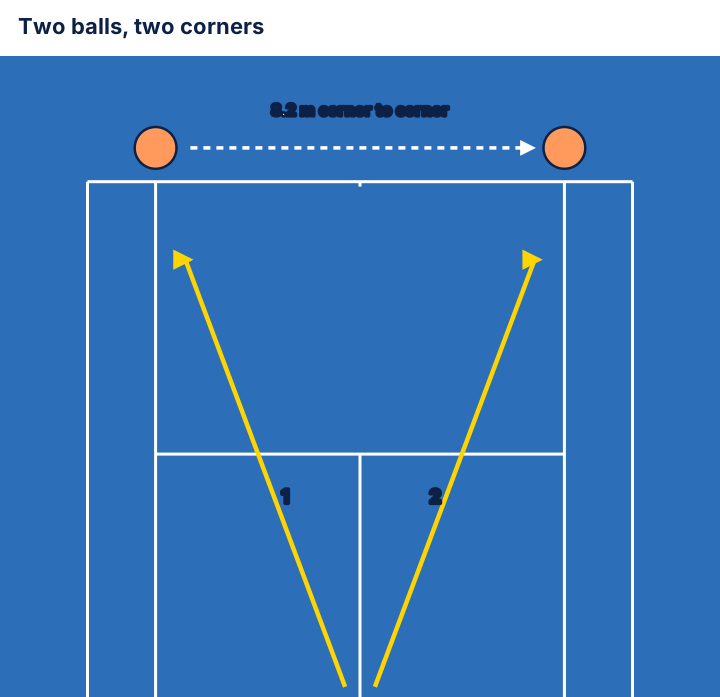
Figure 1. Two balls, two corners. Our drawing on an ITF-sized court.
Build on a neutral ball. It does not need a winner. Championship Tennis says to match the ball’s speed, use building shots to pull them out of position, and clear the net high enough to keep depth.2
Come in on the short ball. The book’s versions: throw up a high, heavy ball to their weak side and sneak in behind it, or hit a drop shot to bring them forward and lob over them as they run back.3
Why can’t you just out-rally them?
Because they don’t mind waiting. Suppose each ball you hit has the same, independent chance of a miss (our simple model, not data). Miss 1 ball in 10 and you get 10 balls in a row without a miss only 35% of the time.
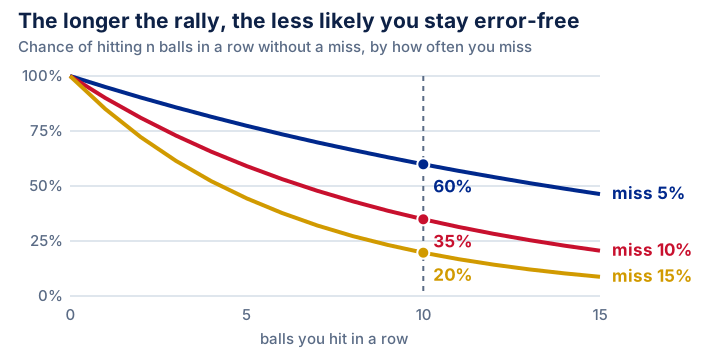
Figure 2. Every extra ball costs you. Real rallies vary; this is an illustration, not data.
Brad Gilbert’s Winning Ugly makes the same point in words. Recreational players can win more often without changing their strokes, by becoming better thinkers who recognise what the opponent does, analyse it and capitalise.5
Four ways to feed a pusher
- A winner from a neutral ball. That is the gift they are waiting for.2
- Rallying with no plan. Decide what you will use: corners, a short ball, the net.5
- Staying back on a short ball. The book’s rush-and-crush plans all start with moving in.3
- A drop shot with no next ball. The book’s version brings them forward, then lobs.3
Try it this week: two corners first
- Play points against a partner whose only job is to get every ball back.
- Before you may go for a winner, you must hit one ball to each corner.
- A point won after the two corners scores 2; any other point won scores 1.
- Swap after 10 points.
How we got the numbers
The 8.2 m is the width of the singles court.4 The chart is our own simple model: every ball has the same chance of a miss, independent of the others, so the chance of n balls in a row is (1 - miss rate) to the power n. Real players are not that regular, so treat it as an illustration of why long rallies cost you.
References
-
United States Tennis Association, Chris Michalowski, “Tactical Tennis: Beating a Runner-Pusher,” 9 May 2017. The runner-pusher reaches every ball but lacks the weapons to overwhelm you; hit behind them or draw them into the net. https://www.usta.com/en/home/improve/tips-and-instruction/national/tactical-tennis--playing-the-runner-pusher.html ↩ ↩2
-
Frank Giampaolo and Jon Levey, Championship Tennis, Human Kinetics, publisher’s excerpt “Reduce your errors on the court by examining zones.” Retrievers win through shot selection; the neutral-ball advice. https://us.humankinetics.com/blogs/excerpt/reduce-your-errors-on-the-court-by-examining-zones ↩ ↩2 ↩3
-
Joey Rive and Scott C. Williams, Tennis Skills & Drills, Human Kinetics, publisher’s excerpt “Strategies give players a competitive edge.” Pulling an opponent off the court (cross-court, then the next ball into the open court) and “rush and crush” (a high, heavy ball then move in; drop shot then lob). https://us.humankinetics.com/blogs/excerpt/strategies-give-players-a-competitive-edge ↩ ↩2 ↩3 ↩4
-
International Tennis Federation, Rules of Tennis 2026, Rule 1 (The Court): the singles court is 8.23 m wide. https://www.itftennis.com/media/7221/2026-rules-of-tennis-english.pdf ↩ ↩2
-
Brad Gilbert and Steve Jamison, Winning Ugly: Mental Warfare in Tennis - Lessons from a Master, Touchstone, 1993. The book’s idea, as described on its Bookshare catalogue page: win more often without changing your strokes by becoming a better thinking player who recognises, analyses and capitalises. https://www.bookshare.org/browse/book/656377 ↩ ↩2