Singles · Score situations
You can't play every point flat out. Which ones matter?
In our model, a point at 30-40 is worth 14 times a point at 40-0. Real match scores rank the top and the bottom of the scoreboard the same way.
What is one point really worth?
You’re serving at 40-0 and you rush a shot, because why not. Two games later you’re at 30-40 and you hit the same shot. The scoreboard says those two points are nothing alike.
Measure it the classic way: a point’s importance is how much your chance of winning the game changes if you win it instead of losing it.12 Take a server who wins 60% of points, each point independent, under standard scoring.3 From 0-0 that server holds 74% of games. Then one point is worth, in percentage points of that chance:
- At 40-0: 5.
- At 0-0: 27.
- At 30-30 and at deuce: 46.
- At 30-40: 69.
That is 14 times more at 30-40 than at 40-0. It is our calculation, and it fits the whole scoreboard.
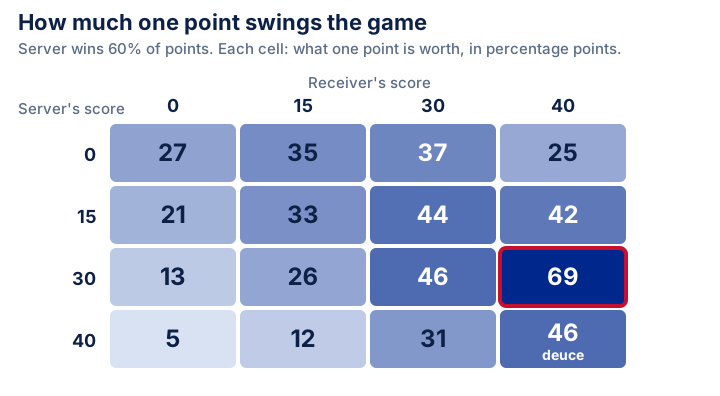
Figure 1. What one point is worth at every score, server’s score down the side. Our calculation.
Would a real match agree?
Do real matches agree?
Mostly. A 2025 study measured the same swing from the scores of 1,689 games in 58 close professional men’s matches. It found the same top two scores, 30-40 then 30-30, and the same least important score, 40-0. Scores where the receiver is ahead filled five of the six top places.4
So a better server should feel it differently. Does it change with how well you serve?
What changes when you serve better?
A lot. At a 50% server, 30-40 is worth 50. At 80%, it is worth 94, and 40-0 is worth almost nothing.
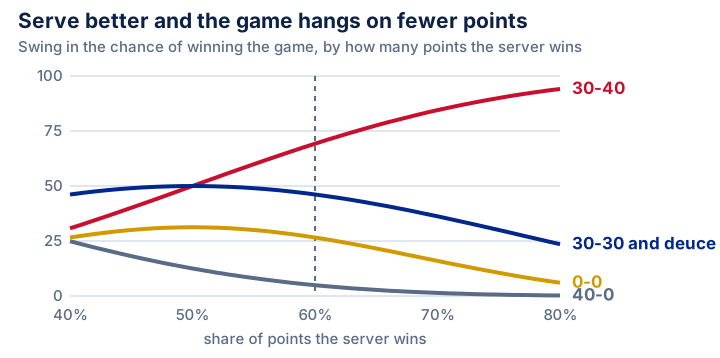
Figure 2. The stronger the server, the more the game hangs on a few scores.
Our suggestion, not a result: spend your full routine on the big scores (30-40, 30-30, 15-40, deuce) and use 40-0 to practise.
Four ways to misplay the scoreboard
- Treating every point alike. The scoreboard says 14 to 1.
- Letting up at 40-30. Losing it gives deuce, so it is still worth 31.
- Thinking 30-30 is the biggest. At 30-40 the point is worth 69, against 46.
- Trusting the model too far. Real points are not perfectly independent. Treat it as a guide.
Try it this week: start at the big score
- Pick a start score: 30-40, 30-30 or 40-30.
- Play 10 games from each with the same server.
- Count how often the server holds.
- Compare with a 60% server in our model: 42%, 69% and 88%.
How we got the numbers
The server wins each point with the same chance, here 60%, independent of the others; a game is first to four points and two clear.3 Importance is the change in the chance of winning the game between winning and losing the point, the definition credited to Morris.12 The model is ours. Real shares vary, so read the numbers as a guide.
References
-
Carl Morris, “The most important points in tennis,” in S. P. Ladany and R. E. Machol (eds.), Optimal Strategies in Sports, North-Holland, 1977. The classic work on the importance of a point. We could not open the chapter itself; the volume is listed at https://openlibrary.org/search?q=optimal+strategies+in+sports and the definition is as described in the next reference. ↩ ↩2
-
“Klaassen-Magnus Hypothesis 3,” On the T (tennis analytics blog), 5 March 2016. Describes Morris’s definition: a point’s importance is the change in the probability of winning the game when the point is won versus lost. https://on-the-t.github.io/2016/03/05/Klaassen-Magnus-Hypothesis-3 ↩ ↩2
-
International Tennis Federation, Rules of Tennis 2026, Rule 5 (Score in a game): standard game scoring, deuce at three points each, then two consecutive points to win. https://www.itftennis.com/media/7221/2026-rules-of-tennis-english.pdf ↩ ↩2
-
Aditya Singla and Anurag Singla, “Optimizing tennis strategy: a data-driven analysis of point importance,” Journal of Emerging Investigators, 21 December 2025 (DOI 10.59720/24-370). The same swing measured from 1,689 games of 58 close ATP matches in 2024 (Flashscore scores): top scores 30-40 and 30-30, least important 40-0, receiver-ahead scores rank highest. https://doi.org/10.59720/24-370 ↩