Serve · Placement
T, body or wide: where should the serve go?
Eight college players mostly served 0.4 to 0.6 m inside their own targets. A model of their serves puts the best second-serve aim about a metre inside the line.
What do T, body and wide each do?
Break point on your serve. The returner waits in the middle of the box. T, body or wide?
Every serve goes diagonally, into the box on the other side of the centre line.1 The T is the corner where the centre line meets the service line. Wide is the corner on the sideline. Both pull the returner away from the side they’re guarding, and the best landing spots lie along those box boundaries, where the returner has the farthest to run. The body serve does the opposite: it aims at the returner to jam them between forehand and backhand and force an awkward return.2
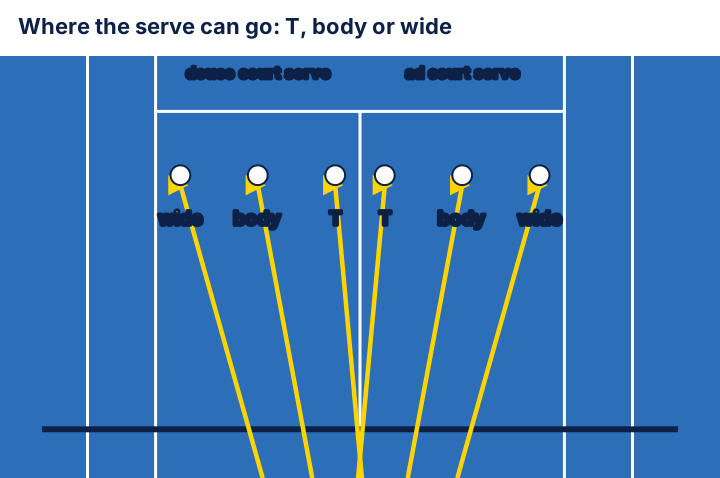
Figure 1. For a right-handed returner, the deuce-court T goes to the backhand and the wide serve to the forehand. In the ad court it’s the other way round.
So which one do you pick?
Which one is best?
Neither. The returner has to guard against both wide and T, so neither dominates and the server gains by mixing them.2 In the paper’s model, serving wide in the deuce court was worth more than the T for all eight players, on first and second serves. In the ad court the two were nearly even.2
The returner’s usual answers: a wide serve comes back cross-court, a T or body serve through the middle.34
Once you’ve picked the spot, how close to the line do you aim?
How close to the line should you aim?
Researchers asked eight college players to name their best aim point for wide and T in both boxes, taped an X on each, and had every player serve about 70 balls.2
The players named targets closer to the line than they served. In nearly nine cases out of ten their serves centred inside the target, by 0.37 m on average on first serves and 0.56 m on second. A model built from those serves said the best aim was inside the named targets too, in 61 of 64 cases. Measured from the line, the best aim was 0.5 to 0.7 m on a first serve and 1.0 to 1.3 m on a second, about twice as far.2
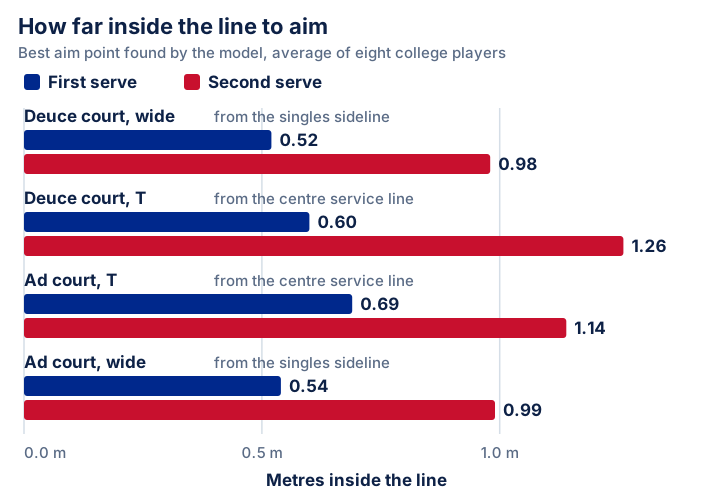
Figure 2. The model’s best aim for eight college players. A second serve gets about twice the cushion.
Why? Because every player misses. Aim at the line and a miss of 0.3 m is a fault. Aim 1 m inside and the same miss still lands in. A second-serve fault loses the point, so it gets the bigger cushion.
These are college men, not club players. The paper’s point is that how far in you should aim depends on how much your serves scatter, so measure yours.2
Four ways to misplace the serve
- Aiming at the line on a second serve. The model’s second-serve aim was about a metre inside.
- Trusting your target. The players’ serves landed inside the targets they named. Check where yours land, not where you aim.
- Serving one spot all day. Mixing wide and T is what keeps the returner guessing.
- Writing off the body serve. It isn’t aimed at a line, and the paper notes that its best aim is comparatively insensitive to how accurate you are.2
Try it this week: where does it really land?
Chalk a line 1 m inside the sideline. Hit ten second serves wide into the deuce box, aiming at the chalk, and count how many land in. Move the line in or out until nine of ten land in. Do the same for the T.
How we got the numbers
The numbers are the paper’s, not ours: eight college men (seven right-handed, one left-handed) and 567 serves, a statistical model of where their serves land, and the value of each landing spot taken from ball-tracking of professional matches at the Australian Open. Distances are averages over the eight players. The returner’s position was approximated, not measured, and players could use any serve type. Our contribution is only the court drawing and the forehand and backhand labels, which are plain geometry for a right-handed returner.
References
-
International Tennis Federation, Rules of Tennis 2026, Rule 17 (Serving): the service must hit the service court diagonally opposite; Rule 1 (The Court): service lines 6.40 m from the net, singles court 8.23 m wide. https://www.itftennis.com/media/7221/2026-rules-of-tennis-english.pdf ↩
-
Nathan Sandholtz, Ryan Hanson, Ronald L. Hager, Stephanie Kovalchik and Gilbert W. Fellingham, “Stated, Realized, and Optimal Aiming Strategies for the Tennis Serve: Experimental Evidence from Collegiate Athletes,” arXiv:2607.28500v2, 30 September 2026. What wide, T and body serves aim to do; players’ serves landed inside their stated targets; the model’s best aim distances (Table 1); mixing wide and T. https://arxiv.org/pdf/2607.28500 ↩ ↩2 ↩3 ↩4 ↩5 ↩6 ↩7
-
USTA, “Tennis strategy: Returning first and second serves,” 6 October 2021. Serves that come in wide are returned cross-court; serves at the body or down the T are returned to the middle. https://www.usta.com/en/home/improve/tips-and-instruction/national/tennis-strategy--returning-first-and-second-serves.html ↩
-
Matt Smith, LTA, “Simple steps to improve your return of serve” (undated). Down the T: return down the middle; centre of the box: return to the middle, to their feet; wide: return cross-court over the middle of the net. https://www.lta.org.uk/play/tennis-tips-and-techniques/simple-steps-to-improve-your-return-of-serve/ ↩