Serve · Second serve
Is a slower second serve really a safer one?
At 110 km/h a flat second serve has a 0.6 m band to hit over the net. Add spin and the band grows to 0.8 m or more, with no loss of speed. Here is why.
It’s your second serve on a big point. You do what everyone does: you ease off. The ball clips the tape anyway.
Look at what a 110 km/h serve has to do. It leaves your racket 2.7 m up, clears a net 0.914 m high, and must land before a service line 6.40 m beyond it.1 Flat, the heights that work at the net are only 0.63 m tall: from the tape up to 0.63 m above it.
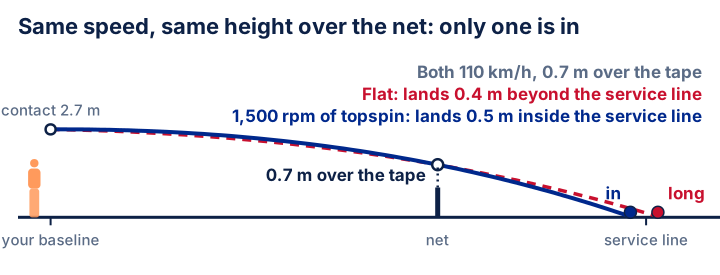
Figure 1. Same speed, same 0.7 m over the tape. The flat serve lands 0.4 m long, the topspin serve 0.5 m inside the line.
What does topspin change?
It pulls the ball down. Topspin pushes a ball down in flight,2 so the serve can cross the net higher and still drop in. The physicist who filmed kick serves says a serve with topspin dives onto the court at a steep angle, even at high speed.3
In our model, 1,500 rpm of topspin (turns per minute) raises the highest crossing that still lands in from 0.63 to 0.82 m. With 2,500 rpm it is 0.94 m.
Why do a few centimetres matter?
Why do those centimetres matter?
Because you can’t aim to the centimetre. For this serve, the range of launch angles that works is 2.8 degrees wide when flat, 3.7 with 1,500 rpm and 4.3 with 2,500 rpm. On a fast serve, the same researcher notes, an error of two degrees can be a fault, into the net or long.3
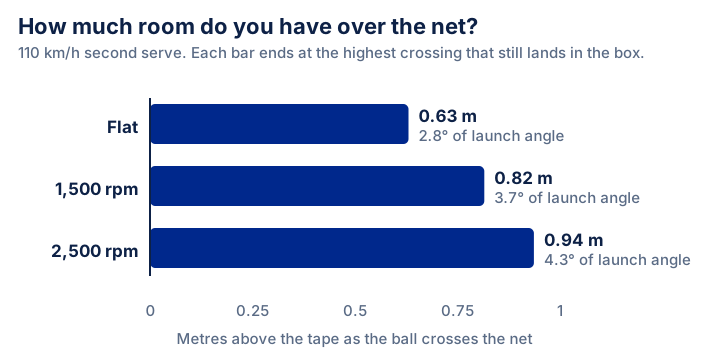
Figure 2. The more spin, the higher over the net you can go and still land in the box.
What about simply slowing down? At 100 km/h a flat serve has 0.76 m, only 0.13 m more than at 110. The up to 1,000 rpm of topspin he found in kick serves buys about the same, and 1,500 rpm buys more, with no loss of speed.
Three ways to lose your second-serve margin
- Easing off. Returners are coached to step in on a second serve and attack it.4 A slow flat serve is the ball they want.
- Skimming the tape. The tape is the bottom of your band. Aim about half a metre above it.
- Aiming for a winner. The second serve is for getting the ball “over and in” and starting the point.5
Try it this week: one serve per point
Play points where each server gets only one serve, as the LTA suggests.5 Hit every one with spin and aim about half a metre over the tape. Compare your double faults per ten points with a day when you eased off.
How we got the numbers
The paths come from our ball-flight model, using the drag and spin-lift coefficients measured by Cross and Lindsey.2 A serve is hit down the middle from 2.7 m high on your baseline, with no wind. Only the topspin part of a serve’s spin changes its up-and-down path, since sidespin curves the ball sideways. Cross’s kick-serve calculations use 3,000 to 5,000 rpm of total spin tilted 20 to 30 degrees from vertical, which we convert to roughly 1,000 to 2,500 rpm of topspin.3 “Lands in” means it clears the tape and lands at or before the service line. The model stops at the first bounce. Treat the numbers as a guide.
References
-
International Tennis Federation, Rules of Tennis 2026, Rule 1 (The Court): service lines 6.40 m from the net; net 0.914 m high at the centre. https://www.itftennis.com/media/7221/2026-rules-of-tennis-english.pdf ↩
-
Rod Cross and Crawford Lindsey, “Tennis Ball Trajectories: The Role of Aerodynamic Drag and Lift in Tennis Shots,” Tennis Warehouse University, 22 December 2013. Drag and spin-lift coefficients; topspin pushes the ball down. https://twu.tennis-warehouse.com/learning_center/aerodynamics2.php ↩ ↩2
-
Rod Cross, “Physics of the Tennis Kick Serve,” Tennis Warehouse University, 26 April 2011. A served topspin ball dives onto the court at a steep angle even at high speed; a two-degree error can make a fast serve a fault; the kick serves he filmed had about 4,000 rpm of mostly sidespin and typically under 1,000 rpm of topspin; his calculations assume 3,000 to 5,000 rpm with the axis tilted 20 or 30 degrees. https://twu.tennis-warehouse.com/learning_center/kickserve.php ↩ ↩2 ↩3
-
USTA, “Tennis strategy: Returning first and second serves,” 6 October 2021. On a second serve, take a step in and be ready to attack with depth and spin. https://www.usta.com/en/home/improve/tips-and-instruction/national/tennis-strategy--returning-first-and-second-serves.html ↩
-
LTA, “How to improve your second serve: Expert tips & techniques.” The second serve is about getting the ball “over and in”; spin gives extra height over the net so you can add speed and stay consistent; practise by playing points with one serve each. https://www.lta.org.uk/play/tennis-tips-and-techniques/how-to-improve-your-second-serve/ ↩ ↩2