Serve · Grip, toss and rhythm
Bevel 1 or bevel 2? Finding your continental grip
One grip serves, volleys and slices, yet guides disagree on its bevel number. Here is where your index knuckle goes, and why this grip earns the spot.
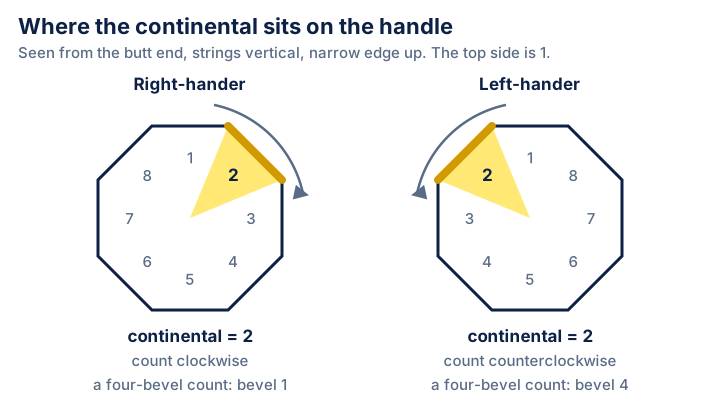
Figure 1. The handle seen from the butt end, strings vertical. Count from the top side. The continental is on 2 for both hands, mirrored for a left-hander.
Why do guides give two numbers?
One article says “knuckle on bevel 1”. Another says “bevel 2”. You’re holding the same racket.
The handle is an octagon and each of its eight sides is a bevel. Hold the racket out with the strings vertical and the narrow edge up, look along the handle from the butt end, and call the top side 1. A right-hander counts clockwise, so the base knuckle of the index finger sits on bevel 2 for the continental. A left-hander mirrors it: count counterclockwise and the continental is still 2, on the other side.1
Some guides count only the four narrow bevels. Theirs puts the continental on bevel 1 for righties and bevel 4 for lefties.2 Same grip, different count.
So check the shape of your hand too. “Shake hands” with the handle, with the V between thumb and forefinger running down the edge.3
Why is this the grip to own?
Why does one grip cover so much?
On the serve, the LTA asks for the continental on flat, kick and slice serves alike,3 so one grip gives you three spins. With it, the forearm and wrist turn naturally through contact, and it puts the least strain on the arm.2
At the net, USTA lists it for overheads, volleys and slice backhands.4 One grip handles forehand and backhand volleys with no change, and its slightly open face suits underspin and control.2
The price: it’s tough to put topspin on the ball.2 That is why rally forehands live on bevels 3 to 5.1
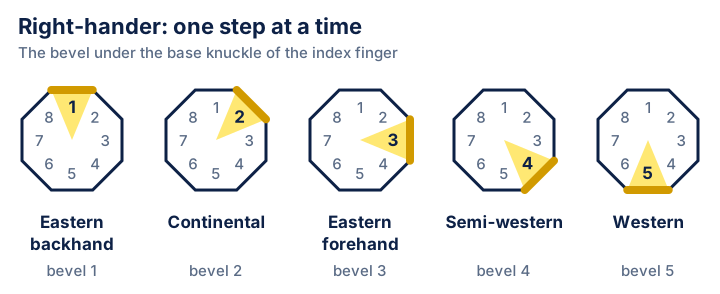
Figure 2. The continental sits one step from the Eastern backhand and one step from the Eastern forehand.
Four grip mistakes hiding in plain sight
- Serving from a forehand grip. The continental is standard for serves because the forearm and wrist can turn naturally through contact.2
- A frying-pan hold. USTA’s cue: set the racket so you see the narrow edge, not the strings, and turn the handle if your hold looks like a frying pan.4
- Counting on the wrong diagram. A four-bevel guide’s 1 is an eight-side guide’s 2.
- Using it for topspin forehands. Keep it for the net, the serve and the slice.
Try it this week: edgies
- Hold the racket with the narrow edge up and shake hands with it.
- Hit 20 “edgies”: tap a ball down at the court with the edge of the frame. USTA uses this to help you find the grip.4
- Look at your hand. Base knuckle on bevel 2, V down the edge. Then serve.
References
-
“Grip (tennis),” Wikipedia (tagged as needing more citations). The handle is an octagon of eight sides; bevel 1 faces up with the blade at right angles to the ground; right-handers count one way and left-handers the other; for a right-hander the index base knuckle is on bevel 2 for the continental, 3 Eastern forehand, 4 semi-Western, 5 Western, 1 Eastern backhand. https://en.wikipedia.org/wiki/Grip_(tennis) ↩ ↩2
-
Jon Levey, “Grip Guide - A Grip on Your Game,” Tennis.com, 15 October 2009. Numbers four bevels: continental on bevel 1 for right-handers and bevel 4 for left-handers; the continental lets the forearm and wrist pronate on serve and overhead, works for forehand and backhand volleys, gives an open face for underspin and control, but makes topspin tough. https://www.tennis.com/news/articles/grip-guide-a-grip-on-your-game-x1214 ↩ ↩2 ↩3 ↩4 ↩5
-
LTA, “Flat, kick & slice: Your guide to serve spins” (LTA expert coach Matt Smith): hold the racket in a continental or “chopper” grip for all three serves, as if shaking hands with it. https://www.lta.org.uk/play/tennis-tips-and-techniques/guide-to-serve-spins/ LTA, “How to practise your serve without a partner” (Matt Smith): the continental grip has a V between thumb and index finger. https://www.lta.org.uk/advantage-home/content/how-to-practice-your-serve-without-a-partner/ ↩ ↩2
-
Rita Gladstone, “Improve your game: Learn the Continental grip,” USTA. The continental is used for overheads, serves, volleys and slice backhands; position the racket so you see the narrow edge; turn the handle if your hold looks like a frying pan; hit “edgies” down at the ground to get comfortable. https://www.usta.com/en/home/improve/tips-and-instruction/national/improve-your-tennis-game--the-continental-grip.html ↩ ↩2 ↩3