Tennis science · Speed and measurement
One serve, two speeds: 153 or 129 km/h?
A serve that leaves the racket at 153 km/h is down to about 110 by the bounce. So which number is your serve? Here's what radar and video each measure.
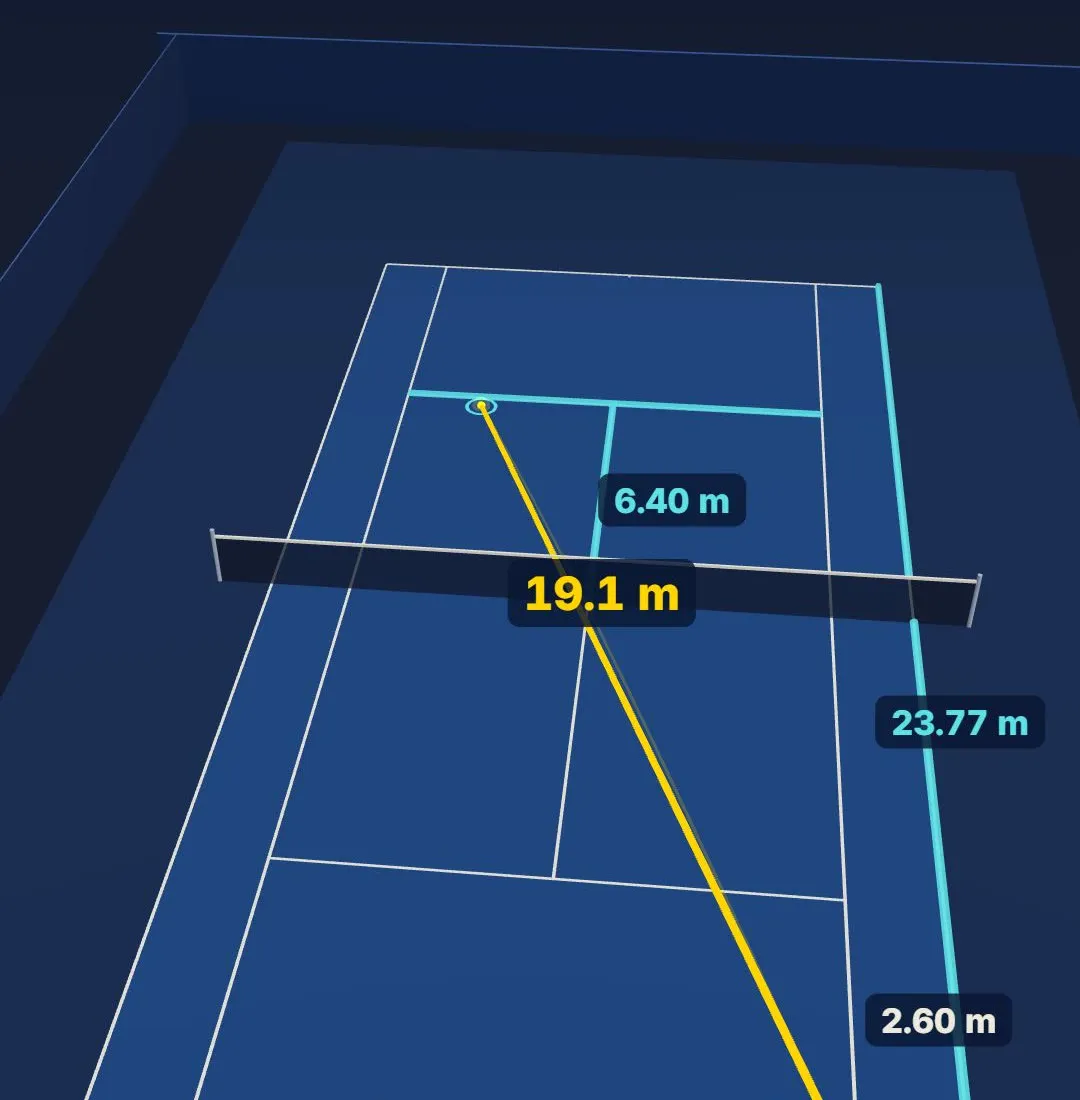
Figure 1. The court lines are a ruler: 23.77 m along the sideline, 6.40 m net to service line. The serve flew 19.1 m. (3D illustration.)
What does the radar number mean?
Radar says 153 km/h. A video app says 129 for the same serve. Both can be right.
A radar gun behind the server reads the ball’s speed at impact, the length of its velocity vector as it leaves the strings, to within 3% of the reading.1 That’s the peak: the fastest the ball ever goes.
Where does the speed go?
Into the air. At 30 m/s (108 km/h) the air pushes back on a tennis ball with 0.93 N, while the ball weighs 0.56 N.2 That push grows with the square of the speed, so twice as fast means four times the push.
Our example serve, 153 km/h, feels 1.9 N, 3.4 times its weight. In 0.533 seconds it slows to about 110 km/h at the bounce. That’s 43 km/h gone.
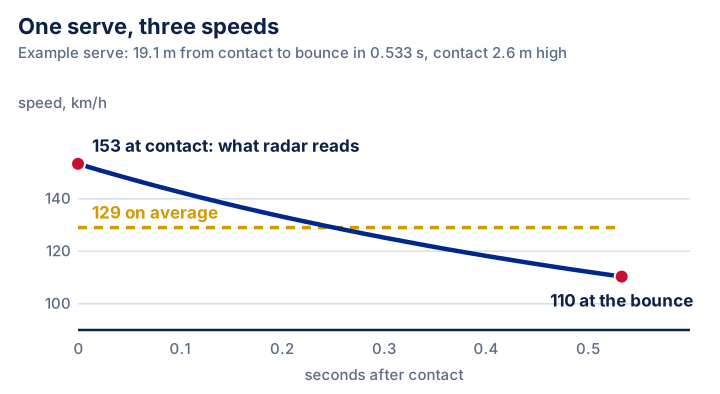
Figure 2. One serve, three speeds. The average is distance divided by time, so it is neither of the other two.
So 129 isn’t the ball’s speed at any moment. It’s the average of the trip.
Where does 129 come from?
Distance over time: 19.1 m from the contact point to the bounce in 0.533 s is 35.8 m/s, or 129 km/h. A video gives you both numbers. The court lines are the ruler.3 Counting frames is the clock: 16 frames at 30 per second is 0.533 s.
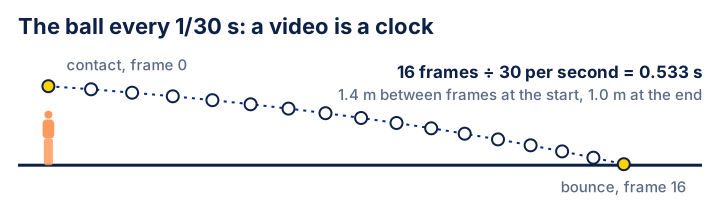
Figure 3. Sixteen frames from contact to bounce. The dots bunch up as the ball slows.
So how do you get back to 153? Run the flight backwards. A ball launched at only 129 km/h would land 1.9 m short. To cover 19.1 m in 0.533 s, this serve had to leave the racket at 153. In our model, a flat serve that lands about 19 m away has a peak about 1.19 times its average.
The MyTennis app measures serve speed from video in this way: distance and frame count for the average, then a gravity-and-drag flight model for the peak.
Three ways to misread a serve speed
- Comparing 129 with a radar’s 153. They measure different things. Compare a peak with a peak.
- Calling the average your hit. Here it’s 24 km/h low.
- Trusting the last digit. Radar is good to 3%, about 5 km/h at 153.1 A 30 fps video times the flight to the nearest frame, 6% of this serve’s flight.
Try it this week: clock your serve
- Film a serve from the side at 30 frames per second.
- Count the frames from contact to the bounce and divide by 30.
- Divide the distance (about 18 to 19 m if it lands near the service line) by that time, and multiply by 3.6 for km/h. That’s your average. For a flat serve, multiply by 1.19 for a peak guide.
How we got the numbers
Our model has gravity and air drag with Cross and Lindsey’s drag coefficient, 0.507, and no spin.2 We solved for the launch speed and angle that carry the ball 19.1 m from a 2.6 m contact point in 0.533 s, the measured flight of a real serve filmed at 30 frames per second. A drag coefficient 20% higher, closer to wind-tunnel values, would put the peak near 160 km/h instead of 153. Treat the numbers as a guide.
References
-
Nathan Sandholtz, Ryan Hanson, Ronald L. Hager, Stephanie Kovalchik and Gilbert W. Fellingham, “Stated, Realized, and Optimal Aiming Strategies for the Tennis Serve: Experimental Evidence from Collegiate Athletes,” arXiv:2607.28500v2, 30 September 2026. A Stalker Solo 2 radar gun behind the server; reported speeds are the scalar magnitude of the serve velocity vector at impact, accuracy 3% of the reading (footnote 4). https://arxiv.org/pdf/2607.28500 ↩ ↩2
-
Rod Cross and Crawford Lindsey, “Tennis Ball Trajectories: The Role of Aerodynamic Drag and Lift in Tennis Shots,” Tennis Warehouse University, 22 December 2013. At 30 m/s drag is 0.93 N against 0.56 N of gravity; mean free-flight drag coefficient 0.507, 15-20% lower than in wind tunnels. https://twu.tennis-warehouse.com/learning_center/aerodynamics2.php ↩ ↩2
-
International Tennis Federation, Rules of Tennis 2026, Rule 1 (The Court): 23.77 m long; the service lines are 6.40 m from the net. https://www.itftennis.com/media/7221/2026-rules-of-tennis-english.pdf ↩