Tennis science · Ball physics
Why does a kick serve jump up at you?
At 135 km/h the air pushes back on the ball 2.6 times harder than gravity pulls it down, and topspin adds a downward push. Here's what that does to the bounce.
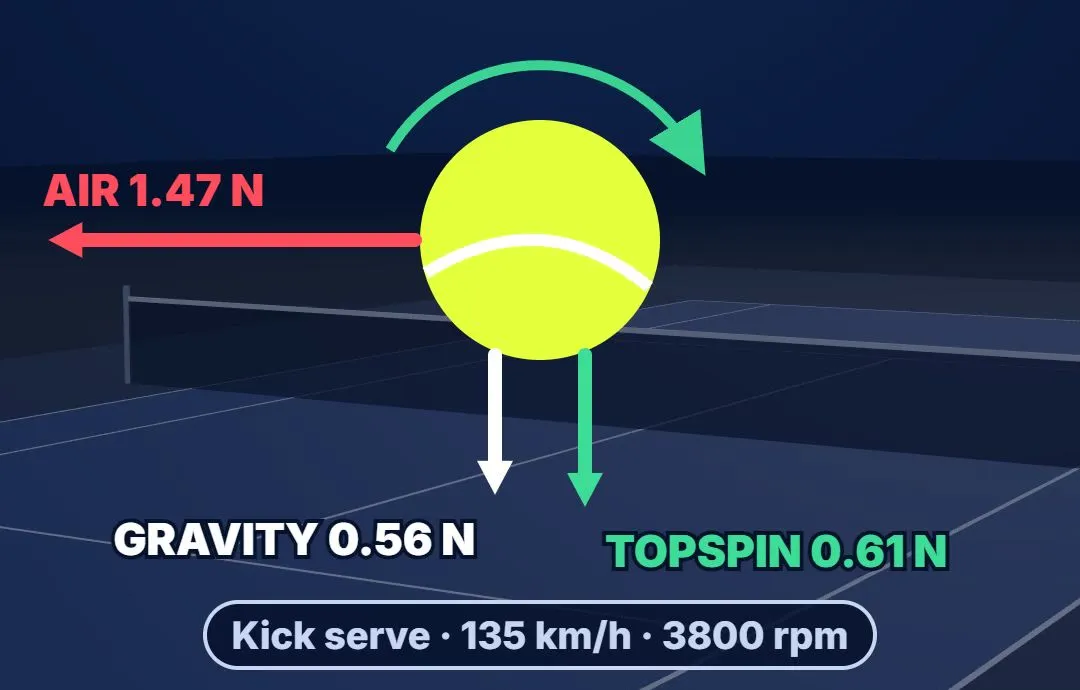
Figure 1. Three forces on a kick serve just after the racket (our model). The air pushes back, gravity pulls down, and topspin adds a second downward push.
Is gravity really in charge?
You’re returning. The serve clears the net by nearly half a metre, which looks like it’s going long. It lands inside the box anyway, then jumps up to head height. Gravity alone can’t do that.
At 30 m/s (108 km/h) the air pushes back on a tennis ball with about 0.93 N, while gravity pulls it down with 0.56 N.1 At a kick serve’s 135 km/h our model puts the air at 1.47 N, 2.6 times the ball’s weight.
That push slows the ball. The dive comes from a second air force.
What does topspin add?
A spinning ball is pushed by the air at right angles to its flight path. Cross and Lindsey call it lift, but for topspin it points down.1 At 3,800 rpm and 135 km/h we get 0.61 N, a little more than the ball’s weight.
So just after the racket, the ball is pulled down about twice as hard as gravity alone would. What does that do to the flight?
How can it clear the net by half a metre?
Take two serves hit from 2.7 m that land in the same spot, 16.8 m from the server. The flat serve (170 km/h, 1,200 rpm) has to be aimed 5.4 degrees down and skims the net by 0.16 m. The kick (135 km/h, 3,800 rpm) leaves almost level, clears the net by 0.47 m, and the spin pulls it into the box.
It arrives at 18.5 degrees against 13.3 for the flat serve.
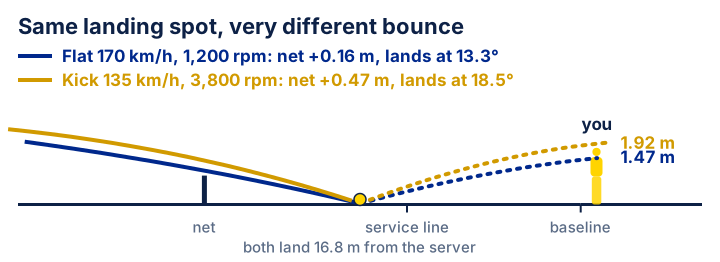
Figure 2. Same landing spot. The kick is steeper in and higher out. (After the bounce: a simple model, see the last section.)
Why does it jump?
The kick is slower (102 km/h at landing, against 127) but steeper, so it still hits the court harder downward: about 9 m/s against 8. A hard court sends back about 75% of that vertical speed.2
In our model that puts the kick 1.92 m up when it reaches a returner standing 0.5 m behind the baseline, 45 cm above the flat serve.
What do you do with that?
Serving: aim over the net with room to spare and let the spin bring it down.
Returning: expect it higher than a flat serve, and about 0.2 s later (0.99 s after the hit, against 0.78 s).
Two traps when you read the kick
- Taking the spin off. In our model, the same swing without the spin lands the ball 4.2 m past the service line.
- Trusting 1.92 m everywhere. Our bounce is a simple rule. Cross puts the vertical rebound at about 0.75 on a hard court, 0.6 to 0.75 on grass and about 0.85 on clay.2
Try it this week: find your spot
- Ask a partner to hit 10 kick serves to your forehand side.
- Return 5 from the baseline and 5 from one big step behind it.
- Count the clean returns from each spot. The better one is your starting point.
How we got the numbers
The paths come from our ball-flight model with Cross and Lindsey’s drag coefficient (0.507) and a spin lift of 0.6 times the spin ratio, capped at 0.3, which sits inside their measured range.1 Both serves are hit from 2.7 m, no wind. After the bounce the ball keeps 75% of its vertical speed2 and 65% of its horizontal speed (our assumption); we ignore spin at the bounce. Treat the heights and times as a guide.
References
-
Rod Cross and Crawford Lindsey, “Tennis Ball Trajectories: The Role of Aerodynamic Drag and Lift in Tennis Shots,” Tennis Warehouse University, 22 December 2013. At 30 m/s drag is 0.93 N against 0.56 N of gravity; drag coefficient 0.507; lift coefficient 0.1 to 0.3 for spin ratios 0.14 to 0.53, negative (downward) for topspin. https://twu.tennis-warehouse.com/learning_center/aerodynamics2.php ↩ ↩2 ↩3
-
Rod Cross, “Tennis physics, anyone?,” Physics Today 61(9):84-85, September 2008. Vertical coefficient of restitution about 0.75 on a hard court, 0.6 to 0.75 on grass and about 0.85 on clay. https://aip.brightspotcdn.com/PTO.v61.i9.84_1.online.pdf ↩ ↩2 ↩3