Tennis science · Racket and strings
Should you string looser for more power?
Forty-one players hit 1,312 forehands at three tensions. Strings 22 lb looser added just 2.8 km/h. So what did change, and what should you do about it?
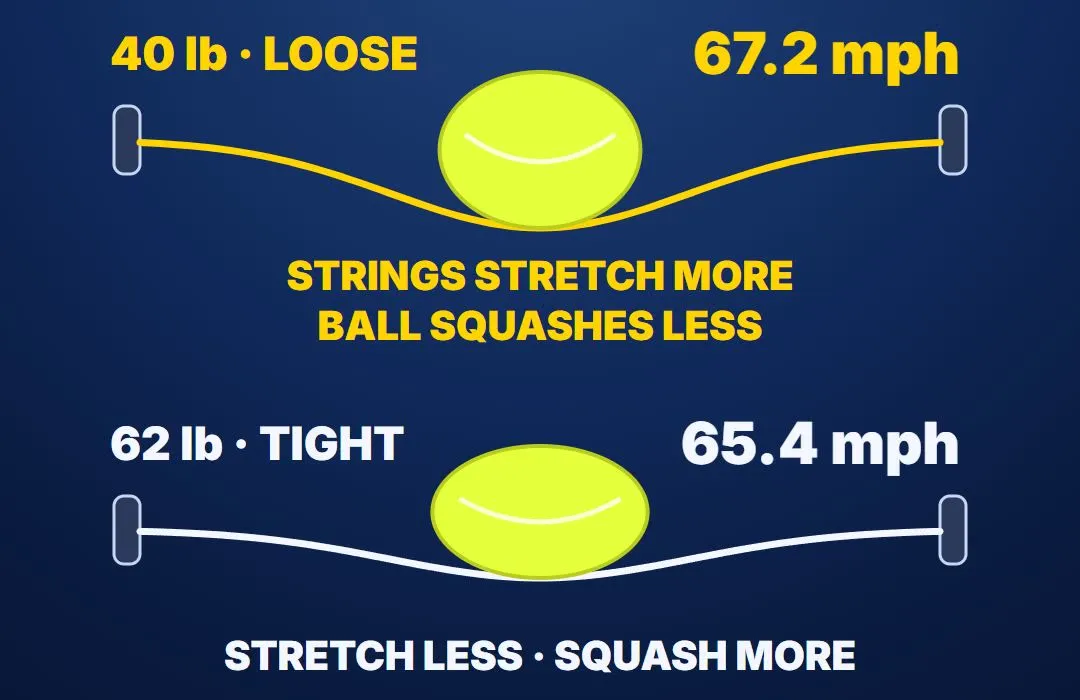
Figure 1. Same racket, 22 lb apart. The looser bed stretches more and the ball squashes less. (Illustration, not to scale.)
How much power do looser strings add?
Your forehand feels flat, and the stringer asks what tension you want. Drop a few pounds and get free power, right?
Researchers in Sydney tested exactly that. Forty-one advanced club players hit 1,312 forehands with three identical rackets strung at 40, 51 and 62 lb, without knowing which was which. A radar gun measured every ball.1
The loosest racket won by 2.8 km/h: 108.1 against 105.3 km/h. That’s under 3% for a 22 lb drop.
So if the speed barely moved, what did?
Where did the difference go?
Into where the ball landed. An observer marked every forehand in, long, wide or net. At 40 lb, 17% flew long. At 62 lb, only 7% did, but 18% went into the net instead of 11%.1
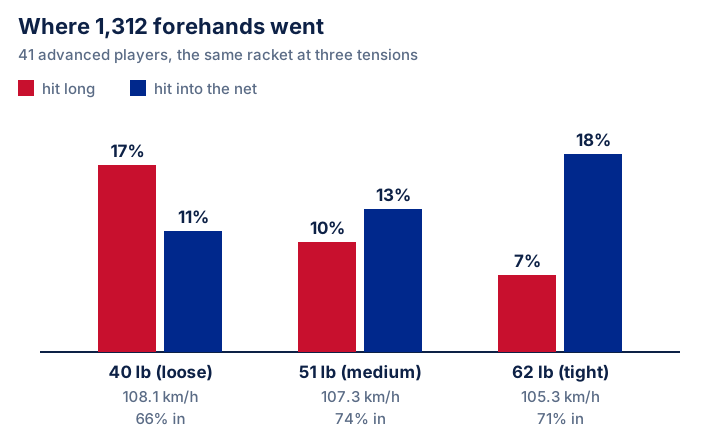
Figure 2. Tension barely moves the speed. It moves the miss. The middle racket put the most balls in.
That’s 2.4 times as many balls long, from less than 3% more speed. What else changed?
Why does a loose racket send it long?
Start with the speed. Strings are very elastic and give back about 90-95% of the energy they store.2 The ball is not: dropped on a hard court, it comes back up at only about 75% of the speed it came down.3 Looser strings stretch more, so the ball squashes less, wastes less energy, and leaves a little faster.2
Then the angle. The authors estimate that loose strings send a topspin forehand off about 2 degrees higher.1 That sounds like nothing. In our model, the extra speed alone moves the landing spot 0.7 m deeper. Add the 2 degrees and the same swing lands 2.8 m deeper, past the baseline.
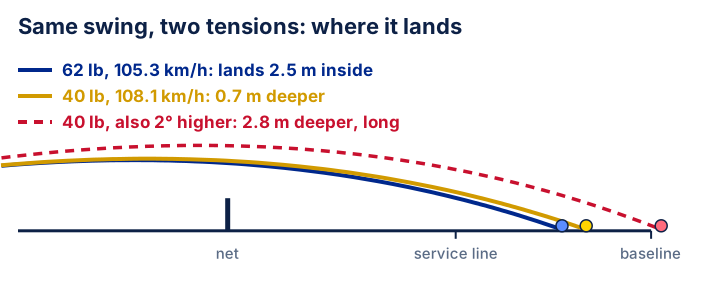
Figure 3. Same swing at 40 lb: a little deeper from the speed, a lot deeper from the launch angle.
So which way should you go?
Let your misses decide. Finding the net a lot? String a few pounds looser. Flying long? A few pounds tighter. That’s the authors’ own advice.1
Move a few pounds at a time. The test compared rackets 22 lb apart, so a smaller change gives a smaller shift.
Three traps when you string looser
- Restringing for power. You’d buy a few km/h and a different miss. Fix the miss you actually have.
- Trusting your hand. The same players were poor at telling which racket was strung tighter. Count your misses instead.
- Judging in ten minutes. The players in the test had no time to adjust to each racket. Give a new tension a few sessions.
How we got the numbers
Speeds and percentages are from Bower and Cross: one racket model, one nylon string, balls fed by a machine at 75 km/h.1 The ball paths come from our ball-flight model with Cross and Lindsey’s drag and lift coefficients:4 contact 1.0 m high and 0.3 m behind the baseline, 2,200 rpm of topspin, the 62 lb ball at 105.3 km/h aimed 2.5 m inside the baseline, the 40 lb ball at 108.1 km/h at the same angle, then 2 degrees higher. Treat the depths as a guide.
References
-
Rob Bower and Rod Cross, “String tension effects on tennis ball rebound speed and accuracy during playing conditions,” Journal of Sports Sciences 23(7):765-771, 2005. The test set-up, rebound speeds (Table II), where the balls landed (Table III), the 2-degree estimate, the advice on long and net errors, and the players’ poor feel for tension. https://doi.org/10.1080/02640410400021914 ↩ ↩2 ↩3 ↩4 ↩5
-
International Tennis Federation, “Strings,” November 2019. Strings return around 90-95% of their energy; looser strings deform more, so the ball stores and loses less and leaves faster. https://www.itftennis.com/media/2155/equipment-strings.pdf ↩ ↩2
-
Rod Cross, “Tennis physics, anyone?,” Physics Today 61(9):84-85, September 2008. Racket strings are highly elastic; a ball bouncing on a hard court rebounds at about 0.75 of its vertical incoming speed. https://aip.brightspotcdn.com/PTO.v61.i9.84_1.online.pdf ↩
-
Rod Cross and Crawford Lindsey, “Tennis Ball Trajectories: The Role of Aerodynamic Drag and Lift in Tennis Shots,” Tennis Warehouse University, 22 December 2013. Drag and spin-lift coefficients for the ball paths. https://twu.tennis-warehouse.com/learning_center/aerodynamics2.php ↩