Rules & etiquette · Etiquette
You think it was out, but you're not sure. Call it?
With no umpire, 'probably out' means good. Here is whose calls are whose, how fast to make them, and what the ITF rulebook doesn't say.
Third set, 5-5. Your opponent’s forehand lands near your baseline, and you think it was out. Probably. Do you call it?
The USTA’s Code says no. You may call a ball out only if you clearly see space between it and the line, and “probably” means it’s good.1
Who makes the calls when nobody is officiating?
The ITF Rules of Tennis don’t say. They describe what line umpires and chair umpires do, and nothing about players without them.2 The gap is filled by The Code, the USTA’s guide to fair play, and USTA regulations require players to follow it in matches without officials.1 It is a USTA document, so check your own league’s rules if you play elsewhere.
The ITF’s procedures for tournament referees assume the same split: the player on each side of the net makes the calls for that side.3 The Code’s first rule of calling says it plainly: you call the balls that land on, or head for, your side. Your opponent calls theirs.1
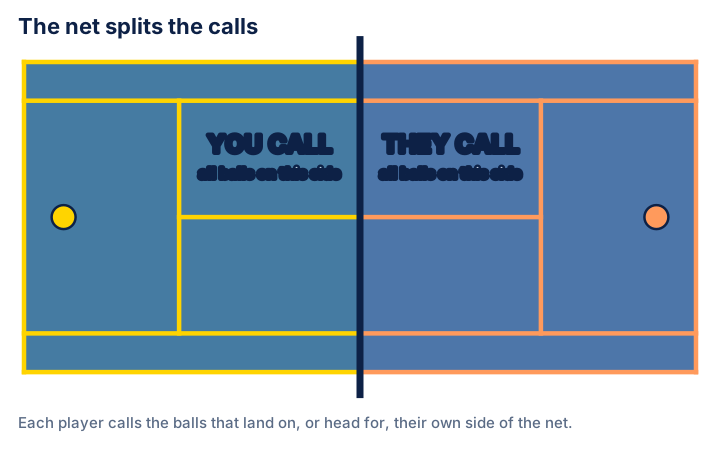
Figure 1. The net splits the calls. Yellow lines are yours to call, orange lines are theirs.
In doubles either partner may call, but the one looking down the line is more likely to be right. If one partner calls “out” and the other saw it good, the ball is good.1
That settles whose call it is. How sure do you have to be?
How sure do you have to be?
Sure. Any doubt goes to your opponent.1 A ball that touches any part of the line is good, and a ball you can’t call out with certainty is good too. You can’t ask for a let because you didn’t see it.1
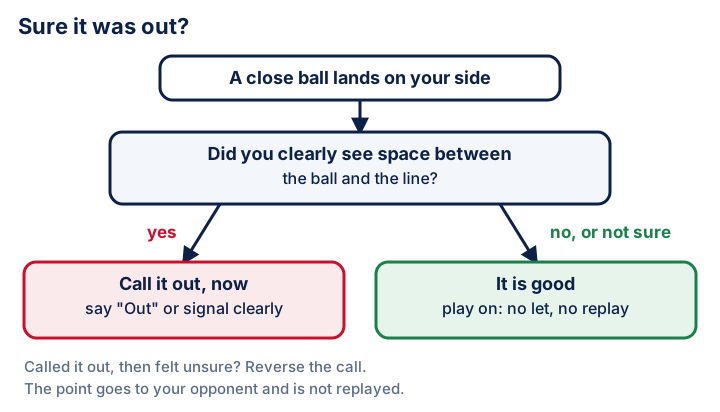
Figure 2. The whole check. If you can’t answer yes with certainty, the ball is good.
Called it out, and a second later you’re not so sure? Take the call back. The point goes to your opponent, and it is not replayed.1
How fast, and how loud?
At once. The call has to come before your return goes out of play, or before your opponent has had a chance to play it.1 And it has to be heard or seen: however obvious it is that the ball is out, your opponent is entitled to a prompt audible or visible out call.1
That ends the “two chances” trick, where you play the ball and only call it out if you lose the point.1
Four ways calls go wrong
- Offering a replay. “Not sure, let’s play it again” is not an option. A ball you can’t call out is good.
- Calling late. Play the ball, lose the point, then call it out? Too late.
- Staying silent. An obvious out still needs a call your opponent can hear or see.
- Hiding your own out ball. If you clearly see your own shot land out, call it, even if nobody asks. The exception is your first serve.1
References
-
United States Tennis Association, Friend at Court 2026, Part 2 “The Code” (the players’ guide to fair play): items 5 (each player calls their own side), 6 and 8 (any doubt goes to the opponent; a ball that cannot be called out is good; no let for not seeing it), 7 (any part of the line is good; call out only if you clearly see space), 9 and 14 (doubles partners), 12 (reversing an out call), 13 (calling your own shots out), 15 and 17 (prompt, audible or visible calls); glossary entry “The Code” (USTA Regulation IV.B requires players to follow it in matches without officials). https://www.usta.com/content/dam/usta/coach-organize/content-fragments/resource-library/assets/pdfs/friend-at-court.pdf ↩ ↩2 ↩3 ↩4 ↩5 ↩6 ↩7 ↩8 ↩9 ↩10 ↩11
-
International Tennis Federation, Rules of Tennis 2026, Rule 28 and Appendix VII (Role of court officials): the rules text assigns calls to line umpires and the chair umpire and gives no guidance for matches without officials. https://www.itftennis.com/media/7221/2026-rules-of-tennis-english.pdf ↩
-
International Tennis Federation, “Procedures for Referees: Matches played without a chair umpire” (undated copy hosted by the Croatian Tennis Federation; file metadata names ITF Licensing (UK) Ltd). For a disputed line call the referee asks the player who made the call, on their own side of the net, whether they are sure, and if so the call stands. https://hts.hr/wp-content/uploads/__2019/07/Matches_without_CU-Guidelines_for_Referees.pdf ↩