Return · Second serve return
Second serve coming: step in, or stay put?
A second serve gives you 0.43 s more than a big first serve. Step in 2 m, as coaches advise, and you spend only 0.16 s of it.
How much time does a second serve give you?
It’s 30-all. Their first serve hit the net. The second is coming and you’re standing exactly where you stood for the first.
In our model a 170 km/h first serve reaches the baseline 0.75 s after it’s hit. A 110 km/h topspin second serve (our example) takes 1.18 s. That’s 0.43 s more.
What do you do with an extra 0.43 s?
Where do you spend it?
On position. The USTA’s advice for a second serve is short: take a step in, and be ready to be aggressive with depth and spin.1 A coach is more specific: stand two or three steps inside your first-serve spot and meet the ball on the rise, before it peaks.2
Two to three steps is about 2 m (our estimate). In our model that costs 0.16 s. You still have 1.03 s, which is 0.27 s more than the first serve gave you at the baseline.
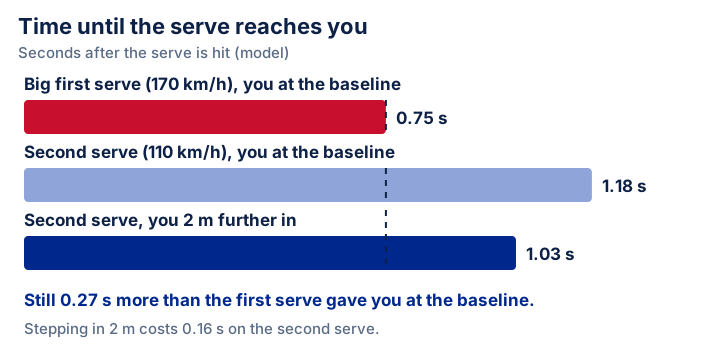
Figure 1. Even 2 m closer, the second serve gives you more time than the first.
The same coach says what the step buys: pressure on the server, who may serve even weaker or double fault, and some balls hit from inside the baseline.2
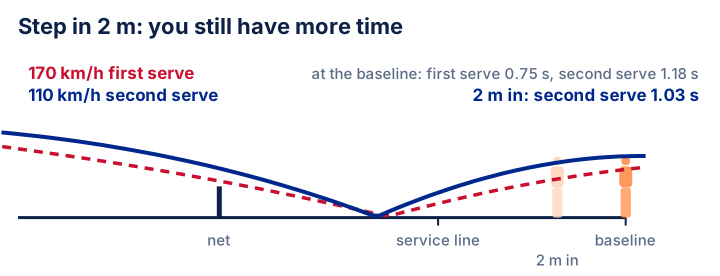
Figure 2. The step puts you earlier on the ball’s path, with time to spare.
So what do you do with the ball?
What do you do with the ball?
Use the time. A slower ball lets you lengthen your swing and add pace of your own, which takes time away from the server, and it gives you more options.3 Two good ones: send it away from the server to get them moving,2 or hit to their weaker side.3 If you’d rather hit hard, make it deep and down the middle.2
Is there a serve that wrecks this plan?
What if it’s a heavy kick?
Yes. Kick serves are often hard to attack, especially into the backhand, because the ball jumps up high.4 Our model can’t show that, because it gives every serve the same bounce, so a real kick arrives higher than our numbers. If a kick is beating you, you can always take a step or two back.2
Three ways to squander the extra 0.43 s
- Stepping in on first serves. At about 0.05 s a metre, 2 m in takes 0.10 s from a flight that lasts 0.75 s.
- Stepping in, then pushing it back. The step buys time for a full swing. Spend it on depth and spin.1
- Charging a kick you can’t handle. Move back until you can take it comfortably.
Try it this week: second serves only
Your partner serves only second serves. Return from three spots in turn: on the baseline, 1 m in, 2 m in. Take ten from each and count the returns that land past the service line. Keep the spot where you attack most and miss least.
How we got the numbers
The serves come from our ball-flight model (drag and spin lift from Cross and Lindsey5), hit from 2.7 m. First serve: 170 km/h, 1,200 rpm. Second serve: 110 km/h, 3,000 rpm, an example and not a statistic. After the bounce the ball keeps 75% of its vertical speed (hard court6) and 65% of its horizontal speed (our assumption; at 55% or 75%, stepping in 2 m costs 0.19 or 0.14 s and still leaves 0.28 or 0.26 s more than the first serve). Treat the numbers as a guide.
References
-
USTA, “Tennis strategy: Returning first and second serves,” 6 October 2021. Against a second serve, take a step in and be ready to be aggressive with depth and spin. https://www.usta.com/en/home/improve/tips-and-instruction/national/tennis-strategy--returning-first-and-second-serves.html ↩ ↩2
-
Steve Annacone, “Tip of the Week: Attack Your Opponent’s Second Serve,” New York Tennis Magazine, 3 April 2019. Stand two or three steps inside the first-serve returning position, hit on the rise, send the ball away from the server or deep down the middle, and step back if uncomfortable. https://newyorktennismagazine.com/?p=26752 ↩ ↩2 ↩3 ↩4 ↩5
-
Matt Smith, LTA, “Simple steps to improve your return of serve” (undated). Second serve: a slower ball gives more time to lengthen the swing and add your own pace, and more options, such as hitting to the weaker side. https://www.lta.org.uk/play/tennis-tips-and-techniques/simple-steps-to-improve-your-return-of-serve/ ↩ ↩2
-
Matt Smith, LTA, “How to improve your second serve: Expert tips & techniques” (undated). Kick serves are often quite hard to attack, especially into the backhand, because the ball jumps up high. https://www.lta.org.uk/play/tennis-tips-and-techniques/how-to-improve-your-second-serve/ ↩
-
Rod Cross and Crawford Lindsey, “Tennis Ball Trajectories: The Role of Aerodynamic Drag and Lift in Tennis Shots,” Tennis Warehouse University, 22 December 2013. Drag and spin-lift coefficients. https://twu.tennis-warehouse.com/learning_center/aerodynamics2.php ↩
-
Rod Cross, “Tennis physics, anyone?,” Physics Today 61(9):84-85, September 2008. A ball bouncing on a hard court has a vertical rebound coefficient of about 0.75. https://aip.brightspotcdn.com/PTO.v61.i9.84_1.online.pdf ↩