Return · Reading the server
Big serve coming: watch the ball or the server?
A 170 km/h serve reaches you in 0.78 seconds, and even the simplest reaction eats 0.21 of them. Here's what to watch while the server is still setting up.
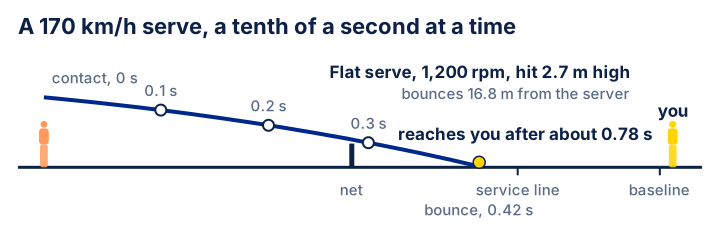
Figure 1. A flat 170 km/h serve is on the ground 0.42 s after contact and reaches you about 0.78 s after it.
How long do you really have?
The toss goes up. You watch the ball, exactly as you were taught. The serve is past you before your feet have moved.
Our model says why. A flat 170 km/h serve takes about 0.78 seconds to reach you, standing half a metre behind the baseline.1 It bounces after 0.42 s and needs another 0.36 s to get to you. That’s everything you get: seeing it, choosing a side, stepping and swinging.
Where does the time go?
Before you can do anything, your brain has to start a response. The quickest kind, tapping a key the moment a target appears, takes about 0.21 seconds. In a study of 1,469 people the average was 231 milliseconds, or 213 once the equipment’s own delay was removed.2
That is 27% of your 0.78 seconds, for the simplest task there is. A real return also needs a direction and a swing.
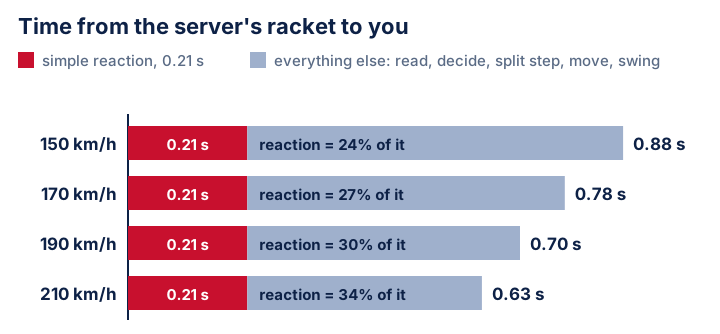
Figure 2. The faster the serve, the bigger the slice the reaction takes. At 210 km/h it is a third.
So if you can’t react faster, what can you do?
What can you read before the ball is hit?
Start earlier. In a lab study, experts and novices watched films of serves and had to name the serve coming. While the server prepared, the experts looked at the shoulder and trunk area. The novices searched around the server’s head.3
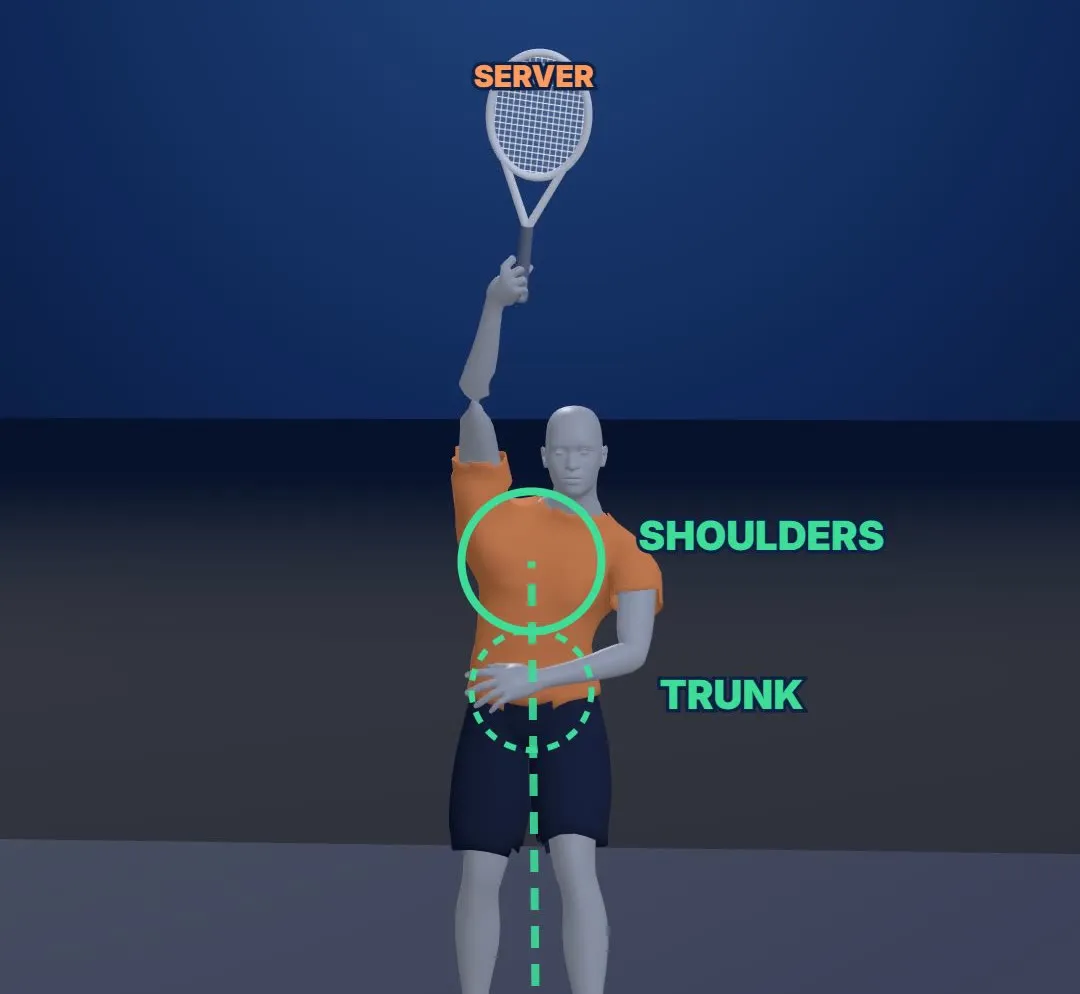
Figure 3. The experts’ first look: shoulders and trunk, not the head. (Mannequin, 3D illustration.)
That skill can be trained. Players who got perceptual training improved on both lab and field tests of anticipation, compared with placebo and control groups.4
So the order on a big serve is: read the server, split step as they hit, then track the ball. The ball is still what you hit. It just can’t be your first clue.
Three ways to misread the server
- Staring at the server’s face. That was the novices’ habit in the study. Drop your eyes to the shoulders and trunk.
- Waiting for contact. The 0.78 s clock starts when the racket meets the ball. If your first clue is the ball leaving it, you’ve thrown away your head start.
- Trusting 0.21 s. That’s a key tap in a lab. A return takes longer, so the early clue matters even more.
Try it this week: ball first, then server
- Ask a partner to serve 10 balls at match pace.
- For the first 5, watch the ball from the toss. For the next 5, watch the shoulders and trunk, split step as they hit, then pick up the ball.
- Count the clean returns each way. Ten balls is a feel, not a study, but you’ll know which one you trust. Swap the order next time.
How we got the numbers
Serve times come from our ball-flight model with Cross and Lindsey’s drag and lift coefficients:1 a flat serve at 1,200 rpm, hit from 2.7 m high, landing 16.8 m from the server, with you 0.5 m behind the baseline. After the bounce we assume the ball keeps 75% of its vertical speed (a hard court5) and 65% of its horizontal speed (our guess); at 60-80% the total moves between 0.71 and 0.81 s. The 0.21 s is the key-tap figure above. Treat all of it as a guide.
References
-
Rod Cross and Crawford Lindsey, “Tennis Ball Trajectories: The Role of Aerodynamic Drag and Lift in Tennis Shots,” Tennis Warehouse University, 22 December 2013. The drag coefficient (0.507) and the spin-lift coefficients used for the ball path. https://twu.tennis-warehouse.com/learning_center/aerodynamics2.php ↩ ↩2
-
David L. Woods, John M. Wyma, E. William Yund, Timothy J. Herron and Bruce Reed, “Factors influencing the latency of simple reaction time,” Frontiers in Human Neuroscience 9:131, 2015. In 1,469 adults the mean simple reaction time was 231 ms, 213 ms when corrected for hardware delays. https://doi.org/10.3389/fnhum.2015.00131 ↩
-
C. Goulet, C. Bard and M. Fleury, “Expertise differences in preparing to return a tennis serve: A visual information processing approach,” Journal of Sport and Exercise Psychology 11(4):382-398, 1989. Experts and novices judged filmed serves; the abstract reports that in the “ritual phase” before the serve experts look at the shoulder and trunk areas, novices around the server’s head. https://doi.org/10.1123/jsep.11.4.382 ↩
-
A. M. Williams, P. Ward, J. M. Knowles and N. J. Smeeton, “Anticipation skill in a real-world task: measurement, training, and transfer in tennis,” Journal of Experimental Psychology: Applied 8(4):259-270, 2002. Players who received perceptual training improved on lab- and field-based tests of anticipation, relative to placebo and control groups (abstract). https://pubmed.ncbi.nlm.nih.gov/12570100/ ↩
-
Rod Cross, “Tennis physics, anyone?,” Physics Today 61(9):84-85, September 2008. A ball bouncing on a hard court rebounds at about 0.75 of its vertical incoming speed. https://aip.brightspotcdn.com/PTO.v61.i9.84_1.online.pdf ↩