Return · Return position
Step back to return a big serve: what do you really buy?
Two metres further back buys 0.10 s on a 170 km/h serve, about half a simple reaction time. The cost is angle: you meet the wide serve 0.55 m further out.
What does one step back really buy?
You’ve just been aced twice, so you drop back behind the baseline. It feels like a lot of extra time.
It isn’t. A 170 km/h flat serve reaches you at the baseline 0.75 s after it’s hit. Stand 2 m further back and it arrives at 0.86 s. That is 0.10 s, about half of the 0.21 s a simple lab reaction takes.1 Coaches say each step back gives a little extra time;2 in our model that is about 0.05 s a metre.
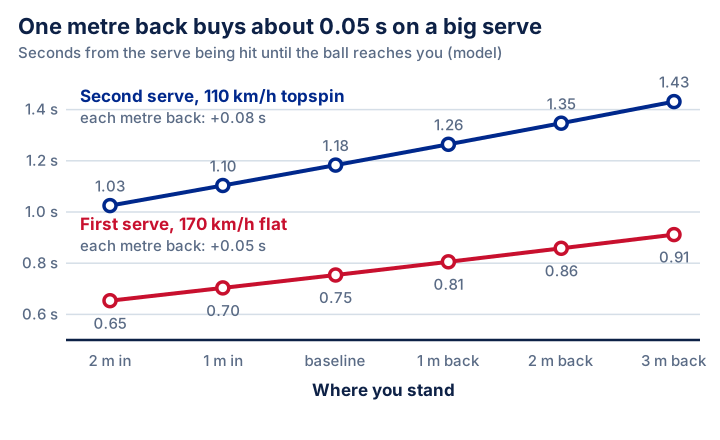
Figure 1. Each metre back adds about 0.05 s against the big first serve and about 0.08 s against the slower second serve.
So why not stand deep every time? The time isn’t free.
What does the extra time cost?
Angle. Every serve leaves the server from one spot, so the T serve and the wide serve keep fanning apart as they travel.
Take a deuce-court serve that lands half a metre inside the line. At the baseline the two serves are 4.4 m apart, and the wide one is already on the doubles sideline. From 3 m back they are 5.0 m apart and you meet the wide ball 0.9 m outside the doubles sideline. From 1 m inside the baseline they are 4.2 m apart and the wide ball is still inside it.
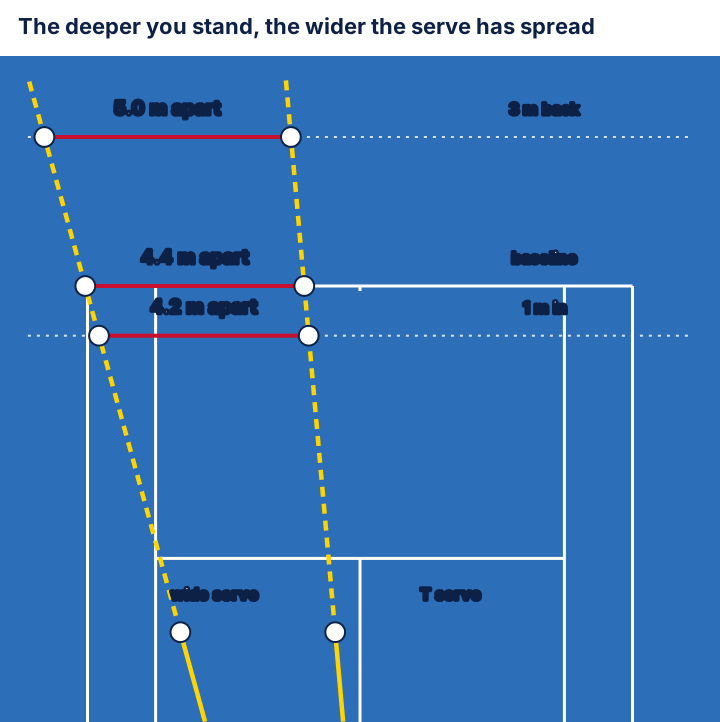
Figure 2. Each metre you stand further back, the serve has spread another 0.19 m, and the wide serve is another 0.28 m outside the court.
Time on one side, angle on the other. Which one are you short of?
Which one are you short of?
Against a big first serve it’s time. An LTA coach suggests standing further back against a fast serve and further in against a slow one.3
A second serve leaves time to spare, so spend it on position. Our 110 km/h topspin example reaches the baseline 0.43 s after the big first serve. Step in 2 m and it still takes 1.03 s, 0.27 s more than the first serve gave you from the baseline, and you meet the wide ball 0.55 m further in.
Three ways to step out of position
- Backing up against everything. On slow serves you pay in angle for time you didn’t need.
- Stepping in on a serve you can’t pick up. A metre in costs about 0.05 s, a tenth of the 0.54 s a big serve leaves after your reaction.
- Going deep, then getting dragged wide. From 3 m back the wide serve arrives 0.9 m outside the sideline, so the time you bought goes on running.
Try it this week: three spots
Put cones 1 m inside the baseline, on it, and 2 m behind it. Your partner serves six balls at each cone, first serves, then seconds. Count the returns in play from each spot and note which felt rushed and which felt wide. Next match, pick the spot by the serve you face.
How we got the numbers
The serves come from our ball-flight model (drag and spin lift from Cross and Lindsey4), hit from 2.7 m on an ITF-sized court.5 First serve: 170 km/h, 1,200 rpm. Second serve: 110 km/h, 3,000 rpm. After the bounce the ball keeps 75% of its vertical speed (hard court6) and 65% of its horizontal speed (our assumption; at 55% or 75%, a metre back is worth 0.06 or 0.045 s on the first serve). The top view puts the server 1 m from the centre mark and lets the ball keep its sideways direction after the bounce, which slice and kick serves don’t. Treat the numbers as a guide.
References
-
David L. Woods, John M. Wyma, E. William Yund, Timothy J. Herron and Bruce Reed, “Factors influencing the latency of simple reaction time,” Frontiers in Human Neuroscience 9:131, 2015. In 1,469 adults the mean simple reaction time was 231 ms, or 213 ms after correcting for hardware delay. https://doi.org/10.3389/fnhum.2015.00131 ↩
-
Dennis Van der Meer, “7 Tips for Return of Serve,” Active.com, updated 9 September 2013. Each step you stand further back gives a little extra time to meet the ball. https://www.active.com/tennis/Articles/7-Tips-Return-Serve.htm ↩
-
Matt Smith, LTA, “Simple steps to improve your return of serve” (undated). Stand further back against a fast serve to gain time, a bit further in against a slow one. https://www.lta.org.uk/play/tennis-tips-and-techniques/simple-steps-to-improve-your-return-of-serve/ ↩
-
Rod Cross and Crawford Lindsey, “Tennis Ball Trajectories: The Role of Aerodynamic Drag and Lift in Tennis Shots,” Tennis Warehouse University, 22 December 2013. Drag and spin-lift coefficients. https://twu.tennis-warehouse.com/learning_center/aerodynamics2.php ↩
-
International Tennis Federation, Rules of Tennis 2026, Rule 1 (The Court): 23.77 m long, 10.97 m wide for doubles, 8.23 m for singles, service lines 6.40 m from the net; Rule 17: the serve lands in the diagonally opposite service court. https://www.itftennis.com/media/7221/2026-rules-of-tennis-english.pdf ↩
-
Rod Cross, “Tennis physics, anyone?,” Physics Today 61(9):84-85, September 2008. A ball bouncing on a hard court has a vertical rebound coefficient of about 0.75. https://aip.brightspotcdn.com/PTO.v61.i9.84_1.online.pdf ↩