Return · Big serves
Big serve: block it, or swing at it?
Hold the racket still and a 170 km/h serve comes back at about 28 km/h, far short of the net. A block needs a little swing, and much less backswing.
What happens if you just hold the racket?
You get there in time, racket out in front, braced like a wall. The ball hits the strings and drops on your own side of the net.
Here is why. A 170 km/h flat serve reaches your racket, half a metre behind the baseline, at about 70 km/h and 0.78 s after it was hit. A racket held still sends the ball back at about 40% of its incoming speed when it meets the middle of the strings.1 That is 28 km/h. Even with the strings tilted for the longest possible lob, the ball carries 7 m. The net is 12 m away.
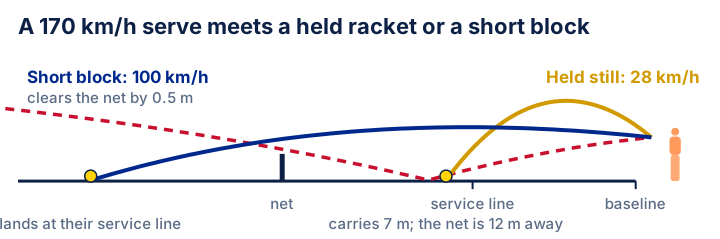
Figure 1. The same serve, two returns. Held still, the ball dies in front of you.
So how much racket do you need?
How much swing is enough?
Less than you’d think. In our model the ball leaves at 40% of its arrival speed plus 1.4 times the racket’s speed. To send this serve back at 100 km/h, half a metre over the net and landing near the service line, the racket needs about 14 m/s (51 km/h). The serve supplies 28 of those 100 km/h. Your racket supplies the other 72.
Now compare a slow second serve (110 km/h topspin). It arrives at 44 km/h, so the same return needs 16 m/s. That is only 2 m/s more racket speed. What changes is the time: 0.78 s for the big serve, 1.23 s for the second.
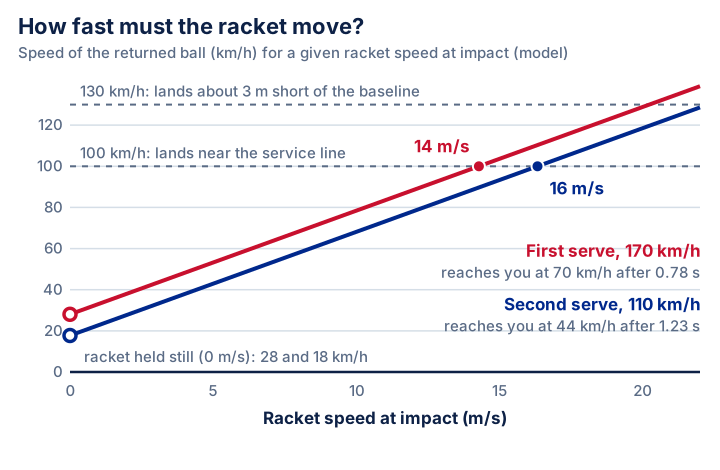
Figure 2. A big serve doesn’t ask for a softer swing. It asks for the same swing in less time.
So how do you fit the swing into 0.78 s?
How do you fit it into the time?
Shorten the backswing. One coach puts it plainly: good returns need a shorter backswing, and the server’s own pace supplies power.2 The LTA agrees for first serves, when you have less time: block the ball back over the net and use the serve’s pace to direct it. On slower second serves it suggests a longer swing that adds your own pace.3
Pick the easy target. The LTA’s percentages: serve down the T, return down the middle; serve at the middle of the box, return to the middle and at their feet; serve wide, return cross-court over the middle of the net.3
When the block stops working
- Holding the racket still. It returns 28 km/h. Push through the ball with a short stroke.
- Chasing a hard return. Sending it back at 130 km/h needs 20 m/s of racket, 40% more than 100 km/h, and it still lands 3 m short of the baseline.
- Blocking everything. A second serve gives you the time to swing longer. Use it.
Try it this week: short backswing
Your partner serves from a step inside the baseline, which shortens your time. Return with the smallest backswing that still sends the ball past their service line, aiming at the middle. Count how many of ten you get over, then try ten with your usual swing and compare.
How we got the numbers
The serve comes from our ball-flight model (drag and spin lift from Cross and Lindsey4), hit from 2.7 m on an ITF-sized court.5 First serve: 170 km/h, 1,200 rpm. Second serve: 110 km/h, 3,000 rpm. After the bounce the ball keeps 75% of its vertical speed (hard court6) and 65% of its horizontal speed (our assumption; at 55% or 75%, the 100 km/h return needs 15 or 13 m/s on the first serve). With a swing, ball speed out is 0.4 times the speed in plus 1.4 times the racket speed: a one-dimensional collision using the 0.4 from the strings test.1 The return leaves from 1.5 m up with 1,000 rpm of topspin. Treat the numbers as a guide.
References
-
Rod Cross and Crawford Lindsey, “Racquet Support Method For Testing: Free-standing vs Hand-held,” Tennis Warehouse University, 22 July 2019. The apparent coefficient of restitution (rebound speed divided by incoming speed for a racket that isn’t swung) is about 0.4 at the centre of the stringbed. https://twu.tennis-warehouse.com/learning_center/freehandheld.php ↩ ↩2
-
Ron Waite, “Return To Sender,” Tennis Server, October 2007. Good returns require a shorter backswing; use the pace of the serve to generate power. https://www.tennisserver.com/turbo/turbo_07_10.html ↩
-
Matt Smith, LTA, “Simple steps to improve your return of serve” (undated). First serve: block the ball back and use the power to direct it; second serve: lengthen the swing; where to aim against T, body and wide serves. https://www.lta.org.uk/play/tennis-tips-and-techniques/simple-steps-to-improve-your-return-of-serve/ ↩ ↩2
-
Rod Cross and Crawford Lindsey, “Tennis Ball Trajectories: The Role of Aerodynamic Drag and Lift in Tennis Shots,” Tennis Warehouse University, 22 December 2013. Drag and spin-lift coefficients. https://twu.tennis-warehouse.com/learning_center/aerodynamics2.php ↩
-
International Tennis Federation, Rules of Tennis 2026, Rule 1 (The Court): 23.77 m long, net 0.914 m high at the centre, service lines 6.40 m from the net. https://www.itftennis.com/media/7221/2026-rules-of-tennis-english.pdf ↩
-
Rod Cross, “Tennis physics, anyone?,” Physics Today 61(9):84-85, September 2008. A ball bouncing on a hard court has a vertical rebound coefficient of about 0.75. https://aip.brightspotcdn.com/PTO.v61.i9.84_1.online.pdf ↩