Practice & video · On your own
20 minutes alone on court. What do you actually do?
Hitting alone is easy to waste. LTA's coach has you call your serve target aloud first. Here is a 20-minute plan with one number to beat in every block.
You have a court to yourself, a basket of balls and 20 minutes before the next booking. Hit until time is up? That feels like practice. How would you know it was?
What can you do alone?
LTA’s coach lists three solo options: a wall, serving and “tap-up” tennis.1 At the wall you set the drill yourself: patterns of play, or the move from groundstrokes to volleys. In tap-up you stand with a shoe either side of a line and tap the ball up on both faces of the racket, letting it bounce each time, to build touch and a feel for slice. Serving is the best use of a court alone, he says, because the serve is the one shot you fully control.
Why call the target out loud?
For serves he starts simple: land as many as you can, first and second serves. Once you are consistent, add targets. Split the service box in half and say aloud forehand or backhand before each serve. Then split it in thirds: down the T, through the middle or out wide. Keep mixing the targets and use both serves.1
A review of nine racket-sport studies backs the idea of aiming at something: focusing on the effect of a movement, such as the ball or a target, helped learning and performance more than focusing on your body, especially for novice or low-skilled players.2 For you the edge may be smaller. A called target also gives you something to count.
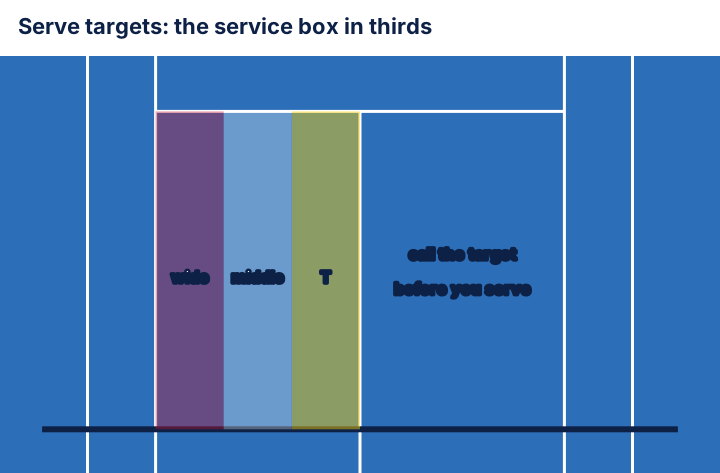
Figure 1. The serve targets in LTA’s article: down the T, through the middle, out wide.
What does 20 minutes look like?
The split below is ours, not LTA’s. Each block ends with one number you write down. We know of no tennis study that tests counting itself. It is simply how you find out whether the session worked.
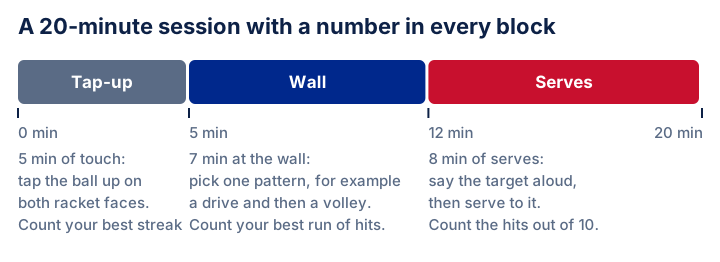
Figure 2. Five minutes of touch, seven at the wall, eight of serves. Three numbers to beat.
Four ways to waste it
- No target, no count. A basket of balls with no number is a warm-up.
- Only first serves. LTA says to practise both.
- One target all session. LTA says to keep mixing.
- Targets too soon. Add them once you are consistent.
Next session: beat one number
Write the three numbers on your phone. Next time, try to beat only one of them.
References
-
LTA, “How to train and practice tennis skills by yourself” (LTA coach Matt Smith). Wall drills, serving alone with first and second serves, targets in halves then thirds called aloud, and tap-up tennis. https://www.lta.org.uk/play/tennis-tips-and-techniques/how-to-train-and-practice-tennis-skills-by-yourself/ ↩ ↩2
-
M. Starzak, T. Niźnikowski, M. Biegajło, M. Nogal, W. Ł. Arnista, A. Mastalerz and A. Starzak, “Attentional focus strategies in racket sports: A systematic review,” PLoS ONE 19(1), 2024, e0285239. Nine studies; an external focus (on the effect of the movement) benefited learning and performance, particularly in novice or low-skilled athletes. https://pubmed.ncbi.nlm.nih.gov/38181000/ ↩