Practice & video · Two players
Why do perfect drills fall apart in matches?
Mixing your shots feels worse in practice and often holds up better later. Here is the evidence, and a tennis class where it did not help.
You hit 50 crosscourt forehands in a row in the warm-up, and every one was perfect. The first one in the match went into the net. The drill felt great, so why didn’t it travel?
What do you give up when you mix?
In the classic test from 1979, people learned three barrier-knocking tasks, practising them in blocks (all of one, then all of the next) or in random order.1 The pattern since then: random order makes your scores worse while you practise, and better later, on a re-test of the same tasks or on a new version of them.2
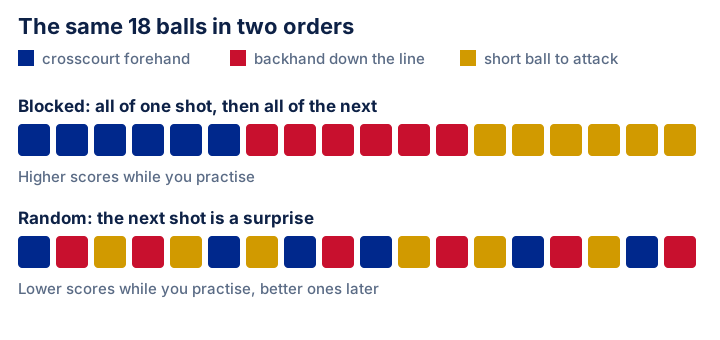
Figure 1. The same 18 balls in two orders. Our illustration, not data.
So how big is the edge?
How big is the edge?
A 2024 review of 34 studies found a medium edge for random practice on transfer tests: 0.55 standard deviations. In lab tasks it was 0.75. In field studies it was 0.34, and not statistically significant. For adults it was 0.54, for young participants 0.12.2 The same research group found the edge on retention tests almost negligible in field studies.3
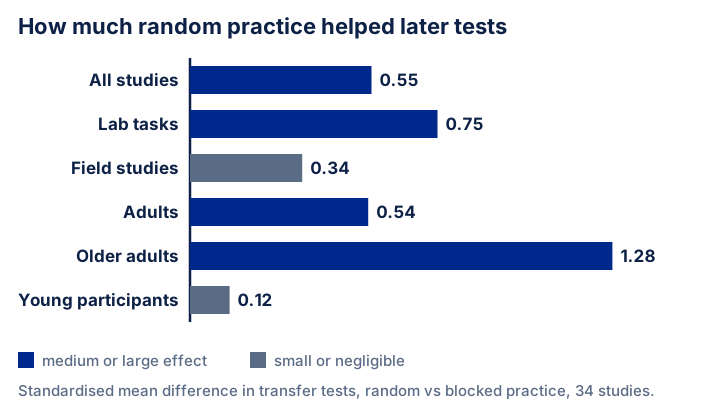
Figure 2. The lab loves random practice. The field is less sure.
And in tennis?
Two tennis studies, two stories. In tennis classes, 83 college students practised forehands and backhands in blocked or alternating order. The low-skilled students did better in blocks; for the high-skilled there was no significant difference.4 In another study, boys of 9 to 10 and young men of 18 to 19 who varied their targets while practising the forehand drive did better on a later test than those who did not.5
So mixing is no magic trick. A stroke you are still building may need blocks first. For strokes you already own, the class found no difference, and in adults the review found a medium edge.
Three ways mixed practice disappoints
- Mixing a stroke you cannot hit yet. In the tennis class, the low-skilled players did better in blocks.
- Quitting because the scores drop. Worse scores in practice are part of the pattern, not a sign it failed.
- Expecting a miracle. In field studies the edge was small.
Try it this week: the called-shot rally
- Pick three shots, for example crosscourt forehand, backhand down the line and a short ball to attack.
- Your partner rolls a die before each feed: 1-2, 3-4 or 5-6 picks the shot.
- Hit the called shot. Your partner counts the balls that land in. Three rounds of 12.
- Expect lower scores than in a blocked round. That is part of the pattern.
References
-
John B. Shea and Robyn L. Morgan, “Contextual interference effects on the acquisition, retention, and transfer of a motor skill,” Journal of Experimental Psychology: Human Learning and Memory 5(2), 1979, pp. 179-187. The first motor test of blocked against random practice (three barrier-knocking tasks, as described by Czyż et al. 2024). https://doi.org/10.1037/0278-7393.5.2.179 ↩
-
S. H. Czyż, A. M. Wójcik and P. Solarská, “The effect of contextual interference on transfer in motor learning: a systematic review and meta-analysis,” Frontiers in Psychology 15, 2024, 1377122. 34 studies; effect sizes 0.55 overall, 0.75 lab, 0.34 applied, 0.54 adults, 0.12 young; the worse-now, better-later pattern. https://pubmed.ncbi.nlm.nih.gov/39205981/ ↩ ↩2
-
S. H. Czyż, A. M. Wójcik, P. Solarská and P. Kiper, “High contextual interference improves retention in motor learning: systematic review and meta-analysis,” Scientific Reports 14, 2024, 15974. Random practice helped retention in the lab and almost nothing in applied settings. https://pubmed.ncbi.nlm.nih.gov/38987617/ ↩
-
E. P. Hebert, D. Landin and M. A. Solmon, “Practice schedule effects on the performance and learning of low- and high-skilled students: an applied study,” Research Quarterly for Exercise and Sport 67(1), 1996, pp. 52-58. 83 college students in tennis classes; blocked better for low-skilled, no significant difference for high-skilled. https://pubmed.ncbi.nlm.nih.gov/8735994/ ↩
-
S. J. Douvis, “Variable practice in learning the forehand drive in tennis,” Perceptual and Motor Skills 101(2), 2005, pp. 531-545. 80 boys and young men; varied targets beat constant practice. https://pubmed.ncbi.nlm.nih.gov/16383091/ ↩