Mental · Self talk
Talking to yourself on court: what should you say?
A 32-study review found self-talk helps sport performance, and that on precise tasks instructions beat pep talks. Here is what to say, and when.
You shank an easy volley and snap at yourself. Everyone mutters on court. The real question is whether the words you choose change the next shot.
Does talking to yourself work at all?
On average, yes. A 2011 meta-analysis pooled 32 studies (62 effect sizes) of self-talk in sport and found a positive, moderate effect (.48).1 The useful part is where it helped more:
- on tasks needing fine control more than on tasks with gross (big, powerful) movements;
- on new skills more than on well-learned ones;
- when people were trained to use it, not just told to.
So the words matter most where you still need to think. They matter least on a stroke you’ve hit ten thousand times.
Which words, then?
Instructional or motivational?
Instructional self-talk points your attention at the job: “toss up,” “low to high.” Motivational self-talk lifts effort and belief: “I can do this,” “next point.” On fine tasks the review found instruction beat motivation.1
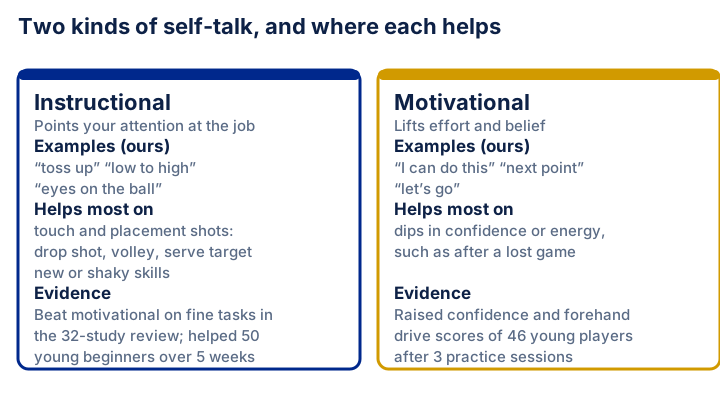
Figure 1. The evidence lines come from the studies; the example phrases and shot types are our reading.
Both kinds have tennis evidence, in young players. In 2008, 46 players (average age 13) practised motivational self-talk over three sessions. On a forehand-drive test their performance and confidence rose, and players whose confidence rose more also improved more. The control group didn’t change.2 In 2026, 50 young beginners followed an instructional plan for five weeks and beat a control group on every stroke and on a rally test.3
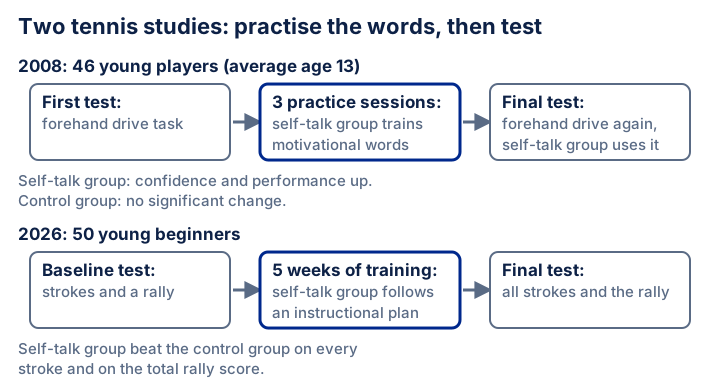
Figure 2. Both studies had players practise the words before the final test.
What should you say, and when?
Our reading of the evidence:
- On a touch or placement shot (a drop shot, a volley, a serve target): one instruction, aimed at the movement or the target. “Toss up.”
- When your confidence or energy needs a lift: a motivational line in your own voice. “Next point.”
- On a new or shaky stroke: this is where self-talk helped most, so be strict about the words.
These were young players doing stroke tests, not adults in a club match. Treat this as a good bet, not proof.
Three ways it backfires
- A pep talk on a precision shot. On fine tasks the instructional words beat the motivational ones.
- A phrase invented on match day. Programmes that trained self-talk beat those that didn’t.
- Expecting it to fix a grooved stroke. The effect was smaller on well-learned tasks.
Try it this week: two scripts
- Pick one instruction for your shakiest touch shot and one motivational line for the dips.
- Say them aloud at the start of every practice for two weeks. The tennis studies trained for three sessions and five weeks.
- Use the instruction just before the shot. Save the motivational line for after a lost point.
References
-
Antonis Hatzigeorgiadis, Nikos Zourbanos, Evangelos Galanis and Yannis Theodorakis, “Self-Talk and Sports Performance: A Meta-Analysis,” Perspectives on Psychological Science 6(4):348-356, 2011. 32 studies, 62 effect sizes, ES = .48; moderators fine vs gross tasks, novel vs well-learned tasks, instructional vs motivational, self-talk training. https://doi.org/10.1177/1745691611413136 ↩ ↩2
-
Hatzigeorgiadis, Zourbanos, Goltsios and Theodorakis, “Investigating the Functions of Self-Talk: The Effects of Motivational Self-Talk on Self-Efficacy and Performance in Young Tennis Players,” The Sport Psychologist 22(4):458-471, 2008. 46 players, forehand drive task. https://doi.org/10.1123/tsp.22.4.458 ↩
-
Galanis, Kouvarakis, Kouli, Krommidas, Comoutos, Hatzigeorgiadis and Theodorakis, “The Effects of a Strategic Instructional Self-Talk Intervention on Performance in a Complex Tennis Rally,” Behavioral Sciences 16(1):87, 2026. 50 young beginners, 5 weeks. https://doi.org/10.3390/bs16010087 ↩