Mental · Pressure
Serving for the match: why does your swing fall apart?
Experienced golfers putted better when a second task kept their mind off the stroke. The fix under pressure isn't thinking harder; it's picking what to look at.
You’re serving for the match at 5-4. The toss feels different, so you start checking: elbow up, wrist loose, weight forward. The ball sails long.
Psychologists have a name for that, and experiments that show it.
What is your swing running on?
A skill you have repeated thousands of times is stored so that it runs by itself, without you narrating the steps. Beilock and Carr tested this with golfers. Experienced putters remembered little about specific putts, as if the skill ran without them watching. Under pressure, putting got worse; a task that was not on autopilot, alphabet arithmetic, did not. And training that made golfers self-conscious removed the choking in putting, while training with a distracting second task did not.1
So does thinking about the steps really hurt?
Does thinking through the steps make it worse?
In a follow-up, experienced golfers putted in two ways: while doing a second task that kept their mind off the stroke, and while thinking through it step by step. The distracted putts were more accurate. Footballers dribbling through cones split by foot: experts did better distracted on their strong foot, but better thinking through the steps on their weaker foot. Novices did better thinking through the steps.2
Expert batters in a simulated baseball task made more errors when they had to monitor the direction of their bat. A distracting tone didn’t hurt them.3
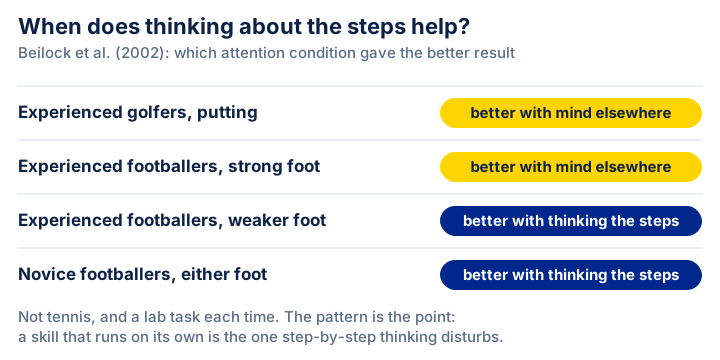
Figure 1. Step-by-step thinking helps a skill that isn’t automatic yet and disturbs one that is.
So the rule isn’t “never think.” A grooved first serve is the kind of skill that disturbance hurts; a brand-new slice backhand is probably the other kind. That second part is our reading. None of these studies was tennis, and not every result lines up: in the batting study, experts were more accurate with the bat-direction task when put under pressure.3
What do you look at instead?
Outside your body. Ten highly skilled golfers (handicap about 4) pitched a ball toward a pylon. They were more consistent when told to hit the ball as close to the pylon as possible than when told to concentrate on the form of the swing. Ten low-skilled golfers (about 26) showed the opposite.4 The tennis version is to name the spot: “the T,” “deep backhand corner.”
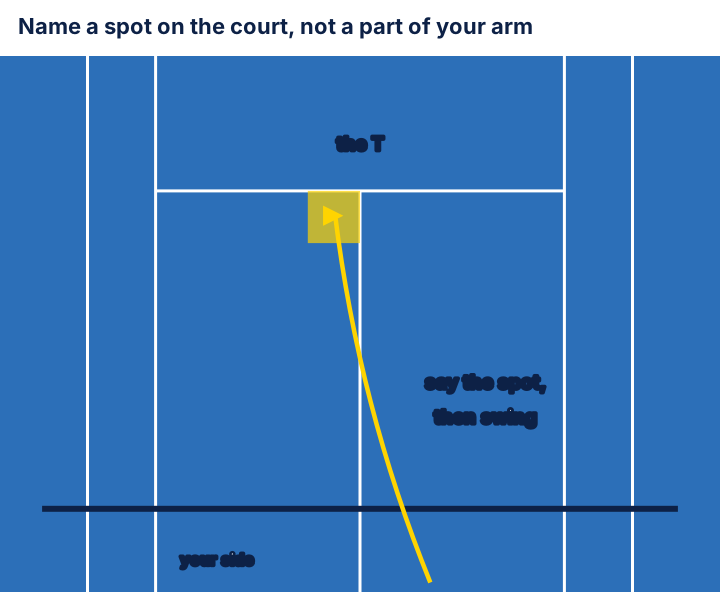
Figure 2. Say the spot, then swing.
Then protect your routine. A 2017 review of 47 choking studies with athletes found pre-performance routines, quiet-eye training, left-hand squeezes and practising under pressure among the most reported effective. A second task helped under pressure but hurt when used in training.5
Three habits that make pressure worse
- Checking your technique mid-point. Save the checks for practice.
- Training with a distraction. It can rescue the day but hurt when it becomes the way you practise.
- Practising only when nothing is at stake. Practising under pressure was among the most reported effective interventions.
Try it this week: serve for the set
- Put a towel on the T.
- Serve ten balls at it with a small stake and a friend watching. The loser buys the coffee.
- Before each toss, say only the target out loud.
References
-
S. L. Beilock and T. H. Carr, “On the fragility of skilled performance: What governs choking under pressure?” Journal of Experimental Psychology: General 130(4):701-725, 2001. Novice and expert golfers; putting against alphabet arithmetic; effects of pressure and of two kinds of training. https://doi.org/10.1037/0096-3445.130.4.701 ↩
-
S. L. Beilock, T. H. Carr, C. MacMahon and J. L. Starkes, “When paying attention becomes counterproductive: impact of divided versus skill-focused attention on novice and experienced performance of sensorimotor skills,” Journal of Experimental Psychology: Applied 8(1):6-16, 2002. Golf putting and soccer dribbling. https://doi.org/10.1037/1076-898X.8.1.6 ↩
-
R. Gray, “Attending to the execution of a complex sensorimotor skill: expertise differences, choking, and slumps,” Journal of Experimental Psychology: Applied 10(1):42-54, 2004. Simulated baseball batting. https://doi.org/10.1037/1076-898X.10.1.42 ↩ ↩2
-
N. Perkins-Ceccato, S. R. Passmore and T. D. Lee, “Effects of focus of attention depend on golfers’ skill,” Journal of Sports Sciences 21(8):593-600, 2003. 10 highly skilled and 10 low-skilled golfers pitching to a pylon. https://doi.org/10.1080/0264041031000101980 ↩
-
Peter Gröpel and Christopher Mesagno, “Choking interventions in sports: A systematic review,” International Review of Sport and Exercise Psychology 12(1):176-201 (online 2017). 47 studies with athletes; routines, quiet eye, left-hand contractions and acclimatisation training most reported effective; dual task helpful under pressure, harmful in training. https://doi.org/10.1080/1750984X.2017.1408134 ↩