Mental · Momentum
You lost five points in a row. Is that momentum?
In 100 coin-toss points, someone wins six in a row about 81% of the time. Pro data say momentum is real but small. Here is what you can change.
Four-all in the second set. You lose five points in a row, and it feels like the match has tipped. Has it?
Would pure chance give you five in a row?
Take two evenly matched players and make every point a coin toss. In 100 points, someone wins at least five in a row about 97% of the time. Six in a row: 81%. Seven: 54%.
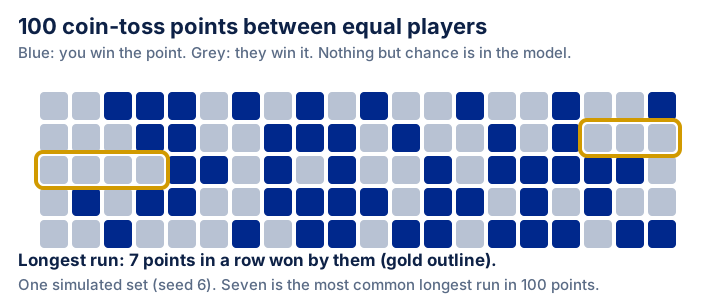
Figure 1. One simulated set with no momentum in it. It still contains a run of seven.
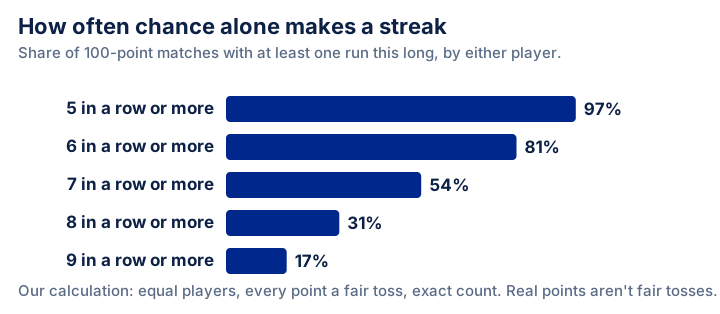
Figure 2. Streaks are what chance looks like. Real points aren’t fair tosses, but the lesson holds.
A streak alone proves nothing. So is anything else going on?
Is momentum real?
A little, in professional tennis. Klaassen and Magnus studied almost 90,000 points from Wimbledon 1992-1995. Points were not independent: winning the previous point raised your chance of winning the current one, and on “important” points the server found it harder to win. The weaker the player, the stronger both effects. Their own verdict: the deviations are small, and treating points as independent is still a good approximation in many cases.1
A later study looked at 4,930 games from 141 Grand Slam men’s matches. After a player converted a break point, he was more likely to win the next game. The edge was weaker when play was interrupted.2
Real, then, but small. What do you do with that?
What can you actually change?
- Treat a streak as weak evidence. Your next point is close to a fresh start.
- Know who it bites. In the Wimbledon data the weaker player felt the effects more. If you’re the underdog, a streak can hurt you more. That is our reading of pro data, not a club result.
- Use your pauses; don’t stall. That study measured interruptions imposed on players, not pauses they chose, so taking your time is only a hint. The rules give you 25 seconds between points and 90 at a changeover.3 Use them.
- Respect important points. Servers did worse on them, so your routine matters most there (our reading).
Two ways streaks fool you
- Reading five lost points as proof you’ve lost your game. Chance does that most of the time.
- Coasting after a streak of your own. The same small effect runs your way.
Try it this week: start 0-30 down
- Play a set where every service game starts at 0-30.
- After any two lost points in a row, use your full routine before the next serve.
- Count how many of those games you still hold.
How we got the numbers
The streak odds are our own calculation: two equal players, 100 points, each an independent fair toss. We counted exactly how many sequences contain a run of that length or longer, and checked the result with 20,000 simulated matches. Real points are not fair tosses, so read it as what pure chance looks like, not a forecast for your match.
References
-
Franc Klaassen and Jan Magnus, “Are Points in Tennis Independent and Identically Distributed? Evidence From a Dynamic Binary Panel Data Model,” Journal of the American Statistical Association 96(454):500-509, 2001. Almost 90,000 points at Wimbledon 1992-1995; effects of the previous point and of important points; deviations from independence are small. Findings as stated in the abstract. https://doi.org/10.1198/016214501753168217 ↩
-
Meier, Flepp, Ruedisser and Franck, “Separating psychological momentum from strategic momentum: Evidence from men’s professional tennis,” Journal of Economic Psychology 78:102269, 2020. 4,930 games from 141 Grand Slam men’s singles matches. https://doi.org/10.1016/j.joep.2020.102269 ↩
-
International Tennis Federation, Rules of Tennis 2026, Rule 29 (Continuous Play): at most 25 seconds between points and 90 seconds when players change ends at the end of a game. https://www.itftennis.com/media/7221/2026-rules-of-tennis-english.pdf ↩