Mental · Between points
What should you do in the 25 seconds between points?
The 25-second clock starts when the point ends, not when you reach the baseline. Here is a four-step routine that fits inside it, and what research says.
You double-fault. The ball rolls to the back fence and you trudge after it, replaying the toss.
How much of your time is gone by the time you pick it up? Rule 29 of the Rules of Tennis gives you a maximum of 25 seconds between points. The clock starts the moment one point finishes and stops when the first serve of the next is struck.1 The walk to the fence is on the clock. So is the toss.
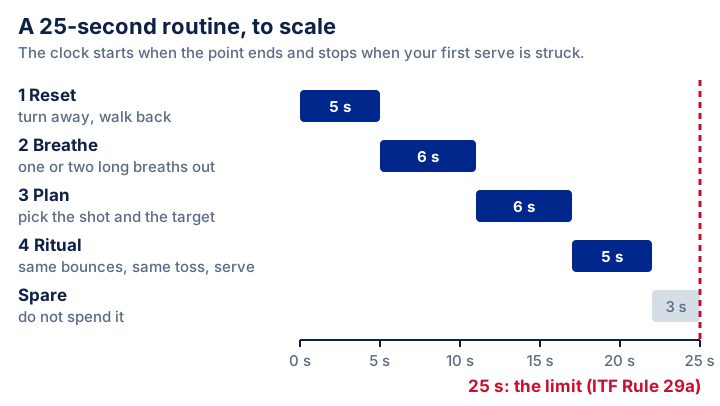
Figure 1. One way to spend 25 seconds. The 25 are the rule; the split into steps is ours.
Is a routine worth those seconds?
A pre-performance routine is a set of thoughts and actions you run through before every shot. A 2021 meta-analysis pooled 112 effect sizes from sport studies. Routines helped in before-and-after studies (a small effect, 0.31) and in experiments against groups without one: 0.64 without pressure and 0.70 under pressure. Routine type, age and skill level made no difference.2
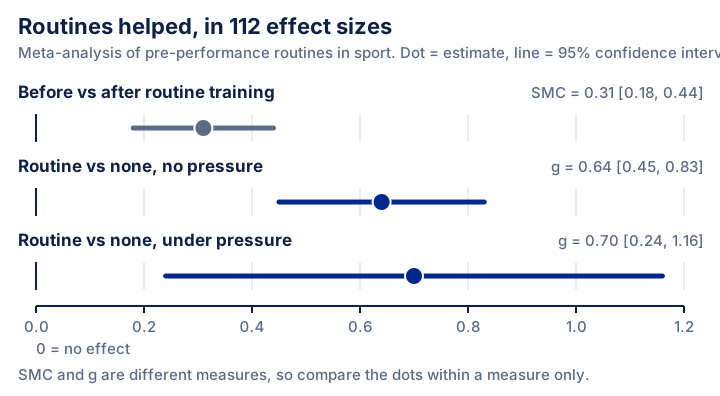
Figure 2. Every estimate is above zero. The line under pressure is wide, so that number is the least certain.
It isn’t a sure thing. In one study, 54 beach volleyball players served under pressure after routine training or none, and accuracy came out the same. The authors suspect the pressure was too weak.3 And none of these studies tested a particular split of seconds. That part is ours.
So what goes into the 25?
What fits inside the clock?
- Reset (5 s). Turn away from the net, walk back, drop your shoulders. The last point is over.
- Breathe (6 s). One or two long breaths out.
- Plan (6 s). Pick the shot and the target in a few words: “wide, forehand side.”
- Ritual (5 s). The same bounces and the same toss every time, then serve.
That is 22 seconds, leaving 3 spare. The clock stops when the serve is struck, not when you start the toss. In a tie-break the 25 seconds are all the rest you get, because players change ends without one.1
Breathing before the serve has a small tennis trial behind it. Four county-level teenagers learned diaphragmatic breathing, and their first-serve percentage rose by about 4%. The authors suggest a routine may need to last more than 2 seconds to work.4
Returning? The server is the one on the clock. Run steps 1 to 3 while they collect balls and be set before they are. Rule 21 asks the receiver to be ready within a reasonable time.1
Four ways to waste the clock
- Starting late. The clock began when the point ended. Begin step 1 as you turn away, not when you reach the baseline.
- Skipping the plan. Without a target, the ritual is just bouncing a ball.
- Using all 25 seconds. Aim to have the serve away by about 22.
- Changing it when it matters. Researchers define a routine as something you do systematically. Run the same steps after an ace and after a double fault.
Try it this week: the 22-second game
- Ask a friend to time you with a phone stopwatch from the end of each point.
- Play a set where your serve must be struck between 18 and 22 seconds after the point ends.
- Afterwards, note which step you cut when time got tight, and shorten only that one.
References
-
International Tennis Federation, Rules of Tennis 2026. Rule 29 (Continuous Play): at most 25 seconds between points, from the end of a point until the first service is struck; in a tie-break, players change ends without a rest. Rule 21: the receiver plays to the server’s reasonable pace. https://www.itftennis.com/media/7221/2026-rules-of-tennis-english.pdf ↩ ↩2 ↩3
-
Rupprecht, Tran and Gröpel, “The effectiveness of pre-performance routines in sports: a meta-analysis,” International Review of Sport and Exercise Psychology 17(1):39-64 (online 2021). 112 effect sizes; definition of a routine; effect sizes with 95% confidence intervals. https://doi.org/10.1080/1750984X.2021.1944271 ↩
-
Wergin, Beckmann, Gröpel and Mesagno, “Investigating cumulative effects of pre-performance routine interventions in beach volleyball serving,” PLOS ONE 15(1):e0228012, 2020. 54 players; no difference in serving accuracy under pressure. https://doi.org/10.1371/journal.pone.0228012 ↩
-
Zoe Louise Moffat and Paul Joseph McCarthy, “Serving a Brief-Contact Cognitive Behavior Therapy Intervention in Youth Tennis Using a Single-Case Design,” Case Studies in Sport and Exercise Psychology 7(1):33-42, 2023. Four youth players; diaphragmatic breathing before serves. https://doi.org/10.1123/cssep.2022-0029 ↩