Forehand · Spin and depth
Cleared the net by 1.2 m, still landed long. Why?
Three forehands, same speed, same height over the net, landing 3.5 m apart. One thing moved them, and it isn't how hard you swing.
You’re on the baseline. You clear the net by a generous 1.2 m, a height coaches recommend from there,1 and the ball still sails out.
Here are three forehands at 100 km/h, all crossing the net 1.2 m above the tape. The flat one lands 0.6 m beyond the baseline. One with 1,500 rpm of topspin (turns per minute) lands 1.4 m inside it. One with 3,000 rpm lands 2.9 m inside it.
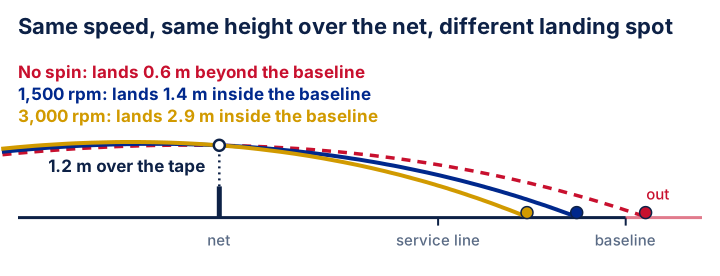
Figure 1. Same speed, same height over the net. Only the spin differs, and the landing spot moves by 3.5 m.
What does spin do that height can’t?
Height sets roughly how deep the ball goes: the higher it crosses the net, the deeper it tends to land.1 Spin decides when gravity wins. Topspin pushes the ball down in flight,2 so it comes down sooner.
That makes spin your depth dial. Slowing a flat ball from 100 to 80 km/h shortens it by about 3.8 m. Adding 3,000 rpm shortens it by about 3.5 m and keeps all 100 km/h.
So how much of the height range can you actually use?
How high can you go?
A coaching text suggests aiming 3 to 5 feet (0.9 to 1.5 m) over the net from the baseline, and the LTA agrees that a generous clearance buys depth.3 A flat ball can’t use that whole zone.
At 100 km/h, a ball with no spin lands in only if it crosses within 1.1 m of the tape. With about 1,500 rpm you can use the whole zone, and at 3,000 rpm the limit is 1.9 m. Hit harder and you need more spin: at 120 km/h the flat limit shrinks to 0.6 m.
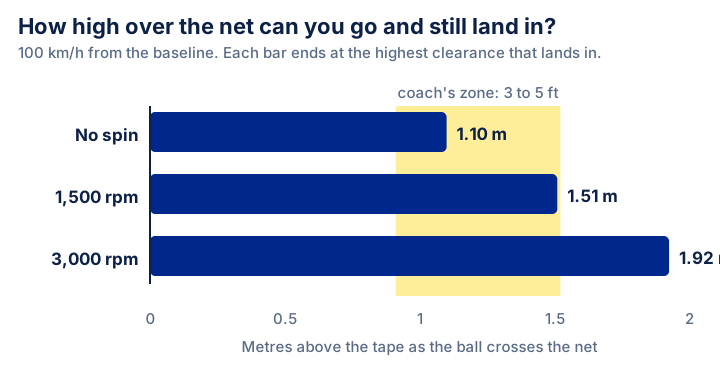
Figure 2. The highest height over the net that still lands in grows with every extra turn of spin.
Sailing long? Brush up, don’t slow down
Topspin comes from brushing the ball from low to high, about 6 o’clock to 12 o’clock on the ball.4 Keep your swing speed and brush more steeply.
Three fixes that make it worse
- Swinging softer to stop it going long. It works, but you pay in pace. Spin shortens the ball and keeps it.
- Going high with no spin. A flat ball 1.5 m over the net at 100 km/h lands 2.2 m beyond the baseline.
- Adding spin and forgetting the height. With 3,000 rpm and only 0.6 m over the net, the ball lands 5.5 m inside the baseline: a short ball in the middle of the court.
Try it this week: the deep zone
Mark a line 3.9 m (13 feet) inside the baseline with a towel. Championship Tennis calls that back stretch the “grind zone.”1 Rally crosscourt with a friend and count the balls that land between the baseline and the towel. Then change only your brush, not your swing speed. Does the count rise?
How we got the numbers
The paths come from our ball-flight model, which uses the drag and spin-lift coefficients measured by Cross and Lindsey.2 Every forehand is hit at 100 km/h from 1.0 m high, 0.3 m behind your baseline, with no wind, on an ITF-sized court.5 “Lands in” means at or before the baseline. They measured up to about 2,500 rpm of topspin; our 3,000 rpm case goes a little beyond, so read it as an upper-end example. The model stops at the first bounce. Real balls vary: treat the numbers as a guide.
References
-
Frank Giampaolo and Jon Levey, Championship Tennis, Human Kinetics, publisher’s excerpt “Reduce your errors on the court by examining zones.” Air zones: aim 3 to 5 feet (91 to 152 cm) above the net from the baseline, and the higher the ball crosses the net, the deeper it generally goes; court zones: the “grind zone” is the first 13 feet (3.9 m) from the baseline. https://us.humankinetics.com/blogs/excerpt/reduce-your-errors-on-the-court-by-examining-zones ↩ ↩2 ↩3
-
Rod Cross and Crawford Lindsey, “Tennis Ball Trajectories: The Role of Aerodynamic Drag and Lift in Tennis Shots,” Tennis Warehouse University, 22 December 2013. Drag and spin-lift coefficients; topspin pushes the ball down; spins up to about 2,500 rpm measured. https://twu.tennis-warehouse.com/learning_center/aerodynamics2.php ↩ ↩2
-
LTA, “How to play better tennis rallies.” Clear the net with a generous margin for more depth; practise with targets a few feet above the net cord. https://www.lta.org.uk/play/tennis-tips-and-techniques/how-to-play-better-tennis-rallies/ ↩
-
Elliott Pettit, “Tennis 101: The Forehand,” USTA, 1 January 2017. For topspin, brush the ball from lower to higher, about 6 o’clock to 12 o’clock. https://www.usta.com/en/home/improve/tips-and-instruction/national/learning-the-basics--forehand.html ↩
-
International Tennis Federation, Rules of Tennis 2026, Rule 1 (The Court): 23.77 m long, net 0.914 m high at the centre. https://www.itftennis.com/media/7221/2026-rules-of-tennis-english.pdf ↩