Forehand · Short ball attack
Easy short ball, and you still hit it long. Why?
Step 4 m inside the baseline and your usual swing lands 2.3 m long: there is less court left. The fix is a flatter ball or more spin, not a harder swing.
Your opponent drops it short. A free ball, you’re well inside the baseline, and you swing the way you always do. It sails out.
Here is that swing: 110 km/h, 2,000 rpm of topspin (turns per minute), launched 10 degrees up. From the baseline it lands 2.0 m inside. From 4 m further in, it lands 2.3 m beyond.
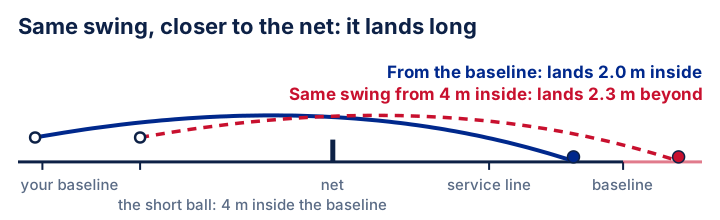
Figure 1. The same swing, 4 m closer to the net. The ball lands 4.3 m further on.
Where did the court go?
You started 4 m closer, so there is 4 m less court for the ball to land in: 19.8 m to the baseline instead of 24.1 m, about a fifth less. Your swing doesn’t know that. It flies the same distance, so the ball lands 4.3 m further on.
It also eats your margin. From the baseline, the launch angles that clear the net and land in span 6.0 degrees. From 4 m inside they span 4.7, about a fifth narrower, and the highest crossing that still lands in falls from 1.3 m to 0.7 m. A coaching text says the same in feet: aim 3 to 5 above the net from the baseline, but only 2 to 3 feet (0.6 to 0.9 m) inside the court.1
So what do you change?
What do you change?
Three things work in our model:
- Cross the net lower. Launch 3.7 degrees flatter and the ball crosses 0.45 m over the tape instead of 0.96 m, and lands 2.0 m inside.
- Add spin. With 3,500 rpm and the same launch, the ball lands 0.4 m inside the baseline, and your margin is back to 6.3 degrees.
- Slow down. 92 km/h also lands in. But you stepped inside to take time from your opponent, and this gives it back.1
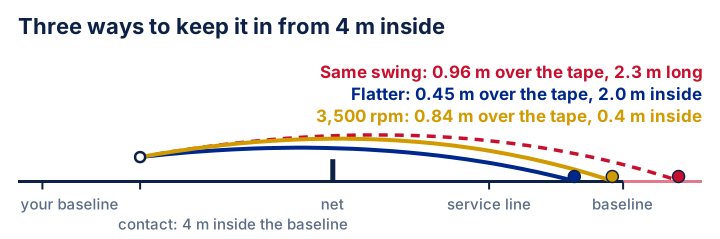
Figure 2. From 4 m inside, the same swing lands long. A flatter ball or more spin lands in.
Three ways to botch a short ball
- Swinging harder. The same swing at 120 km/h lands 4.7 m beyond the baseline.
- Aiming high to be safe. Crossing 1.3 m over the net from 4 m inside lands 5.0 m long, even with 2,000 rpm.
- Doing nothing different. Every metre you step in shifts the landing spot a metre. Change your target when you change your position.
Try it this week: the last two metres
Lay a towel 2 m inside the baseline. A friend feeds short balls to your service line. Hit ten attack forehands crossing the net about half a metre up, then ten with extra brush for spin. Count the balls that land between the towel and the baseline. Which way scores more?
How we got the numbers
The paths come from our ball-flight model, which uses the drag and spin-lift coefficients measured by Cross and Lindsey.2 Every ball is struck 1.0 m high with no wind, on an ITF-sized court.3 The rally swing is 110 km/h with 2,000 rpm, launched at the angle that lands it 2 m inside the baseline from 0.3 m behind it; the short ball is struck 4 m inside the baseline. “Lands in” means it clears the tape and lands at or before the baseline. The model stops at the first bounce. Real swings vary, so treat the numbers as a guide.
References
-
Frank Giampaolo and Jon Levey, Championship Tennis, Human Kinetics, publisher’s excerpt “Reduce your errors on the court by examining zones.” On offence, position inside the court to reduce the opponent’s recovery time; aim 2 to 3 feet (61 to 91 cm) above the net inside the court, 3 to 5 feet (91 to 152 cm) from the baseline; the closer you are, the less net clearance you need. https://us.humankinetics.com/blogs/excerpt/reduce-your-errors-on-the-court-by-examining-zones ↩ ↩2
-
Rod Cross and Crawford Lindsey, “Tennis Ball Trajectories: The Role of Aerodynamic Drag and Lift in Tennis Shots,” Tennis Warehouse University, 22 December 2013. Drag and spin-lift coefficients used by our model. https://twu.tennis-warehouse.com/learning_center/aerodynamics2.php ↩
-
International Tennis Federation, Rules of Tennis 2026, Rule 1 (The Court): 23.77 m long, net 0.914 m high at the centre. https://www.itftennis.com/media/7221/2026-rules-of-tennis-english.pdf ↩