Forehand · On the run
Wide forehand on the run: set your feet, or just hit?
Running wide, you can't set your feet, and a lab study says you don't need to. What to hit instead, and the half second it buys you to get back.
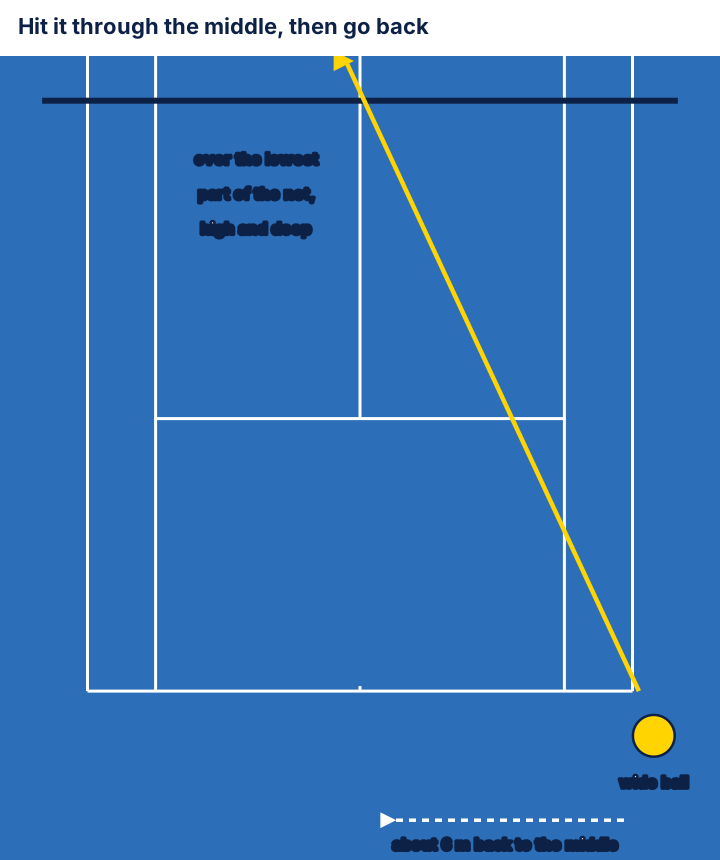
Figure 1. Pulled 1.8 m wide, you have about 6 m to get back. Hit high and deep through the middle first.
Do you have to set your feet?
The ball is going to bounce two metres outside your forehand sideline. You can reach it, but there’s no time to turn side-on and step in. Your feet will face the net: an open stance.
That feels like a compromise. For swing speed it isn’t. In a lab test, 13 advanced players swinging flat out produced the same racket-head speed from an open stance as from a square one.1 With less weight shift toward the target, the open stance makes up the speed with more trunk rotation and upward drive.1
The catch is your knees. In motion-capture tests of eight advanced players, an open-stance forehand after a sideways run loaded the knee more than a neutral stance did, and the authors flagged a possible injury risk.2 Use it when you’re stretched, not on every ball.
So you hit it open. Where should it go?
Where should it go?
Not at the line. In the match studies a review covers, most groundstroke errors under high time pressure went into the net, and under low pressure they went long.3 Tennis Australia’s rule for when you’re taken out of court: hit it high and deep down the middle to buy time to get back.4
How much time? In our model your usual 120 km/h drive lands 0.88 s after you hit it and clears the net by 1.0 m. An 80 km/h ball landing in the same spot clears it by 2.8 m and takes 1.43 s: 0.54 s more.
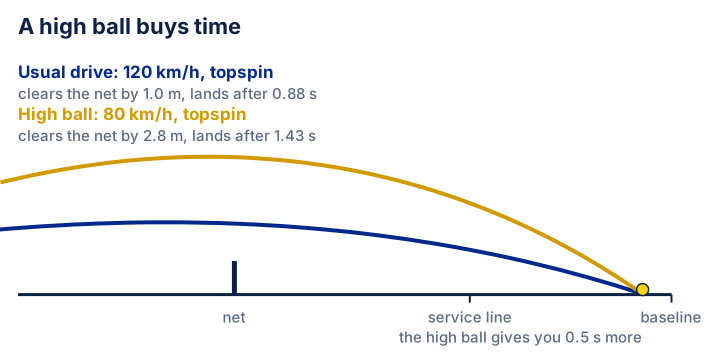
Figure 2. Same landing spot, half a second more to get back.
And then?
Start back as soon as you’ve hit. Dr. Mark Kovacs, a sports scientist who works on tennis movement, calls the recovery movement arguably the most important one to train.5 A review puts the distance covered for about 70% of elite groundstrokes at 3 to 4 m,3 so the 6 m trip from 1.8 m wide is longer than most.
You’ll hear that the open stance gets you back faster. We looked for a study that timed it and found none; the research we found measured swing speed and knee load.12
Two ways the wide ball beats you
- Going for the line. Change direction only from a good position, feet inside the court. From behind the baseline, go crosscourt over the lowest part of the net.4
- Hitting it flat. Tennis Australia’s rule is that clearing the net by over a metre creates depth.4
Try it this week: wide, high, home
- A partner feeds a ball about 2 m outside your forehand sideline.
- Hit it high and deep to a target in the middle of the far baseline.
- Get back and touch the centre mark before the next feed.
- Ten balls, then swap.
How we got the numbers
Both balls come from our ball-flight model (Cross and Lindsey’s drag and spin lift), hit from 1.0 m high, 0.3 m behind the baseline, landing 0.8 m inside the far baseline: 120 km/h and 80 km/h, both with 2,500 rpm. The 1.8 m wide position is our assumption, and 5.9 m is its distance to the centre mark. Treat it all as a guide.
References
-
Yuta Kawamoto, Yoichi Iino, Shinsuke Yoshioka and Senshi Fukashiro, “Directionally compensated mechanical work provided by the shoulder leads to similar racket velocities during open and square stance forehand groundstrokes in tennis,” European Journal of Sport Science 19(7):902-912, 2019. Abstract: 13 advanced players, similar racket head speed in both stances; more trunk rotation and upward acceleration in the open stance. https://pubmed.ncbi.nlm.nih.gov/30551731/ ↩ ↩2 ↩3
-
Caroline Martin and colleagues, “Influence of the forehand stance on knee biomechanics: Implications for potential injury risks in tennis players,” Journal of Sports Sciences 39(9):992-1000, 2021. Abstract: eight advanced players; the defensive open stance (lateral run) raised vertical force and knee loads compared with a neutral stance. https://pubmed.ncbi.nlm.nih.gov/33283656/ ↩ ↩2
-
Machar Reid, Bruce Elliott and Miguel Crespo, “Mechanics and Learning Practices Associated with the Tennis Forehand: A Review,” Journal of Sports Science and Medicine 12(2):225-231, 2013. Section on court movement: about 70% of elite groundstrokes cover 3-4 m; errors under high and low time pressure were mostly into the net and long. https://pmc.ncbi.nlm.nih.gov/articles/PMC3761830/ ↩ ↩2
-
Tennis Australia, “Technical Fundamentals” (Coach Development, 2013), Tactical Fundamentals 3 and 4: height equals depth, safe spots (high and deep down the middle when taken out of court), limit directional changes. https://www.tennis.com.au/wp-content/uploads/2014/11/Technical-and-Tactical-fundamentals-guidelines_low-res.pdf ↩ ↩2 ↩3
-
Mark Kovacs, “Tennis Movement & Footwork Using Common Language - A Recovery Movement Focus,” Kovacs Academy, 24 September 2020. Recovery movement as arguably the most important type of tennis movement training. https://kovacsacademy.com/2020/09/24/tennis-movement-footwork-using-common-language-a-recovery-movement-focus ↩