Footwork · Split step
You split-step every time. When should you land?
In one lab test a hop got players to the target 0.1 s sooner, but landing too early made them miss. Where should your feet touch down?
You split-step on every ball, and the crosscourt one still beats you. Is the hop useless, or are you landing at the wrong moment?
Does the hop really make you faster?
In a lab test, ten male college players waited for a light that said left or right, then stepped to a target. With a split step they got there in 764 ms. Without one: 868 ms.1 A tenth of a second, from a hop.
The catch is when you land.
What happens if you land too early?
Players landed at different moments. Those who touched down well before their own usual response time sometimes made very fast steps, but missed the target in 7.8% of trials. Those who landed close to it (within one standard deviation either side) made errors in only 0.8%.1 Land before the ball tells you anything, and you are guessing.
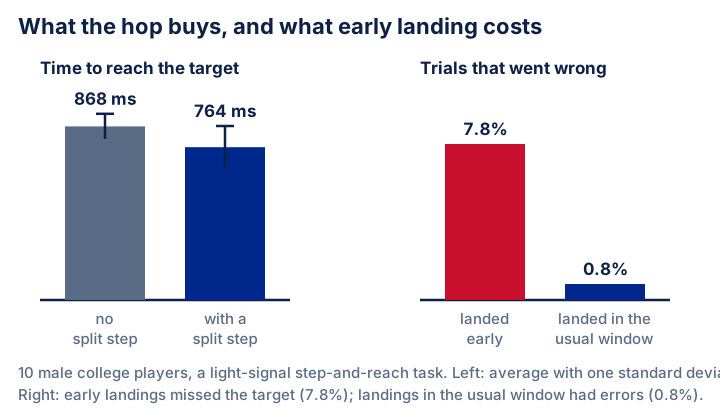
Figure 1. The hop saves about a tenth of a second, but only a well-timed landing keeps the misses low.
So when do the best returners land?
When do the best returners land?
On court, 22 elite players (adult pros ranked in the world top 500, and top-100 juniors) returned first serves of 140 to 190 km/h. They took off about when the server hit the ball (9 ms after) and landed 152 ms after it, when the first part of the ball’s flight is visible. Their rackets started to move at 187 ms and their feet at 266 ms (seniors) or 311 ms (juniors).2
They landed, read the ball, then went.
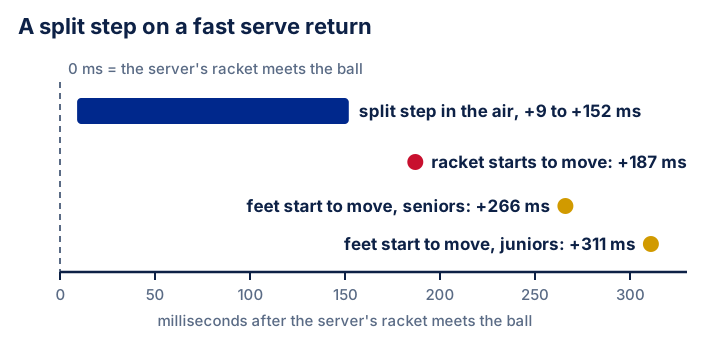
Figure 2. Landing comes before anything else moves, and after the ball has left the strings.
And in a rally?
One coach used to tell students to hop right as the opponent hits. He now says the game is too fast for that. From the baseline after a good shot he waits until just before their contact; inside the baseline or at the net he hops as their racket starts forward; after hitting to a net player, as his own ball nears the net.3 That is one coach’s rule, not a study.
Set the two side by side and your feet touch down somewhere between a little before their contact and about 0.15 s after it. Finding your spot inside that window is the skill.
Three ways to mistime the hop
- Landing early to “be ready.” That is the 7.8%.
- Landing late. The serve-return authors warn that a hop that ends after the ball is clearly on its way leaves too little time to reach it.
- One timing everywhere. The coach’s rule changes with where you stand and where you hit.
Try it this week: land on “now”
- A partner feeds easy balls from across the net, left or right at random.
- Split-step and say “now” out loud the moment both feet touch down.
- Do 10 balls landing a touch before their contact, 10 on it, 10 just after.
- Count the balls where your first step went the right way. Keep the timing that scores best.
References
-
R. Uzu, M. Shinya and S. Oda, “A split-step shortens the time to perform a choice reaction step-and-reach movement in a simulated tennis task,” Journal of Sports Sciences 27(12), 2009, pp. 1233-1240. Ten male college players; 764 vs 868 ms with and without a split step; 7.8% vs 0.8% misses depending on landing time. https://pubmed.ncbi.nlm.nih.gov/19735035/ ↩ ↩2
-
S. Mecheri, G. Laffaye, C. Triolet, D. Leroy, M. Dicks, M. A. Choukou and N. Benguigui, “Relationship between split-step timing and leg stiffness in world-class tennis players when returning fast serves,” Journal of Sports Sciences 37(17), 2019, pp. 1962-1971. Take-off +9 ms and landing +152 ms after the server’s contact; racket and foot movement times; the warning about landing too late. https://pubmed.ncbi.nlm.nih.gov/31030639/ ↩
-
Steve Annacone, “Tip of the Week: Timing the Split Step,” New York Tennis Magazine, 11 February 2019. A coach’s advice on when to hop from the baseline, inside the baseline, at the net and after hitting to a net player. https://newyorktennismagazine.com/?p=26738 ↩