Footwork · First step
Why is your first step to a wide ball so slow?
Players reached 52% of hard, wide balls with one first step and 34% with the step most often taught. The difference is where your weight goes first.
You read the wide ball early, and you still arrive stretched, with your arm doing the work your legs should have done. What happens in that first half second?
Which first step reaches more balls?
In a Stanford study, ten club players returned balls from a ball machine, 30 each. From the baseline every ball was reached and 96 of 100 came back in control. The first step hardly mattered. There was time.1
It mattered when the start had to be quick: 200 balls fired wide while the player stood at the T or ran in. With the gravity step players reached 44 of 85 (52%). With the jab step, the one most often taught, they reached 17 of 50 (34%).
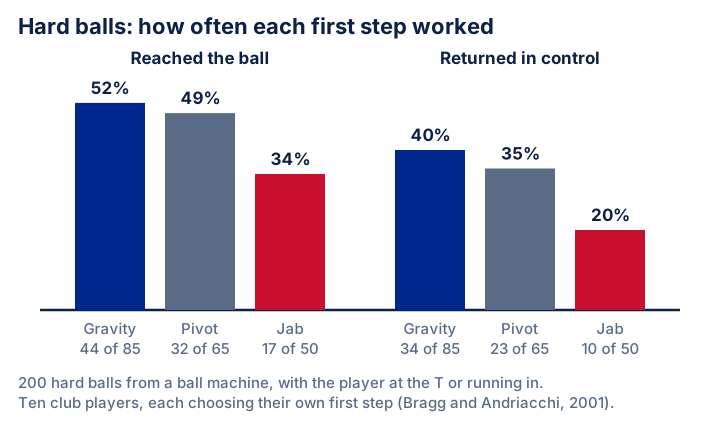
Figure 1. On balls that needed a quick start, the step you pick changes how many you reach.
So what is a gravity step?
What does the gravity step do differently?
The jab step is the obvious one: step first toward the ball with the foot nearer to it. In the gravity step you do the opposite. You bring that foot in toward your body as your hips turn, which pushes your weight outside your feet and lets gravity start the move. The pivot step sits between the two.1
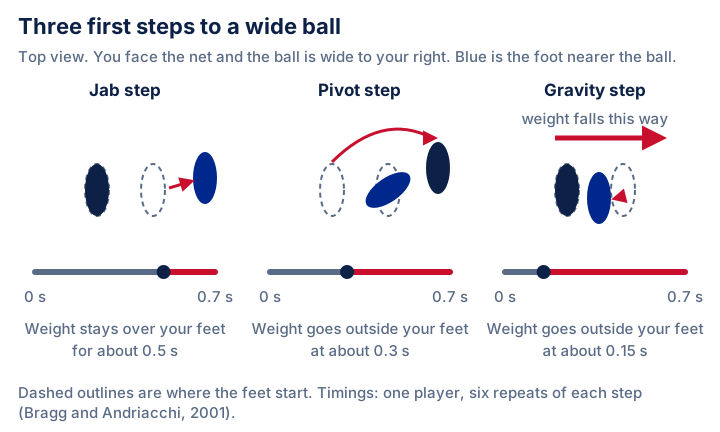
Figure 2. The sooner your weight is outside your feet, the sooner you are moving.
Why is the natural step slow?
One player was measured in a motion lab, six repeats of each step. With the jab step his weight stayed between his feet for about 0.5 s, so he crept away until his legs pushed hard at about 0.3 s. With the gravity step his weight was outside his feet at about 0.15 s and he was moving almost at once, helped by the push of the leg farther from the ball.1
Some lateness is built in. Even elite returners do not move their feet until 266 to 311 ms after the server hits, waiting for the ball to say which way.2 You cannot skip that wait, only what follows it. A fitness text adds that in the split step, good players land first on the foot farther from where they are going.3
How sure can we be?
Not very. Players chose their own step, all had been coached in the gravity step before, and “in control” meant the ball went into or over the net, which the authors call ad hoc. The motion lab used one player. Treat it as a strong hint for wide balls, not proof.
Two ways to waste it
- Reaching with the near foot first. That is the jab: 34% against 52%.
- Using it on every ball. From the baseline the step made little difference. Save it for balls that need a quick start.
Try it this week: freeze after one step
- No ball: stand ready at the T while a partner points left or right at random. Take one step, then freeze. Has your weight moved toward the point?
- With feeds: 10 wide balls with a jab step, 10 with a gravity step. Count the balls you reach and return in control.
- Keep whichever scores higher. Go at half speed first.
References
-
R. W. Bragg and T. P. Andriacchi, “The lateral reaction step in tennis footwork,” Biomechanics Symposia 2001, University of San Francisco, pp. 34-37. Ten club players, 200 hard balls (Table 1), jab, pivot and gravity step; motion-lab timings for one player. https://ojs.ub.uni-konstanz.de/cpa/article/view/3761/3483 ↩ ↩2 ↩3
-
S. Mecheri, G. Laffaye, C. Triolet, D. Leroy, M. Dicks, M. A. Choukou and N. Benguigui, “Relationship between split-step timing and leg stiffness in world-class tennis players when returning fast serves,” Journal of Sports Sciences 37(17), 2019, pp. 1962-1971. First foot movement 266 ms (seniors) and 311 ms (juniors) after the server’s contact. https://pubmed.ncbi.nlm.nih.gov/31030639/ ↩
-
Mark Kovacs, E. Paul Roetert and Todd S. Ellenbecker, Complete Conditioning for Tennis, 2nd edition, Human Kinetics, public excerpt “Major movements.” Good athletes land first on the foot farthest from their intended target in the split step. https://us.humankinetics.com/blogs/excerpt/major-movements ↩