Footwork · Spacing
You ran to the right spot. Why is the ball on top of you?
Big steps get you to the ball; small ones decide where it ends up. One coach says your last step should land as the racket meets the ball.
You read the shot, ran to the spot and set up early. Then the ball bounced a little differently and landed on your hip, and you hit it with your elbow tucked in.
Why doesn’t arriving early fix it?
Because you picked the spot before the ball showed you where it was going. In our model a 110 km/h topspin drive takes about 0.9 s to reach its bounce. That is all the time your big steps get.
LTA’s coach splits the job in two. Use big steps to close the gap and reach a rough position before the ball bounces on your side. Then switch to smaller adjustment steps, which set your balance and let you transfer your weight through the ball. He says this matters most in tricky weather or on an uneven court.1
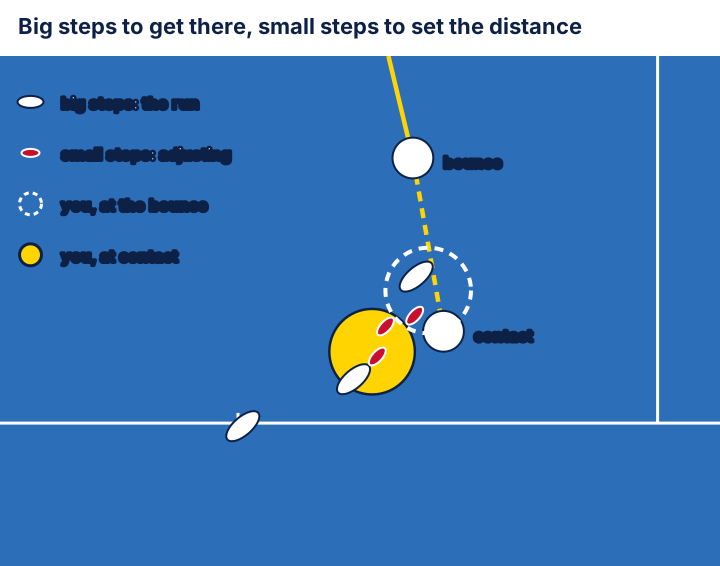
Figure 1. Three big steps get you near the ball. Three small ones, after the bounce, move you off a ball that came in too close. Our drawing, not measured data.
So how many small steps, and when do you stop?
When does the last step land?
Another coach says to take a few adjusting steps once you are close, and to make your last step hit the ground just as the racket meets the ball.2 He adds that on a slow ball we get ready later and move our feet less, which is exactly when the adjusting steps are needed.
So the last step and the swing happen together.
How far away should the ball be?
USTA calls getting too close to the ball at contact a common challenge for beginning players, and gives a quick check.3 Pin a ball to the strings with your free hand, put the end of the racket on your stomach with the head level, and look at the gap. That is the distance to aim for. The tip says the position also gives you a good shoulder turn and creates space.
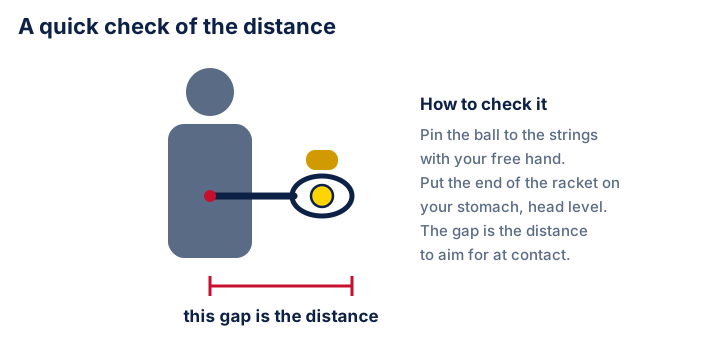
Figure 2. The USTA spacing check: racket end on your stomach, ball pinned to the strings.
Three habits that crowd you out
- Stopping at the spot. Stand still while the ball bounces and the bounce sets your spacing. Keep your feet moving until it has bounced.
- Big steps all the way in. They cannot be undone in the last half-metre. Switch to small ones as you close in.
- Lazy feet on slow balls. That is when you most need them.
Try it this week: count your steps
- A partner feeds 10 crosscourt balls.
- Run with big steps until the ball bounces, then take exactly three small steps, counting out loud. The last one lands as you hit.
- After each ball say “close”, “right” or “far” using the stomach check; your partner calls it from the side.
- Repeat with two small steps, then four. Keep the number that gives you the most “right”.
How we got the numbers
The 0.9 s comes from our ball-flight model, which uses the drag and spin-lift coefficients measured by Cross and Lindsey.4 The drive is hit from 1.0 m high, 0.3 m behind the baseline, at 110 km/h with 2,500 rpm, and lands 2.3 m inside the far baseline of an ITF-sized court.5 The model stops at the bounce, so it cannot say how long the ball takes after it. Real shots vary; read 0.9 s as a scale, not a stopwatch.
References
-
LTA, “Improve your tennis footwork on court with these simple tips” (LTA coach Matt Smith). Big steps to a rough position before the bounce, then smaller adjustment steps to set balance; most important in tricky weather or on uneven courts. https://www.lta.org.uk/play/tennis-tips-and-techniques/improve-your-tennis-footwork-on-court-with-these-simple-tips/ ↩
-
Steve Annacone, “Tip of the Week: React To a Slow Ball With Your Feet,” New York Tennis Magazine, 19 August 2021. A few adjusting steps once close, the last one landing as the racket meets the ball; slower balls tempt lazy feet. https://newyorktennismagazine.com/?p=25709 ↩
-
Leah Friedman, “Tennis for beginners: Find your optimal contact point,” USTA, 27 March 2018. Getting too close to the ball at contact is a common challenge; the ball-on-strings distance check. https://www.usta.com/en/home/improve/tips-and-instruction/national/find-your-optimal-contact-point.html ↩
-
Rod Cross and Crawford Lindsey, “Tennis Ball Trajectories: The Role of Aerodynamic Drag and Lift in Tennis Shots,” Tennis Warehouse University, 22 December 2013. Drag and spin-lift coefficients. https://twu.tennis-warehouse.com/learning_center/aerodynamics2.php ↩
-
International Tennis Federation, Rules of Tennis 2026, Rule 1 (The Court): 23.77 m long, net 0.914 m high at the centre, service lines 6.40 m from the net. https://www.itftennis.com/media/7221/2026-rules-of-tennis-english.pdf ↩