Doubles · Middle ball
Ball down the middle: yours, mine, or nobody's?
The net is about 16 cm lower in the middle than at the posts. Here is whose ball it is when it comes down the middle, and what to agree before the match.
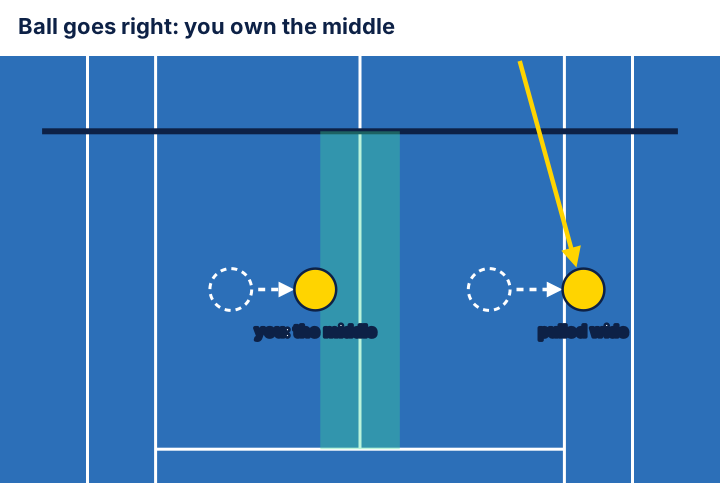
Figure 1. The ball goes right and pulls your partner wide. You slide in, and the green middle is yours.
Why does the ball keep landing between you?
Two players, one gap, one ball down the middle. You both hold back, each sure the other has it.
The net is lowest in the middle: 0.914 m, against 1.07 m at the posts.1 Down-the-line shots are the riskier ones.2 So the middle is a natural target, and you need to know whose it is before the ball arrives.
Whose ball is it?
The LTA’s rule for partners at the net: if your partner pushes out wide, you come toward the middle to cover it.3 So the middle is covered by the player who is not being pulled wide.
A Tennis Server coach gives the same answer from the other side. When your pair shifts toward the ball, the partner moving toward the centre handles a down-the-middle return, even if that means a backhand volley.4
Does the rule ever bend?
When can the other player take it?
On a high, slow ball. The same coach calls it a perfect chance for the player covering the alley to poach: call “mine,” charge to the centre and hit a forehand volley, usually the stronger shot.4
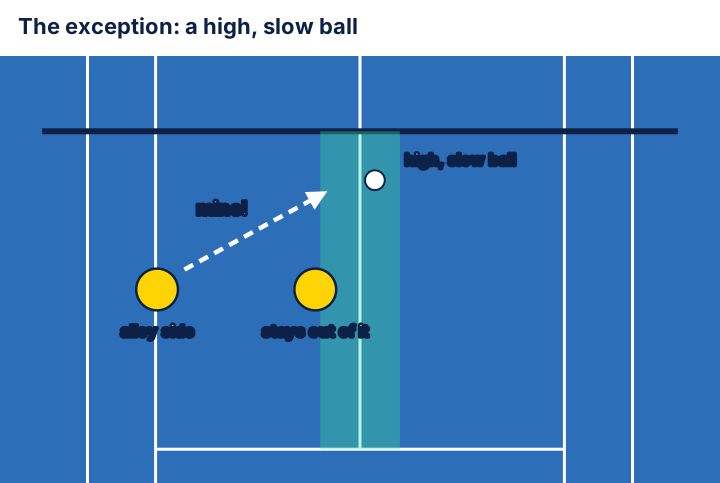
Figure 2. A high, slow ball in the middle. The alley-side player calls “mine” early and charges in; the other player stays out of the way.
A call only works if you both agreed what it means.
What do you agree before the first serve?
LTA coach Louis Cayer lists agreement as one of three poaching situations: you and your partner decide beforehand, and pros do this.5 The LTA also says to have a goal when you talk between points and between serves.3 The Tennis Server coach adds that you must talk, because no one can read another person’s mind.4
Before the warm-up ends, settle four things:
- The default: whoever isn’t pulled wide takes the middle.
- Who may poach a high, slow ball.
- The call: “mine,” said early.
- Who takes lobs. The same coach says that has to be ironed out too.4
Three ways the middle ball gets lost
- Both leave it. The ball drops between you.
- Both go. Two rackets, one ball.
- Saying nothing. No call means no agreement.
Try it this week: mine or yours
Two players at the net, a feeder at the baseline with ten balls.
- The feeder hits every ball down the middle, some high and slow, some firm.
- The pair calls “mine” or “yours” on every ball, out loud.
- Score 1 point for every ball taken by exactly one player. Swap after ten balls.
References
-
International Tennis Federation, Rules of Tennis 2026, Rule 1 (The Court): net height 0.914 m at the centre, 1.07 m at the posts. https://www.itftennis.com/media/7221/2026-rules-of-tennis-english.pdf ↩
-
Kathy Krajco, “The Doubles Angle of Return,” Tennis Server (Wild Cards), February 2004. Down-the-line shots are riskier than crosscourt shots. https://www.tennisserver.com/wildcards/wildcards_04_02.html ↩
-
LTA, “Essential doubles tactics and hand signals” (coach Matt Smith). Move with your partner: if they push out wide, come toward the middle to cover it; have a goal when you talk between points and between serves. https://www.lta.org.uk/play/tennis-tips-and-techniques/essential-doubles-tactics-and-hand-signals/ ↩ ↩2
-
Greg Moran, “Solving Common Doubles Dilemmas,” Tennis Server (Mortal Tennis), February 2006. The partner moving toward the centre covers a down-the-middle return, even with a backhand volley; on a high, slow ball the alley-side player may poach by calling “mine”; partners must talk and iron out who takes lobs. The advice is the author’s own; no data are cited. http://www.tennisserver.com/mortal/mortal_06_02.html ↩ ↩2 ↩3 ↩4
-
LTA, “How to improve your doubles skills: your questions answered by expert LTA coach Louis Cayer.” Poaching by agreement: you and your partner decide beforehand; pros do this. https://lta.org.uk/advantage-home/content/how-to-improve-your-doubles-skills-your-questions-answered-by-expert-lta-coach-louis-cayer ↩