Backhand · Two handed
On a two-handed backhand, which hand really hits the ball?
The hand at the bottom of the grip is not the one the USTA wants swinging. What the research says about each hand, and a drill to feel it.
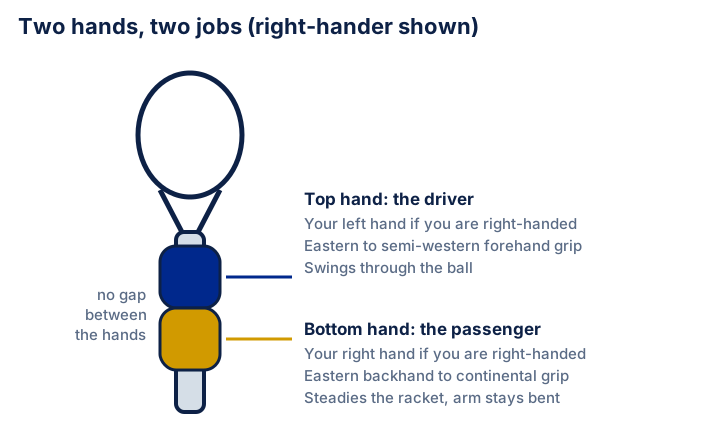
Figure 1. Two jobs. For a right-hander, the left hand drives and the right hand steadies.
Which hand actually swings the racket?
You’re right-handed, so your right hand sits at the bottom of the grip and your left hand on top. Now ask which of them is hitting the ball.
The USTA’s answer is the one you wouldn’t guess: the top hand, your non-dominant one. It calls that hand the driver and the bottom hand the passenger. Swing through the ball with the top hand, it says, and finish with that elbow pointing across the net.1
Is that just coaching talk?
What does the evidence say about the top hand?
More than you’d expect. In one study of nine experienced coaches, the hip, shoulder, elbow and wrist on the non-dominant side moved faster than the same joints on the dominant side.2 In another, professionals ranked in the top 100 who hit two-handed backhands used an eastern forehand grip with the non-dominant hand.2 Tennis Australia’s checklist says the same: top hand in an eastern to semi-western forehand grip, no gap between the hands.3
So your top hand is really a forehand hand. For a right-hander, the backhand is a left-handed forehand with a helper underneath.
What is the helper doing?
And what is the bottom hand for?
Steadying. One study argues the dominant side stabilises the non-dominant arm.2 At contact the bottom arm stays more bent than a one-hander’s arm, with the wrist more extended.2
Neither hand starts the swing, though. The body does. In two small studies (nine coaches, five college players), two-handers turned their hips 28 to 33 degrees further, and their shoulders 34 to 41 degrees further, than one-handers between the start of the forward swing and contact.2
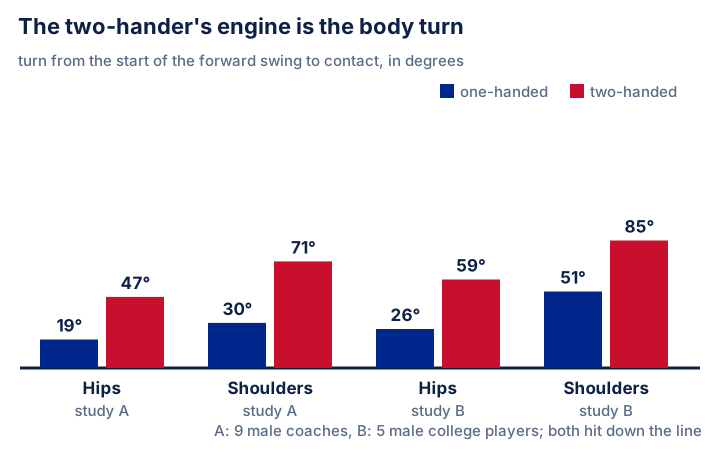
Figure 2. Two-handers turn further, so the hands ride a bigger body turn.
Try it this week: the lefty forehand
If you’re right-handed (left-handers swap everything):
- Put your left hand on top of the grip, as for a backhand.
- Hit a few forehands the left-handed way, finishing with the left elbow pointing across the net.
- Alternate: one lefty forehand, one two-handed backhand. Try to feel the same left-arm swing.1
- Ten rounds, then swap with your partner.
Four ways the bottom hand takes over
- Letting the strong hand lead. The USTA wants the top hand swinging through the ball.
- A gap between the hands. Tennis Australia’s list says no space between them.
- A backhand grip on top. The top hand wants a forehand-style grip.
- Arms only. Two-handers lean on trunk rotation more than one-handers do,2 so a still body leaves the arms to do it alone.
References
-
Karl Davies, “Improve Your Game: Driving the Two-Handed Backhand,” USTA, 2 July 2018. The top, non-dominant hand is the “driver” and the bottom hand the “passenger”; lefty-forehand drill; finish with the elbow across the net. https://www.usta.com/en/home/improve/tips-and-instruction/national/improve-your-tennis-game--the-driving-force-in-your-two-handed-b.html ↩ ↩2
-
Cyril Genevois, Machar Reid, Isabelle Rogowski and Miguel Crespo, “Performance Factors Related to the Different Tennis Backhand Groundstrokes: A Review,” Journal of Sports Science and Medicine 14(1):194-202, 2015. Faster non-dominant-side joints and a stabilising dominant side (Stepien 2011), eastern forehand grip on the non-dominant hand (Eng and Hagler 2014), more flexed dominant arm at impact (Reid and Elliott 2002), and the turns in Table 2 (Stepien 2011; Fanchiang 2013). https://pmc.ncbi.nlm.nih.gov/articles/PMC4306773/ ↩ ↩2 ↩3 ↩4 ↩5 ↩6
-
Tennis Australia, “Technical Fundamentals” (Coach Development, 2013). Double-handed backhand: bottom hand eastern backhand to continental, top hand eastern forehand to semi-western, no space between the hands. https://www.tennis.com.au/wp-content/uploads/2014/11/Technical-and-Tactical-fundamentals-guidelines_low-res.pdf ↩