Backhand · Slice
Your slice skims the net and lands deep. Why?
Same speed, same landing spot, yet a slice crosses the net 0.9 m lower than a topspin drive. The air is holding it up, and you can aim around that.
You’re stretched wide on your backhand, so you slice. The ball skims over the tape, about a racket’s length above it, and still lands deep.
Now hit a topspin drive just as fast to the same spot. It needs 1.6 m of air over the net. Why does the slice get away with less than half of that?
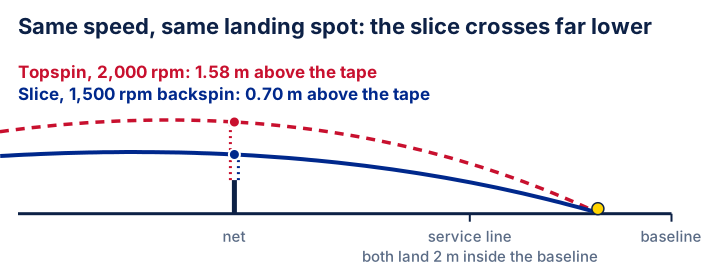
Figure 1. Both balls travel at 90 km/h and land 2 m inside the baseline. The slice crosses the net 0.9 m lower.
What is holding the slice up?
The air. Backspin makes the ball push the air down, so the air pushes the ball up. Topspin does the opposite and pushes the ball down.1
In our model, at 90 km/h, 1,500 rpm of backspin lifts the ball with a force worth about 30% of its weight. Topspin at 2,000 rpm adds about 40% to its weight. So the slice falls like a lighter ball, and the topspin drive like a heavier one. The researchers who measured this describe the “floating, skidding backspin slice.”1
So how low is low enough?
How low should you aim?
Not like a drive. The launch angle that lands a 90 km/h topspin drive 2 m inside the baseline sends a slice 6.9 m beyond it. Aim a slice like a drive and it sails.
Your pace changes the answer. A 90 km/h slice needs to clear the net by about 0.7 m. At 80 km/h it needs 1.1 m, and at 100 km/h only 0.4 m. Hit it slower and you must hit it higher.
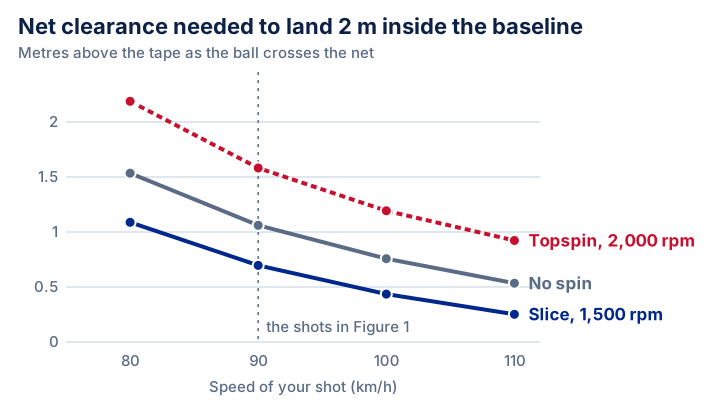
Figure 2. The slice needs the least height at every speed.
The swing matters too. The USTA’s advice is a racket path from high to level, because a steep high-to-low chop can send the ball into the net.2
Three ways a slice loses its skim
- Chopping down. A steep swing drives the ball into the tape. Slide the racket high to level and let the spin do the lifting.2
- Giving it a drive’s height. If your slice sails long, check how high it crosses. Half a metre over the tape is plenty at 90 km/h.
- Hitting it too slowly. At 80 km/h the same slice needs 1.1 m, not 0.7 m. A slow slice has to go higher, and then it isn’t a low ball any more.
Try it this week: the tape check
Rally slices crosscourt with a friend. A third person stands beside the net post and calls “in” if your slice crosses within a racket’s length of the tape and lands beyond the service line, “high” if not. Hit 20, count your “ins”, and beat the count next session.
How we got the numbers
The paths come from our ball-flight model, which uses the drag and spin-lift coefficients measured by Cross and Lindsey.1 Every shot starts 1.0 m high, 0.3 m behind your baseline, with no wind, on an ITF-sized court,3 and is aimed to land 2 m inside the far baseline. We chose 80 to 110 km/h, 2,000 rpm of topspin and 1,500 rpm of backspin; they measured balls with up to about 2,400 rpm of backspin. The model stops at the first bounce, so we say nothing about the bounce. Real slices vary, so read the numbers as the shape of the shot, not exact values.
References
-
Rod Cross and Crawford Lindsey, “Tennis Ball Trajectories: The Role of Aerodynamic Drag and Lift in Tennis Shots,” Tennis Warehouse University, 22 December 2013. Drag and spin-lift coefficients; backspin lifts the ball and topspin pushes it down; spins up to about 2,400 rpm measured. https://twu.tennis-warehouse.com/learning_center/aerodynamics2.php ↩ ↩2 ↩3
-
Karl Davies, “Improve your game: Tips for your backhand slice,” USTA, 9 July 2018. The slice racket path is high to level; a high-to-low chop can send the ball into the net. https://www.usta.com/en/home/improve/tips-and-instruction/national/improve-your-tennis-game--tips-for-improving-your-backhand-slice.html ↩ ↩2
-
International Tennis Federation, Rules of Tennis 2026, Rule 1 (The Court): 23.77 m long, net 0.914 m high at the centre. https://www.itftennis.com/media/7221/2026-rules-of-tennis-english.pdf ↩