Backhand · One handed
Why are you always late on your one-handed backhand?
In one study, one-handers hit the ball 19 cm further in front of the body than two-handers. Why the gap exists, and how much earlier you have to start.
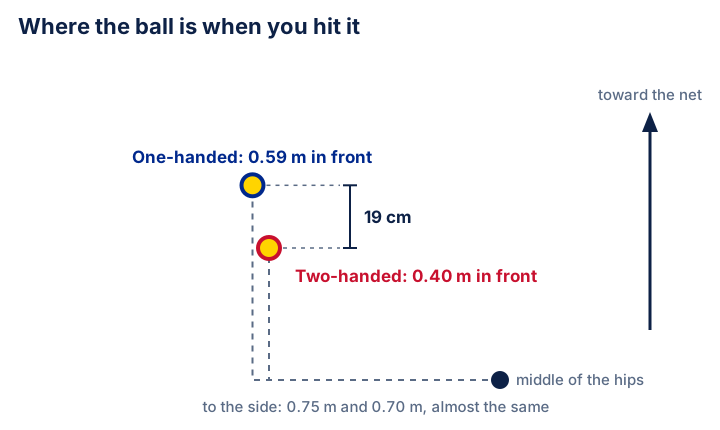
Figure 1. Almost the same distance to the side, but the one-hander’s ball is 19 cm further ahead. Measured from the middle of the hips, to scale.
Where is the ball when you hit it?
A deep ball comes to your backhand. You turn, you swing, and it is already beside you. Again.
You’d think both meet the ball in about the same spot. They don’t. High-speed cameras tracked 18 college players and put the one-hander’s contact 0.59 m in front of the body, the two-hander’s 0.40 m.1 Sideways the two were almost identical, 0.75 m and 0.70 m. The whole gap is forward.
So why does one hand have to reach so far out?
Why does the ball have to be out there?
The USTA starts with your shoulder. Your body is turned with the hitting shoulder closest to the net, so that shoulder, and the arm hanging from it, are already further forward.2
The numbers fit. At the end of the backswing the one-hander’s shoulder line was turned 36 degrees further round than the two-hander’s: 119 against 83.1
Then the swings part ways. In two small studies, two-handers turned their shoulders 34 to 41 degrees further between the start of the forward swing and contact.3 The reviewers’ summary: two-handers lean on trunk rotation, one-handers on the arm.3
If the ball is out there, when do you have to start?
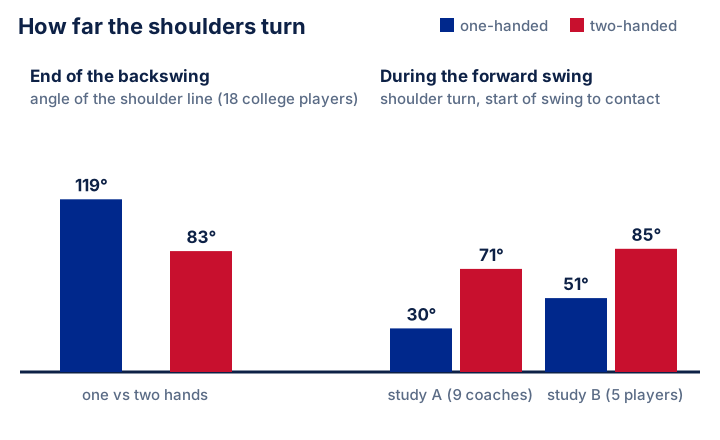
Figure 2. The one-hander winds up further, then turns less. The arm does the rest.
How much earlier is “earlier”?
Earlier, says the USTA, because you meet the ball further in front, where it hasn’t travelled as deep into the court.2 In the study, one-handers started the racket’s forward acceleration 0.13 s before contact. Two-handers waited until 0.08 s.1
Fifty milliseconds sounds like nothing. Do the sum: a rally ball at 60 km/h covers 1.7 m every tenth of a second, so 19 cm of ball flight is only about 0.01 s. Be that late and your one-hander is hitting where a two-hander would. Be 0.1 s late and the ball is 1.7 m past the spot.
Three ways the ball still gets past you
- Waiting for the bounce. Tennis Australia’s checklist wants the backswing finished by the time the ball bounces.4 Contact is out front, so the swing can’t wait.
- Squaring up too soon. Turn first so the hitting shoulder points at the net. The arm follows the shoulder, not the other way round.
- One spot for every shot. Topspin one-handers are struck further forward than slices.3 Don’t slice-time a topspin ball.
Try it this week: beat the bounce
- Stand side-on at the baseline while a partner feeds easy balls to your backhand.
- Have the racket back before the ball bounces on your side.
- After each ball, say where it was at contact: ahead of your front foot is a pass, level with it is late.
- Ten balls, then swap.
How we got the numbers
Contact distances, shoulder angles and swing-start times come from one video study of 18 male college players, six one-handers and twelve two-handers: different players, not one player hitting both.1 The review notes that distances were measured from the middle of the hips and may look smaller from another reference point.3 The forward-swing turns come from two small studies it reports. The ball arithmetic is ours, assuming 60 km/h for a rally ball after the bounce: 0.19 m divided by 16.7 m/s is about 0.011 s.
References
-
Machar Reid and Bruce Elliott, “The one- and two-handed backhands in tennis,” Sports Biomechanics 1(1):47-68, 2002. Abstract: contact 0.59 m vs 0.40 m in front and 0.75 m vs 0.70 m to the side, shoulder angle 119.1 vs 83.4 degrees at the end of the backswing, racket acceleration starting 0.13 s vs 0.08 s before contact. https://pubmed.ncbi.nlm.nih.gov/14658135/ ↩ ↩2 ↩3 ↩4
-
Ben Zaiser, “Improve Your Game: Hitting a One-Handed Backhand,” USTA, 19 February 2019. Contact is further in front because the hitting shoulder is nearest the net; start the swing earlier. https://www.usta.com/en/home/improve/tips-and-instruction/national/improve-your-tennis-game--hitting-a-one-handed-backhand.html ↩ ↩2
-
Cyril Genevois, Machar Reid, Isabelle Rogowski and Miguel Crespo, “Performance Factors Related to the Different Tennis Backhand Groundstrokes: A Review,” Journal of Sports Science and Medicine 14(1):194-202, 2015. Impact further forward for the one-hander (measured from the middle of the hips), shoulder turns in Table 2, topspin struck further forward than slice. https://pmc.ncbi.nlm.nih.gov/articles/PMC4306773/ ↩ ↩2 ↩3 ↩4
-
Tennis Australia, “Technical Fundamentals” (Coach Development, 2013). Single-handed backhand: contact in front and to the side of the body, backswing completed by the time the ball bounces. https://www.tennis.com.au/wp-content/uploads/2014/11/Technical-and-Tactical-fundamentals-guidelines_low-res.pdf ↩